I went to see about buying a new truck in the hills above Tavistock. It’s otter country there, and deep, dividing streams cut between the trees like the tread of an offroad tyre. Did you know that the words otter and water have the same anglo-saxon root? So the River Otter is an acknowledgement to both otters and water alike, and it’s fine to hear the name spoken with a West Country accent which almost chokes on that opening vowel, holding the sound so deeply in the throat that it almost comes out like a gargle.
Woodcock had recently arrived in the southwest, and two birds ran like rabbits ahead of me as I drove down lanes towards Foghanger, weaving back and forth across bridges and fords while the Otter loped beneath me. The road and the river were overhung by oak leaves and the bustle of empty cobnuts, and if I had stopped for more than a few minutes on the water’s edge, I would surely have found spraints or slides or the remains of head-eaten fish.
I came at last to the seller’s farm, which stood back between two hedges and a tall gate reinforced with rusted sheets of tin. He came to meet me, stepping from a static caravan which stood in the shelter of a blackthorn hedge. He didn’t so much smile as radiate friendliness, grinning in the angle of his arms and legs and recognisably warm as a dog in his bearing. He had shoulder-length hair and the kind of Hulk Hogan moustache which last found favour in the early nineteen nineties. At sixty years old, every natural pigment had been worn from his hair, but a band of riotous orange ran up from his top lip through his eyebrows and into his fringe. Nicotine stains, but of an order so powerful that you could have steeped him in hot water like a teabag and used the brew to brown a yard of cloth.
A little girl peeped out of the caravan behind him, hardly able to walk but happy as a clam with her morning. I gathered that my host was childminding his granddaughter, and as the kid tried to climb down the caravan steps to join us, he growled happily in her direction, realising that she wasn’t wearing her wellies. To save her soaking her socks in the puddles, he bent and picked her up as he talked, and she sat like a monkey on his shoulder, winding the orange strands of his hair between her fingers. When I waved at her, she came over suddenly shy and threw her arms around his head, burying her face in the mess of it.
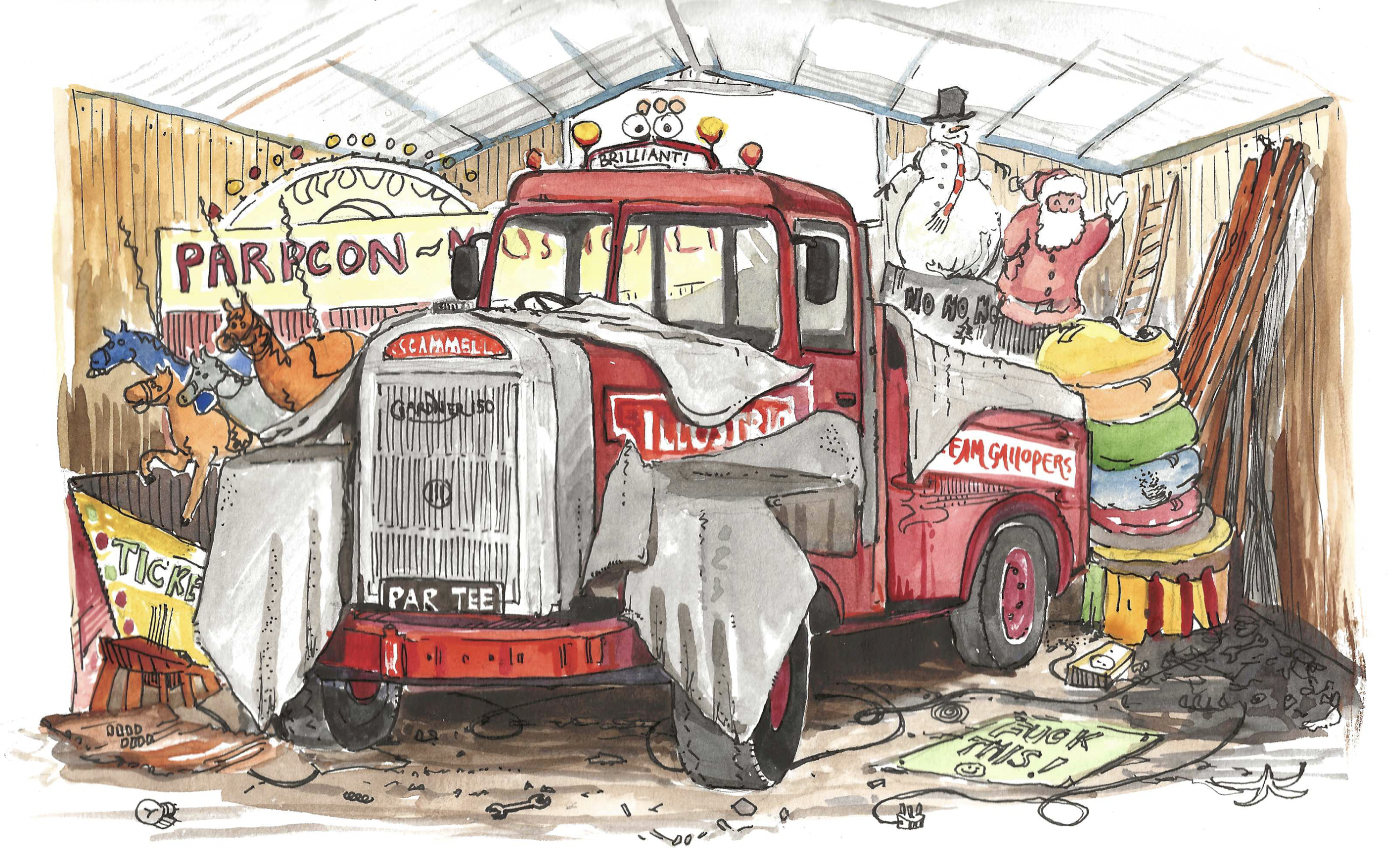
I didn’t understand much of what he said. There’s a West Country accent, and then there’s Deep Devonian. I wished he’d open his mouth more, but a mumble is part of the style – and every third or fourth word was fuck, fucked or fuckin anyway. Those words were recognisable, and I pieced the rest together by chance and context. Then he took me to look at the truck as it stood in a shed beyond the yard. I’m not very interested in machinery, and what I know about cars can be written on the back of a small envelope. But as we stepped inside the shed, my ignorance felt suddenly unimportant. The place exploded in a riot of excitement and intrigue. It turned out that this man had run fairground rides for the best part of fifty years, and the building was like a museum to his life’s work.
There were fibreglass clowns, hotdog boilers and candyfloss machines in the shelter of that shed – every frame and bar had coloured lightbulbs fastened to it; strings of bunting were underhung with cobwebs and sparrow nests; herds of bounding horses were heaped on upright poles like golfclubs. And within this gaudy cornucopia of delight and diversion, the practical parts of motors and machinery were exposed to view – the backside of confection; cogs and springs stacked in order of size and condition, while a city of car batteries charged and were supercharged amidst leafy heaps of discarded cigarette butts. Hardly caring about the truck I’d come to buy, I marvelled at a massive Scammell Gardner 150 lorry half hidden under dust sheets – the original Amusement Machine, complete with foghorns and batteries of brightly-coloured lamps and illuminations – because what is a travelling fairground without a workhorse to pull it?
I can’t tell you much about the truck I agreed to buy, but I can recall every detail of this red behemoth which growled in silence beneath the rafters. It was first registered in 1966, and the wooden sides still bore the original signwriting; it read “Steam Gallopers”, and another panel bore the word “illustrious”, as if context was unnecessary. The word might equally have been applied to any small detail as much as the accumulated whole.
As I watched, the little girl wriggled down from her grandfather’s shoulder and moved as if to climb up into the cab. He responded to the thrust of her request with a list of fond expletives, then he opened the door for her and boosted her bottom into the driver’s seat. Only the top of her head was visible from where I was standing, but two pink hands gripped at the underside of the enormous steering wheel. There was still wonder in the old machine yet, and as I shook the man’s hand to confirm the purchase of a truck I’d hardly seen, I wished I could have bought the lorry instead.

 Bog Myrtle & Peat
Leave a comment