There isn’t much of Émile Zola to be found on la Beauce these days. The great agricultural plain which lies southwest of Paris served as a backdrop to parts of Zola’s monumental “Rougon-Macquart” cycle, and his novel La Terre struck me like a thunderbolt in its depiction of filth, hardship and peasant life in the 1860s. But times change, and the landscape has been reinvented by progress.
I loved the filth of La Terre, particularly when I was looking for representations of truth and deprivation in rural places which are so often presented as calm and restorative. Modern readers are encouraged to “escape to the country” – a place where it’s possible to reconnect with the healing power of nature. But that’s not always my experience of the countryside, and Zola’s characters struck a chord because the entirety of their lives were being played out against the gruelling seasonality of agriculture and the frustrations of small-town politics. His landscapes sing, but in muted tones which depend for their brilliance upon juxtaposition and the assurance that it’s normally bleak and terrible. These are the ins and outs of belonging which I’m compelled to follow, and in some ways it’s reasonable to think of Zola as a French Thomas Hardy – in fact, both men were born in 1840 and each was similarly preoccupied with the portrayal of small, unglamorous realities. Like Zola, Hardy disturbed his contemporaries with expressions of gloominess and suffering, but British objections to Hardy’s work were largely on aesthetic grounds. Robert Louis Stevenson and JM Barrie complained that literature should focus upon brightness and escapism, and they were unnerved by books like Tess of the D’urbevilles. But Zola’s depiction went beyond the taut confinements of Hardy’s Wessex – his characters were semen-stained creatures with emotionally warped and morally chequered lives; you could say that they offered reflections of humanity which lay a little too close to home.
Zola’s sordid realism caused an uproar amongst his contemporaries, and he deliberately courted controversy to promote his work – but faced by censorship and critical rejection, he also argued that “sincere analysis purifies everything, just as fire does”. And there certainly is a rough kind of beauty and perfection in his grubby depiction of peasants warring over agricultural land in la Beauce, which has sometimes been described as “the breadbasket of France”. Understanding that this is an area of rich and fertile land, it’s inevitable that the last one hundred and fifty years should have written immeasurable change upon the place. Zola was writing about peasant life in the lead-up to the first Franco-Prussian War; he died in 1902, so he never saw the Great War coming, much less the Nazi invasion of 1940. Economic and environmental pressures only grew in the second half of the Twentieth century, and nowadays it’s clear that la Beauce continues to pull more than its weight in terms of agricultural productivity. The landscape has been intensified, mechanised and ironed into a fever-pitch of commercial efficiency.
In literal terms, la Beauce is just as flat as ever it was. It offers an extraordinarily straight horizon to all points of the compass, and clouds pile vastly overhead as they did in Zola’s day. But instead of tiny farms and a patchwork of pigs, donkeys and cramped-up smallholdings (remember “la mère Caca” who shat on her vegetable patch), the landscape has been pressed into uniformity. Fields sear out of sight across hundreds of acres, and the textures in late October are only of relentless cereal stubbles; the undead residues of vegetable crops which run for miles beside the autoroute beneath a metrically perfect expression of drainage ditches. Above them, the skyline is confused by the skeletons of electricity pylons and wind turbines which turn majestically in the silent light.
As Nineteenth Century writers approached Chartres across la Beauce, they reckoned that the grand old Cathedral de Notre Dame rose above the plain like a galleon in full sail – and seeing how the flying buttresses flare away from the walls like sheets of canvas, that’s surely a fair comparison. But in a landscape of agricultural intensification, it now seems to stand against the sky like a combine harvester, or some robotic invader from the War of the Worlds, designed to process the year’s harvest with greater ease and efficiency than ever before.
This is not to say that la Beauce is ugly now, or that it has changed for the worse. In fact, many of these recent intensifications only serve to heighten the sense of overwhelming enormity in this landscape. Love them or loathe them, the astonishing scale and ponderous austerity of wind farms can provide a useful context to big places, and lines of pylons sometimes offer a sense of perspective which leads the eye across enormous, striding distances. Besides, this is a working landscape, and if the peasants of la Terre had been able to monetise la Beauce by building substations and turbines, they certainly would have done. Many of Zola’s novels are fixated by change and progress and all the associated human tensions which arise from the clash between tradition and modernity. Within these stresses, la Beauce in 2023 makes calm and perfect sense.
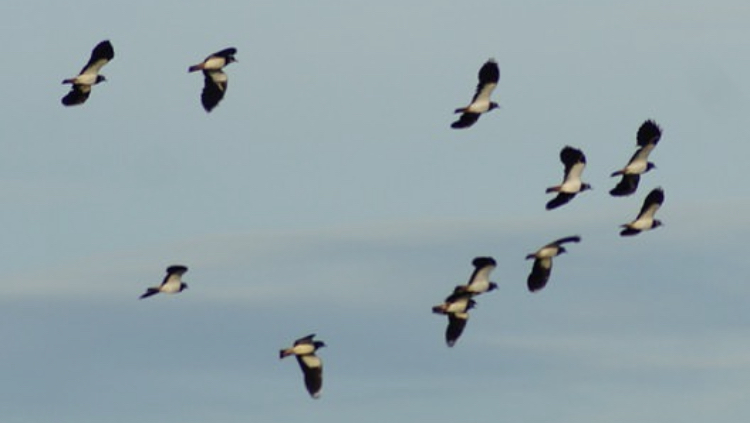
I drove through the place in a weak and sodden sunset, watching hundreds of lapwings turning above the fields. Some were in tight flocks of a hundred and more, and they passed noisily overhead like panting darts. Others were further out, a mile away or more. These made indistinct impressions against the failing cloud, like palls of smoke which turned and were overturned by the breeze. Starlings fell in their thousands from the overhead wires, and egrets prowled by the ditch-sides as I passed. Arriving abruptly at a crossroads, I found the remains of a hare which had been smashed and flattened into the tarmac – a tiny tragedy played out beneath terrible, unsympathetic skies. It’s still the same old place, and it’s surely more fitting to have change continually written upon these very human landscapes than preserve them forever in cotton wool like the bittersweet nostalgia of Hardy’s Wessex. There isn’t much of Émile Zola to be found on la Beauce these days, but if the landscape has moved on from the man himself, his understanding of change is alive and well.

 Bog Myrtle & Peat
Leave a comment