She was talking about her pelvic floor – and how you never knew what you had until it was gone. Her friend could only agree, and they began to exchange the details of their respective specialists. Then one of the ladies began to sneeze in a series of raucous, blood-curdling screams and the sound reverberated around the arcades and down into the chapel where five of us had gathered to observe silence for the Offering of Incense. They were thirty feet away, but they had no idea we were there. Eventually, a lady rose from her seat beside me and went to ask if they might lower their voices. Of course they were mortified, and when they saw that we’d heard everything they’d said, they all but ran from the Cathedral in embarrassment.
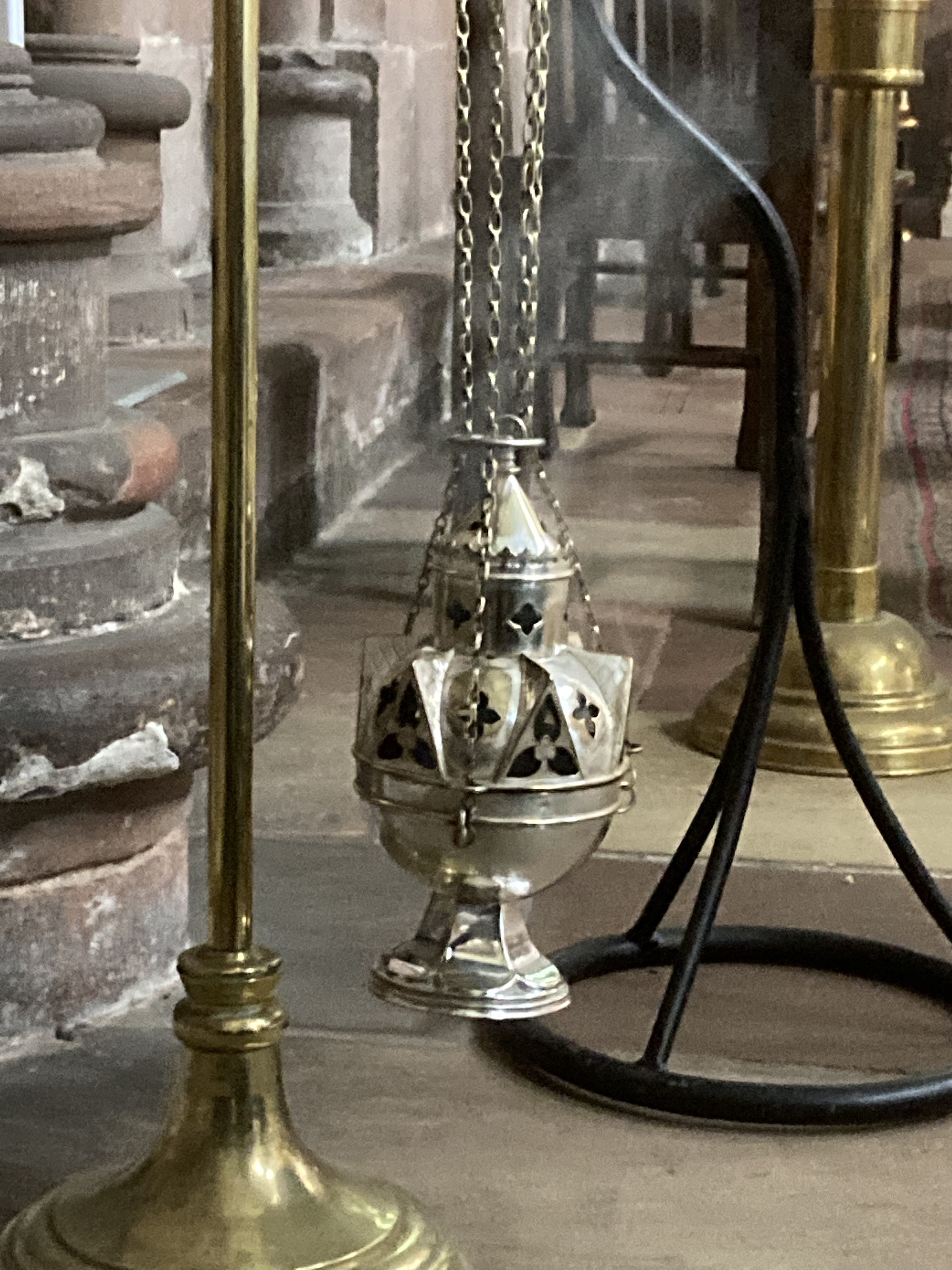
The Offering of Incense is based upon silence and introspection. At its best, the building falls so quiet that you can hear the charcoal crackling in the bowl, and every gasp and flutter of breath through the nasal passages of the people around you. As a consequence, the service can offer a great relief from the day-to-day harassment of life, and I choose it because having offered my sorrows, I am sometimes less sorrowful. But it’s hard to sustain a level of quiet in a popular building, and the mood is often obscured by the tourists and visitors who’ve missed the sign which asks for quiet during the service. They talk, and the sound of their talking rackets down the aisles to the little altar with its thread of smoking rosa mystica. It’s hard to manage this kind of disturbance, and difficult to ignore it. It’s never meant maliciously, and if the story of the pelvic floor is anything to go by, it’s only sound broadcast without forethought or self-awareness. But it’s sometimes tempting to ask for silence anyway, even though you’ve come to observe the peace, not police it.
Carlisle Cathedral is a rich and restful place in its own right. I treasure that, because I’ve seen enough to know it’s unusual. When I have visited Cathedrals in the south, it’s clearly hard to find a balance between peaceful prayer and revenue-generating tourism. At Gloucester and Chichester, the atmosphere is jarred by sound technicians, gifts shops and the droning jokes of tour guides. Those Cathedrals can feel more like venues than religious spaces, and if I seem to rail at England and the South, this effect is most off-kilter at Glasgow, which only has one ugly little alcove for prayer and you’re treated like an escaped zoo animal if you ask to use it.
But as an act of self-defence against the riot of life, prayer needs to be robust. If you can’t find a place within yourself except in total, bleached-out silence, you’re not going to get far in the real world. Besides, like so many aspects of Christianity, prayer is only recently a solitary task, focussed upon silent internals. Medieval faith was loud and bright; churches were communal meeting places which served a variety of secular functions. Before the Reformation in England, the pilgrim’s desire to visit relics would have made certain Cathedrals feel like football stadiums or music festivals, particularly on specific holy days. Measure that against modern Christianity which often feels cold and censorial. Perhaps it’s a Victorian hangover, but the expectation is that you’ll whisper and feel shy in the shadow of soaring, soap-clean colonnades.
English cathedrals can feel like an exercise in clean lines and asceticism – I love Wells and Norwich equally, but both feel like sea shells found empty on the beach. Once gaudy and bold, they’re bony and cold these days, with little to suggest that normal life was ever found there. In this way, cathedrals in the hearts of busy cities can feel lonelier and more isolating than far-flung chapels in Radnorshire or Ceredigion. These at least have a living charm in the tangle of ivy; the business of bats overhead and the inevitable drip of a broken gutter.
Perhaps in church we’re attempting to reverberate our prayers together – to remind ourselves why it’s important to sit quietly, so that we can hone our skills and take them back into the fray of our lives. If that’s the case, then we do need silence and peace when we go. But there is nothing inherently calm or quiet about religion, and while it’s tempting to look at these places as if they’re still being used for their “original purpose”, the reality is that the place and the purpose has changed beyond all recognition over the centuries. Tourists now pay more to visit the cathedral at Carlisle than any conventional congregation would, and in pragmatic terms, it’s surely better to endure a constant mutter of voices than reach for a full and sanctimonious silence which endures for fifty years, after which the cathedral falls down because nobody’s paid to maintain the roof.
So there’s a compromise to strike – and sometimes I leave that Cathedral in a state of grinning delight. It gives me everything I wanted, and life feels not just possible but fun. On other occasions, the mark is missed and I’m just quietly pleased to have experienced a distraction. But more often than not, the visit does nothing for me at all. I keep going because I know that when it’s good, it’s extraordinary – and breathing deeply, I’m ready to hope that the failure of one silent observance can deepen and lend magic to the success of the next.

 Bog Myrtle & Peat
Leave a comment