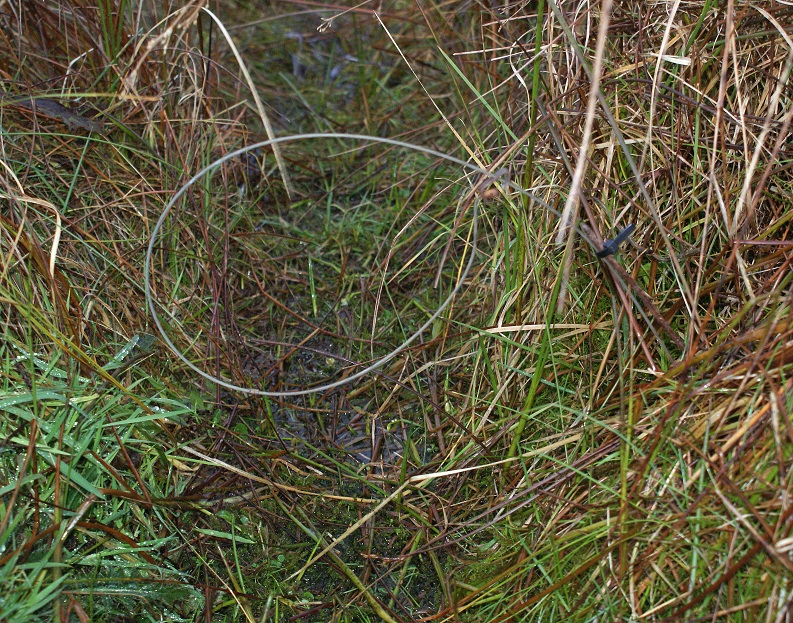
I was given my first rabbit snares when I was ten years old. They’d come fresh from the shop, and the shiny hoops were the colour of gold. But nobody showed me how to make them work, and I spent several weeks in suspended frustration. I didn’t know how to make tealers or pegs, and I had no idea that the wires had to be weathered before use. I didn’t even know that rabbits ran in runs, and my first few sets were just loops around the entries of well-used holes. Sometimes I’d find that they’d been snagged, and I’d interpret that evidence as sure signs of a “near-miss”. I was miles off the mark, but those “bumps” gave me the enthusiasm I needed to persist in the face of constant failure.
In the end, a gamekeeper took me under his wing and showed me how to set snares properly. I got quite good at it in the end, and I once caught seventeen rabbits from twenty one snares in a night. Down in the village, I learned that “Trapper” Glendinning would expect to take ninety five from a hundred. That was something to aim for, but his success was borne of necessity – he didn’t have permission to set any snares at all, so every one had to be worth the risk of setting it.
In due course, I learned how to snare foxes too. That was harder and slower work, but many of the same rules applied. And out on the hill in my early twenties, most of my foxes were killed in snares which I set along fencelines against the endless blocks of forestry. Of every hundred foxes I killed in a year, sixty or seventy would be caught in this way with a minimum of fuss, work and financial outlay. A fox snare will only catch once. After it’s been wound around itself, it will never fall back into a loop that’s smooth enough to run cleanly. But fox snares were a pound a piece in those days, and sixty pounds was a fair price to pay for sixty foxes.
The law changed in 2011, and it became illegal to set snares on fences in Scotland. I never understood the rationale for this; at the compulsory accreditation course (which I paid to attend), I learned that legislators were worried about foxes which had been caught on fencelines and afterwards tangled themselves up in the sheep-net, choking themselves in the process. But that had never happened to me, and it’s pretty easy to set a snare so that it won’t. It was the first time I’d encountered laws which are passed to address problems which might otherwise be solved by common sense. Like a transatlantic convoy during the Second World War, we’re all bound to move at the pace of the slowest ship, and it didn’t matter if you knew how to run snares safely and effectively – some people didn’t, and the result was that we all had to slow down to match them.
Not being able to snare on the fencelines meant that the number of foxes I caught each year reduced by more than half. Black grouse and curlews were already on the downward slide, and I have no way to prove that the change did them harm. But I feel certain that they suffered, and I didn’t pick up the foxes I’d missed by using any of the other methods which were available to me. On open hill ground, snares are the only practical means of working across large areas. People talk about shooting as a method of control to plug the gap, but it’s hard and slow – and if you aren’t a gamekeeper, other work tends to get in the way. Knowing what I had been catching before the law changed allowed me to guess at what I wasn’t catching after it – and it was deeply disheartening to head out into the darkness with the rifle each night when everybody else was in bed, knowing that I was casting for the chance of one fox when I really needed eight or ten to shift the dial.
And now they’re talking of banning snares altogether. I’ve almost stopped, so it wouldn’t have any direct impact on my life. But the small shrug I feel is telling, because laws relating to the countryside are often passed by people who have no direct skin in the game. It’s easy to ban something that you’ve never done, and there’s a self-righteous glow which comes from striking a blow against people who are already perceived to be “the bad guys”. I don’t set so many snares these days, but that shouldn’t mean that the change will have no effect on me. I learned a huge amount from my experience of snaring, not least an early sense of responsibility. And the loss of snaring contributes to a wider feeling that laws are made or changed not by what is right or useful, but by the simplified narratives of activism and pressure groups.
The spectre of snaring has been whipped into a furious glow of anxiety. People want the practice gone and the Scottish Government is responding, not because it believes that legislation passed in 2011 has failed to raise welfare standards, but because it looks bad and so it must be bad. I must have had hundreds of foxes in snares over the years, but I can’t say that I’ve ever been struck by scenes of cruelty or hardship – and certainly nothing worse or more ghastly than animals struck but not killed by bullets. When snaring does hit the headlines these days, it’s usually in weird or horrible instances of cruelty which were already illegal – the kind of nonsense undertaken by idiots and understimulated kids. In truth, snaring is no more inherently bad than rifle-shooting is inherently good.
We have a wealth of scientific data to endorse the control of predators to support rare and endangered wildlife. But humans accept wildlife management options according to personal taste and preference – some are happy for foxes to be shot, but they deplore the idea of snaring. Others refuse to accept that any animal should ever be killed. For my part, I’ve seen enough to know that predator control is never pretty – it’s just work, and nothing to boast or brag about. I’m happy with snares, but I wouldn’t be happy with gins or poison. Each to their own, but the central truth is that omelettes require broken eggs, and predator control is getting harder and more expensive just as we need it most.


 Bog Myrtle & Peat
Leave a comment