We sat between plastic flowers at the crematorium; seven men and a strange Minister who’d come down from Kilmarnock. When the curtains opened and the coffin was conveyed slowly out of sight, one of the undertakers pressed the buttons on a CD player behind a screen. From speakers positioned around the almost empty room, there came the sound of Jimmy Shand playing the Bluebell Polka, which comes as close as anything to a national anthem for a generation of Scotland which is now being drawn to a close. And all the confused associations of the music startled me, because our old friend was teasing us from beyond the grave. Instead of a sombre, emotionally over-wraught rendition of You’ll Never Walk Alone, or Highland Cathedral, he’d chosen something deliberately upbeat and jolly; a final happy reel into the furnace. He’d wanted us to laugh at last.
But that Bluebell Polka said more about this place than a prank designed to raise a smile. Because if that was his idea of happiness and the counter to the loss of long-loved friend, the comedy’s played on a damn fine line. In the tightness of the rhythm and the predictable turns and counter-turns of a jukebox melody, there’s almost nothing to hang your hat upon there. And what promises to be joyful is only a reflection of the straightened world which made our fathers and grandfathers before them. Beneath their cool and calloused exteriors, those people were reaching for something that I might call glee – and the Bluebell Polka is as close as they came to letting themselves be free in public at a reel or a ceilidh in the pub or the hotel floor. Measure the lowland ceilidh against the demonstrative tumescence of flamenco or the careless mash of an Irish jig; they were trying to be themselves in Scotland, but their passion was the ridiculous wobble of tail that’s been docked.
I recently saw film footage of Jimmy Shand playing and his band at the Caledonian Hotel in Edinburgh in the 1950s. The dancers turned and performed with immaculate clarity, and the speckledy film gave out an almost tangible reek of brylcreem and sweat-stained wool. Shand himself sat in a commanding position on a podium above the floor, much as a DJ would claim the highest ground of an Ibiza dancefloor. But there was nothing to see behind that glassy stare; the face calm and inexpressive as if he’d been left to wait in the car while his wife went to collect a prescription. His fingers danced with impressive dexterity across the keys and buttons of his accordion, but there was no tapping of feet or bobbing along to the tune itself. No such act had ever crossed his mind – even his blinks seemed to fall in slow-motion, out of keeping with the beat and the sweat and churn of the dancers beneath him. Now and then, he would turn his head like an ancient Galapagos tortoise which has spent all morning looking for shade, only to remember for the thousandth time that lettuce only grows in the sun.
Then the polka was done, and the dancers stood back and clapped. Whatever animal instincts stirred into life between partners during the dance died immediately. The Scotsmen of my father’s generation were afterwards conceived through hidden acts of pragmatism; necessary evils transacted in the darkness. The film ended, and I watched it again with the sound off. The effect was even more incongruous and desperate; my inheritance laid before me like a ball and chain. I would never intend to poke fun at Jimmy Shand – the man’s a hero, and too much of ourselves to talk down. But while the world flared at sparks of excitement from Elvis and the first mad squall of the Beatles, Scotland was in thrall to a man sat motionless on a stool.
The joke at the crematorium was meant in good heart, and I was glad of it. But if the old boy had meant to leave on an upbeat, the joke came surprisingly close to failure. It’s a tragedy when young people die and leave so many questions about the lives they might have led. But my friend had all his long life behind him in a pattern of sheep-work and rain. And I’m left to wonder who he might’ve been if luck had blessed him to live his life in the freedom of somewhere else.
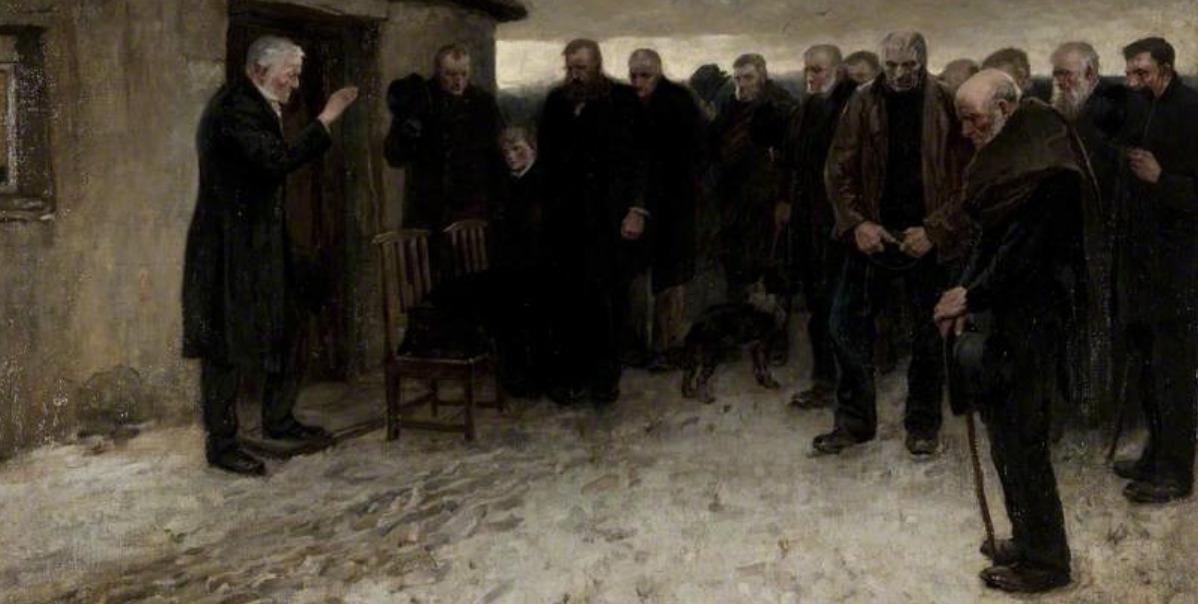
Picture: A Highland Funeral, by James Guthrie (1859-1930)

 Bog Myrtle & Peat
Leave a comment