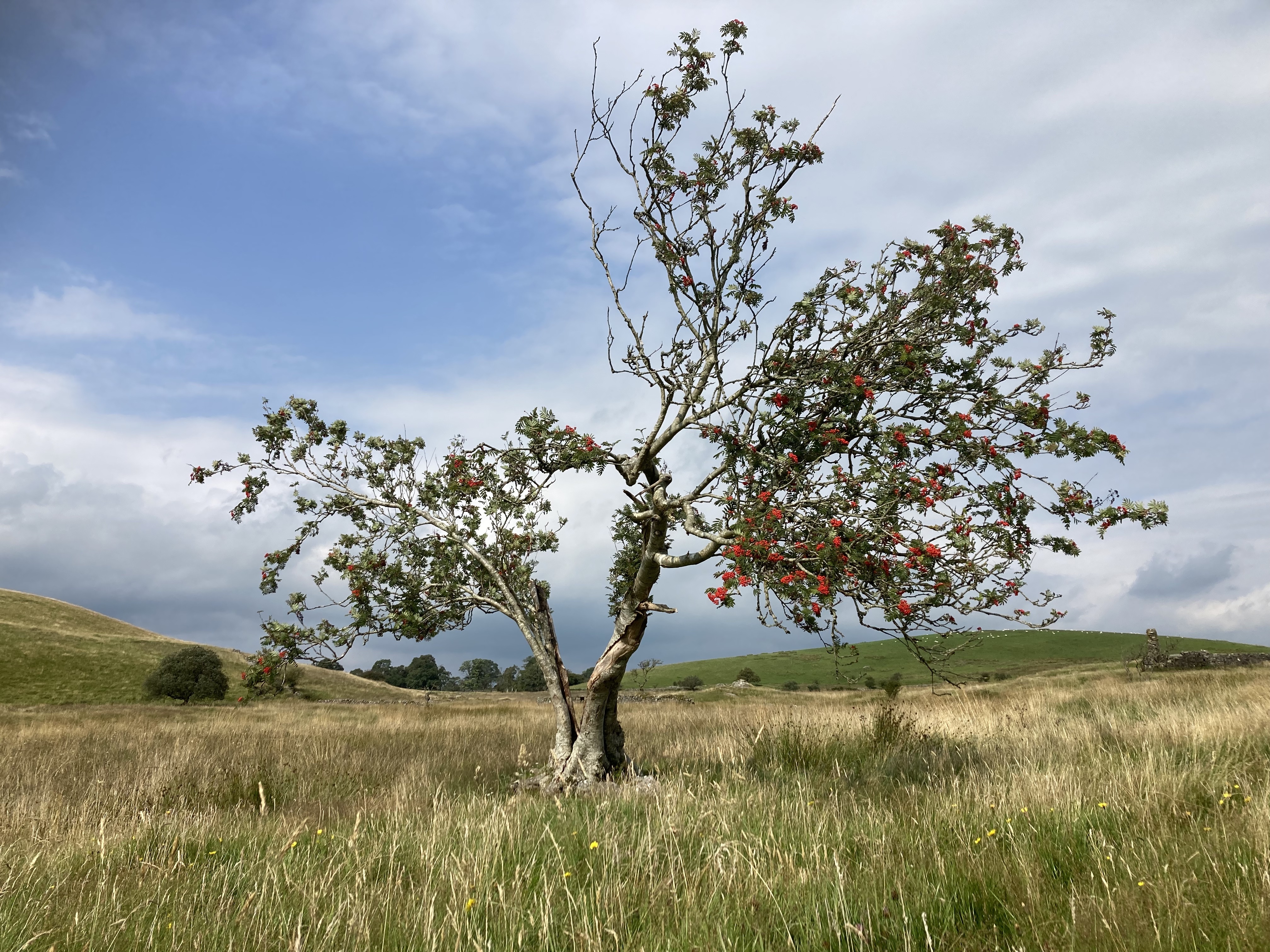
The year’s worn well at Galrinnes, and the moor is swirling with grass as it rises away from the road. This farm was for sale in the winter, and for a while it seemed like it would be sold to foresters. Green investors have a bottomless hunger for “marginal” and “unproductive” land like this, and they’re buying it faster than you’d ever believe. The situation hung in the balance at Galrinnes, but then it was bought by farmers for farming and it feels like one small victory in a rising tide of loss.
There are many good reasons to mourn the changes which have fallen upon Galloway, and I’m not sure we’ve entirely grasped what the new commercial forests will cost us. We’re often told that foresters conjure “something out of nothing”, and trees are the only viable use of a worn-out agricultural wasteland. And it’s easy to overlook what hill farms have to offer because noisy journalists and campaigners have taught the public that the uplands are “sheepwrecked” beyond any hope of salvation. That’s a compelling message, but it does nothing for nuance and the many regional variations in culture and land management. In truth, many hill farms in Galloway are extraordinarily rich and diverse places – when they’re bought to be ploughed and planted by forestry investors, we’re all robbed of something very precious.
Galrinnes stands in a mess of glacial drumlins; tall deposits of rubble and grit which have lain since the last Ice Age like bowling balls under a bedsheet. Their rounded tops are rich and grassy enough to be mown for hay or silage, but their sides are precariously steep. You wouldn’t want to take a tractor down slopes like those – so while the tops are often mowed, the rest is left to grow long and lank as a monk’s tonsure. To the west, there are views of the Rhinns of Kells and the turtle’s hump of Blackcraig across Loch Ken; facing east, there’s a heavy frown of the other Blackcraig where the windfarm now stands against the sky. Meadow pipits creak everywhere, and goldfinches rise in swarms from the knapweed and thistleheads.
Between the drumlins, there’s a tangle of honeysuckle and hazel hedges which lead along cart tracks and out to a maze of tumble-down dykes. So much work and care has gone into the place over the years, and the fields cleared by hand for generations so now there are hand-sifted dumps of stone called bings in every margin – and on every bing, a wheatear revelling in the summer’s final flush of flying ants. A score of ancient crab apple trees stand above an outlay of ruined barns, and then the land descends into tussocks of molinia and bog myrtle. Small copper butterflies sparkle in the grass, and a stonechat watches them from an explosion of valerian.
Galaxies of flowers appear on the margins between wet grass and dry. Talk of purple moorland is often misdirected to describe heather – but that’s nonsense, because heather flowers are pink. Purple moorland is better and more subtle than a blaze of shining ling, and its colour is derived from harebells and field scabious which grow at Galrinnes with outrageous prosperity, forming folds and stands of richness like an emperor’s cloak. On drier ground, there’s goldenrod and hawkbit flowers which grow in crazy density above bedstraw, yarrow and tormentil. And all these flowers are dry and shattery in the August light, bound in dreamy gossamer and the cables laid by orb-web spiders to the tune of drawling grasshoppers. You can see where the hares have been in the patterned grass, and the frayings of bucks on bracken which has grown hard and rough as hacksaw blades.
There are crayfish in the burn, and kneeling on a pad of moss, I caught one without too much trouble. These are the non-native American crayfish which are said to cause great chaos in our waterways, and mine was the size of an AA battery. They’ve crept upstream from a well-established colony which now sprawls across the Glenkens, and my one raised a pair of raucous pincers in the direction of my eyes. I’m supposed to hate these creatures, but I’m long on sympathy for invasive species which often prosper in Galloway. In a world where nature seems to have broken, I like animals which defy the odds and offer a glimpse of abundance. By placing an insistent focus upon species which only do badly, conservation purism comes close to masochism – and it’s nice to cheer yourself up by celebrating the occasional success, even if it wasn’t what you were hoping for. Besides, the remnants of crayfish shells can be found on every burnside rock and tussock where the otter’s spraints look painfully sharp to pass. Beneath the blaze of fattening rose hips and the underside of rowan berries reflected in the water, the burn streamed down to the glen.
I would not go so far as to claim that every hill farm is irreplaceably valuable. Some are more precious than others, and it’s certainly true that many have little to offer in terms of biodiversity. But we can learn something important from Galrinnes because it is outstanding, and it stood on the brink of destruction. And it was not rescued on account of some official designation or any strategic decision made by land use planners to protect something we can’t afford to lose. It was simply offered for sale on the open market, and that offering made a mockery of those mechanisms which are designed to protect rich and valuable landscapes. And that’s how I came to realise that we should not have faith in council planners to protect what’s left of Galloway. Galrinnes only survived because the right people bought it. That’s something to celebrate, but it mustn’t obscure the fact that it came down to a stroke of luck. And beyond this small example, rest assured that many farms of comparable or even greater value will be sold and overhauled before this year has passed.

 Bog Myrtle & Peat
Leave a comment