Controversy was stirred on social media when an English writer stepped forward to share a problem. Having recently moved to Scotland, the man was looking to write about the hills of his newly adopted home. He’d tried to use words like dyke, burn and muir, but they felt unfamiliar in his hands; they weren’t his own, and he wondered if they should be translated into language which felt more comfortable. His question posed a range of questions about what writing is for and who the author should be in relation to their subject – because a dyke is not just a funny name for a wall, and a burn is distinct from a stream. And as you might expect, there were howls of anger from Scottish observers who insisted upon the original usage. I eventually lost sight of the argument as it tumbled away into the recesses of the internet – I can’t say how it was resolved, but the questions had been asked.
Language is important, particularly in rural places where old vocabularies are relentlessly persistent. Many dialects are highly local, and I wonder if some of the fury directed against that writer was on account of the fact that that he’d shown no real interest in the specifics of his place. In trying to write about “Scotland” at large, he’d overlooked the fact that there’s really no such thing, and many old words in Dumfries have more in common with Lancashire than they do Argyll. The promotion of a Scots language by Nationalist interests muddies these waters even further by making an amalgam of dialects and pressing them into a single leid. Modern “Scots” is a kind of Frankenstein language; a muddled mix which is based on pre-industrial lowland Scots and Aberdeenshire Doric. It raises some interesting questions about Scotland, but it’s entirely synthetic and discussions which arise around the subject are usually polarised by hotness and politics.
I’m stuck on the significance of language, but only because I’m lost in a fascination with place and belonging. And I’d be the first to concede that that my interests are restrictive – it’s difficult to write outside your home if you’re too heavily bound up with ideas of ownership and authenticity. However, there has to be a compromise somewhere – and if I feel uncomfortable using words that are not “my own”, it’s useful to think about why. There’s a balance to strike, but as a gesture of respect on my own small travels, I would usually try to get somewhere near the local term – not least because many of these words are interesting and beautiful.
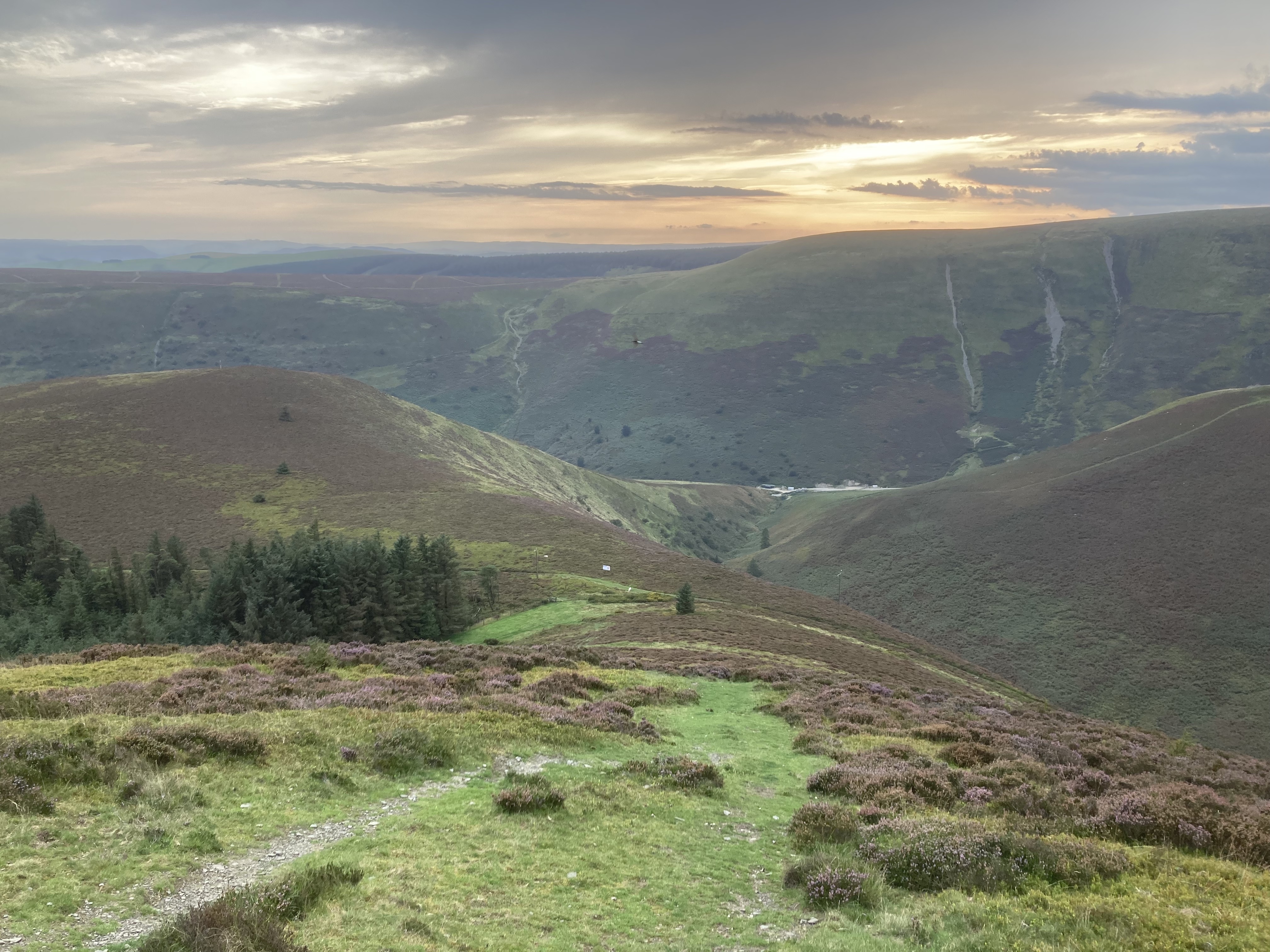
And the subject returned to haunt me while walking in Fforest Clud above New Radnor last week at the end of a stuffy, humid day. It’s a steep climb up the Whimble, but the hill offered some extraordinary views across the Marches and down to Pen Y Fan. After storms in North Africa, thousands of tonnes of Saharan dust swirled in the sunset, casting a red glow on the mountains beyond me. Many of these Radnorshire hills are flat-topped and they fall precipitously from their edges into a maze of steep-sided valleys. Against the effect of an orange afterglow, I felt like I was looking through the smudged-up windows of an antique furniture shop, making out the jumbled shapes of chairs and tables dressed with dust sheets.
Hundreds of house martins swirled around the summit, which rises abruptly from the heather like a loaf of bread. They were catching ants which flew in gales like smoke from the rocks, and they put up a constant chatter of delighted calling. Even the younger birds of this year were in on the action, some flying so close that I could see the last of their yellow chick lips. The hilltop is pock-marked with harebells, thyme and the remains of ancient barrows, and without a breath of wind, I looked out at the pressurised world as if I was seeing it from inside an inflated balloon.
Four miles away, the fine church at Old Radnor caught a final shaft of sunlight as I sat on my own for almost an hour as the day failed. That’s when I saw an animal so familiar and exciting that I felt my stomach twist. He was low to the ground, trotting briskly in my direction – and at other times of the year, I might have said that he was red as fallen bracken. But the bracken is red now in Radnorshire, and he was redder.
I love the word “fox”, with its sinister, sharp-scented phonetics – even to whisper the word is enough to conjure something of the creature himself. But this animal had all of Eastern Wales laid up behind him like a crumple of still-warm laundry; he moved through the rocks and the flowering gorse with all the stuttering ease of newly fallen rain, and the sheep watched him by. Martins called, the valleys hummed and it would be daft of me to insist that he was still a fox then, red as he was. It’s true that they don’t speak much Welsh in this part of the country, but here was cadno, the welsh fox, so much a part of his own place that even that most familiar of animals seemed new.
photo: Looking west into Radnorshire 7/9/23

 Bog Myrtle & Peat
Leave a comment