Once you’ve driven through the business end of Braunton, the old village opens up like a parcel. It’s beautiful on a warm day in July when the willows weep and swifts scream above the crackling thatch. In a pool beneath a stone-topped bridge, brown trout lie between trailing strands of weed. They’re not going anywhere, but if you stare too long they’ll move away to rest in dark panels of shade cast by the alder leaves.
Up the street, there’s a sixteenth century pub with black and white beams which shine like a barcode in the sun, and men sit on a bench outside. They’re old and happy, and they ask if I’ve come to see their church which rises through the trees across the way. I say Yes, but I’m not in so much of a hurry that I need to race towards the ancient building. So I buy a pint and sit beside them, and they ask if I’ve come far. I reply that I’ve come from Scotland, and it turns out that one of the men has a cousin who used to work in Perth. I’m not from Perth and it’s not really a coincidence, but he’s pleased with the connection as an unaccompanied dog walks up the street and into the pub. My pint is warm and soapy, and weight falls from my shoulders as I drain half of it in a single gasp. This is archetypal England in all its peaceful, confident richness, and if you’re born and brought up in Galloway, you can travel the world and never find an experience more foreign than this.
But the church at Braunton is devoted to St Brannock, a Welsh saint who found his way across the sea to North Devon by sailing in his own stone coffin in 535AD. When he arrived, a local pagan stole his cow and butchered it. Unperturbed, St Brannock reassembled the parts and the cow was fine. Later, when he looked for a site to build a place of worship, the vision of a sow being suckled was revealed to him in a dream. Walking nearby soon afterwards, St Brannock found a sow being suckled and built his church where it had lain.
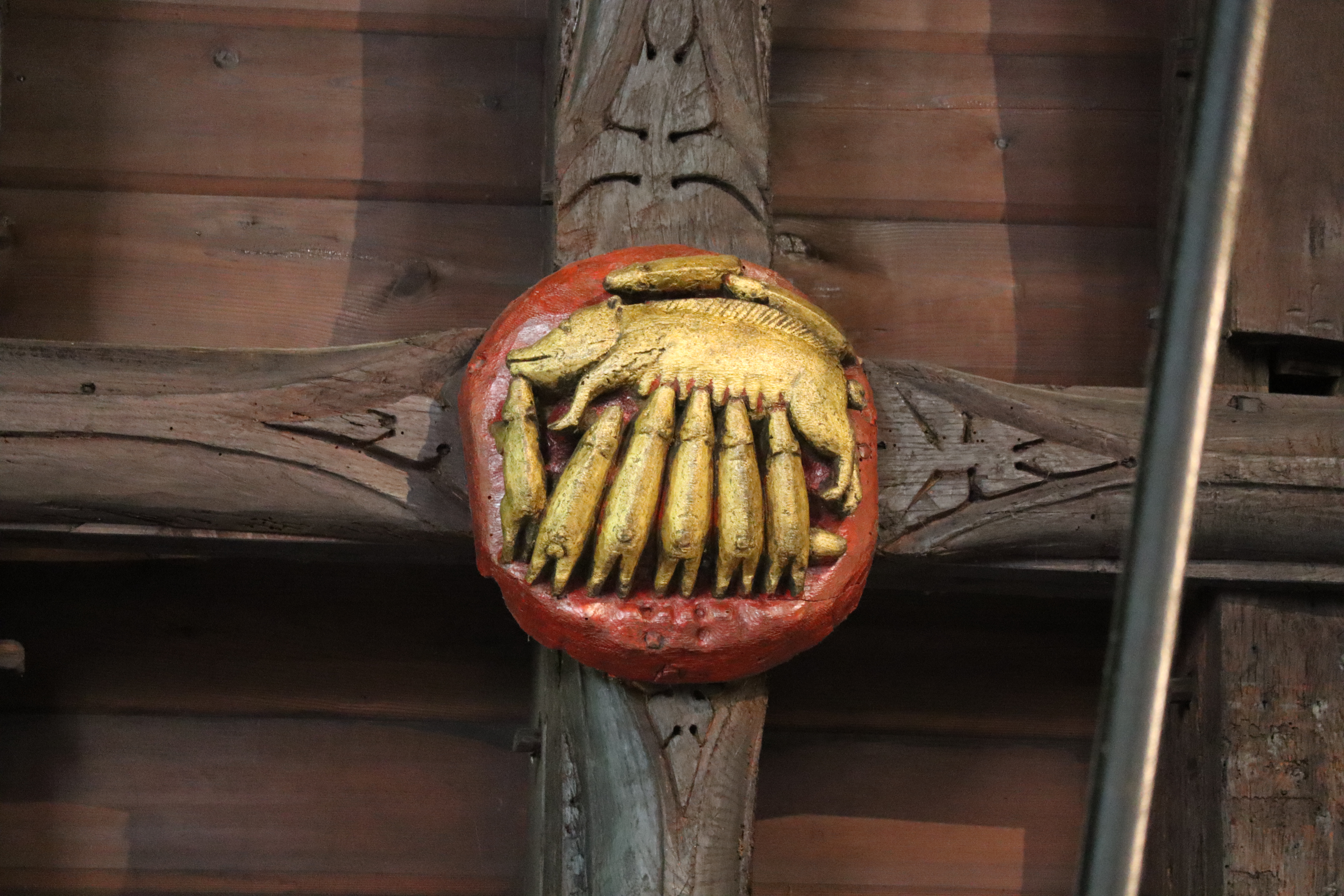
I went to Braunton because high up in the dark waggon roof of the church, there’s a carved wooden boss which depicts a sow being suckled by her piglets. It’s five hundred years old, but the shapes are all distinct; the sow’s lost in a kind of hazy rapture, and the piglets jostle for position along her belly with recognisably porcine urgency. There are eight in total, and to fill available space in the roundel, two outliers were carved to confer around her back. Recent refurbishments have restored the original colour of these pigs; they’re coloured gold, and they strike an odd balance between ribaldry and reverence.
When I was done with the mustiness of St Brannock’s church, I walked out through steep-sided lanes beyond the village. It’s old-time country, and ivy trails from the hazel trees which meet overhead above the road. In shade, the leaves rustled with the promise of dormice; in sun, the seedheads were mingled with hawkers and speckled wood butterflies. Unable to see into the surrounding fields, my walk led me through a high-sided maze of wildflowers and the scraped exposure of stonework beneath.
The local postman had all the time in the world to chat. I told him that I thought England was beautiful, and he proudly corrected me. He said “Well, it’s Devon, innit?”, and I hadn’t thought to make that distinction. But having driven nine hours across ten counties to reach Braunton, it was suddenly hard to locate these sunlight scenes amongst all the many Englands I’d seen from the motorway; the billboards and the drive thru coffee booths; the housing estates, electricity pylons and three-hundred-acre fields of mechanically recoverable crops. As an outsider, I reckoned it was safe to surmise a general sense of Englishness from my surroundings, but it turns out that Devon’s part Welsh anyway, and the serenity of quintessential England is sometimes underwritten by mystical pigs.

 Bog Myrtle & Peat
Leave a comment