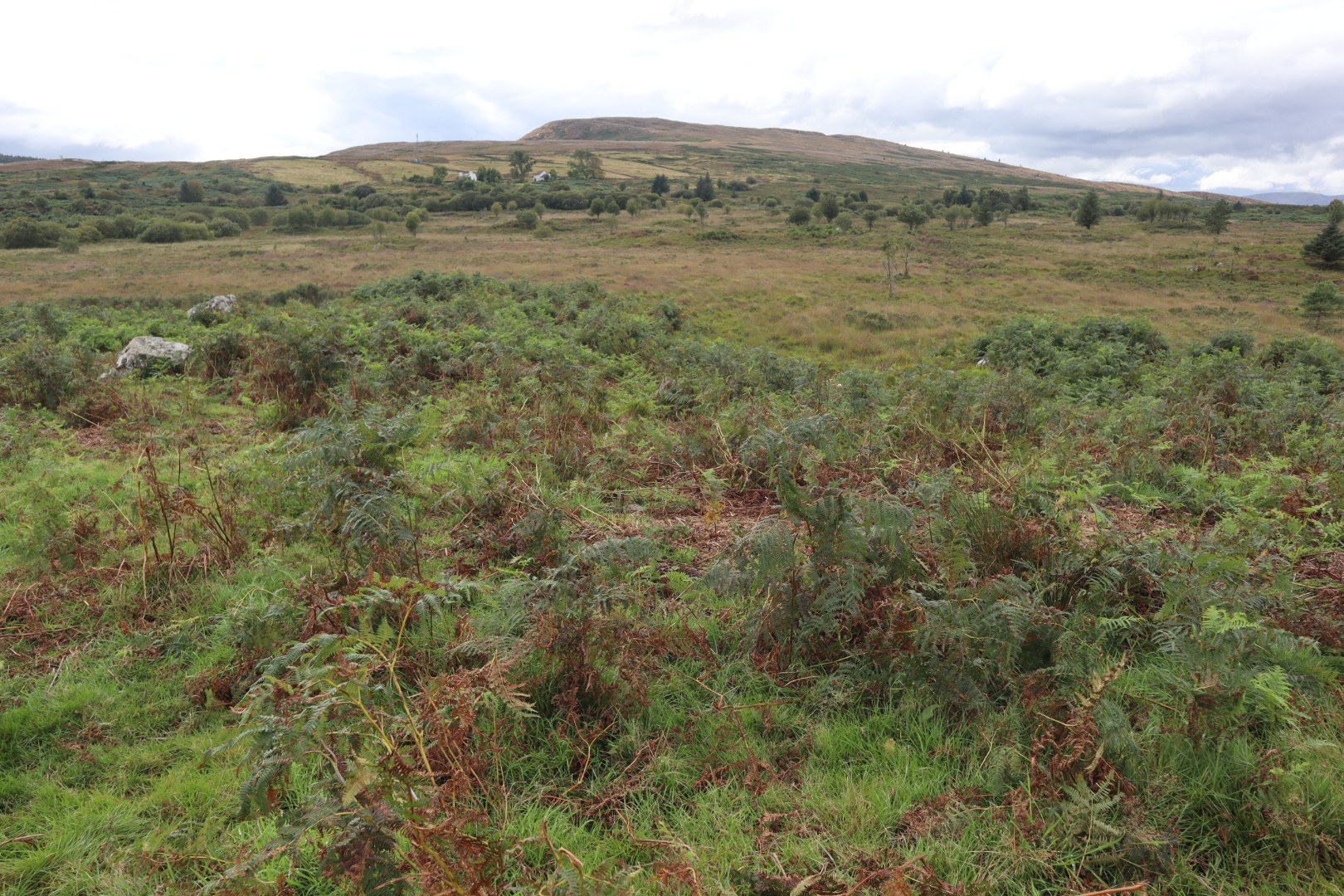
Having recently written about cattle and bracken control, a brief follow-up is warranted after a walk across the hill last week. In one area where the cows often linger, bracken has been badly shocked into open retreat – the effect is extremely impressive.
I’ve sometimes complained about the inexplicable behaviour of my livestock. They stay away from certain areas without any indication of why, just as they’ll actively linger in other places which seem utterly uninteresting to me. For no reason I can see, they’ve always gathered on one particular knowe where the bracken is extremely well established. In 2019, I would say this knowe was entirely covered by bracken – one hundred percent coverage. After three summers, this has diminished to around thirty percent, and the surviving bracken is short, shattered and tatty. I also notice a great deal of bright green fronds on this knowe, which at this time of year suggests that this is second (or third) growth responding to the destruction of earlier stuff. That’s great, because it means that the bracken is deploying self defence mechanisms – it knows it’s getting stuffed.
The change is obvious, but it’s interesting to note that this knowe is divided in two halves by a dyke. My cows have annihilated the bracken on their side, but since they cannot cross the dyke, the vegetation over there remains as it was when I started; shoulder-high bracken. It’s almost like I designed this as an experiment with a clear “control”.
What’s more, the vegetation which has succeeded the bracken on my side is good, sweet grass. Of course the cows want to eat this grass, so a virtuous circle has been established whereby the more cows want to be there, the more it attracts them. This succession is encouraging, because where I’ve seen bracken removed artificially (either by spraying or cutting), there’s often a period of barrenness and sterility in the aftermath of management; tall stands of bracken are replaced by large areas of dead litter where nothing much seems to grow. That’s when it’s important to remember that bracken hates to be disturbed. Tractors, horse-drawn rollers and herbicide sprayers are troublesome, but they only come round every few years and there’s plenty of time to rest and recuperate afterwards. Grass doesn’t stand much of a chance in these cases, and active management seems to attack the bracken itself without addressing the cause of its prosperity. It’s therefore no surprise that most bracken control is defined by long term treatments, retreatments and follow-up treatments. By contrast, cows open ground up and keep it open, disturbing the soil on a daily, weekly basis for years at a time – it’s only a matter of time before the bracken gives way to something new.
I’d say that in this situation, my cows have delivered the best bracken control outcome I’ve ever seen. That’s not a brag, because I’d have to measure this success against the fact that I did not plan for this, and it’s one of only two or three places on the whole hill where they’ve done it. There are still many acres of bracken out there, and I cannot compel the cows to tackle them. But perhaps that’s a lesson in itself; that even down to a granular level of individual acres and half-acres, some bracken is naturally easier to manage than others. After all, we’re talking about a native species which plays a useful ecological function. It’s not for us to exterminate it, but instead find the easiest, cheapest and most sustainable way of keeping it in check.
It’s clear that bracken would eventually come back on this knowe if the cows were removed. What my cows have done is nothing like a silver bullet, but in terms of building a long-term management plan, I’d say that developing a permanent hill grazing system is easier and delivers more good across multiple fronts than an occasional boom and bust approach designed to tackle bracken in isolation – particularly when those assaults are so famously costly and arduous.
Picture: This bracken was shoulder-high in 2019. After three summers, it’s been reduced to ruins and grass is succeeding it. Mossdale 09/09/22

 Bog Myrtle & Peat
Leave a comment