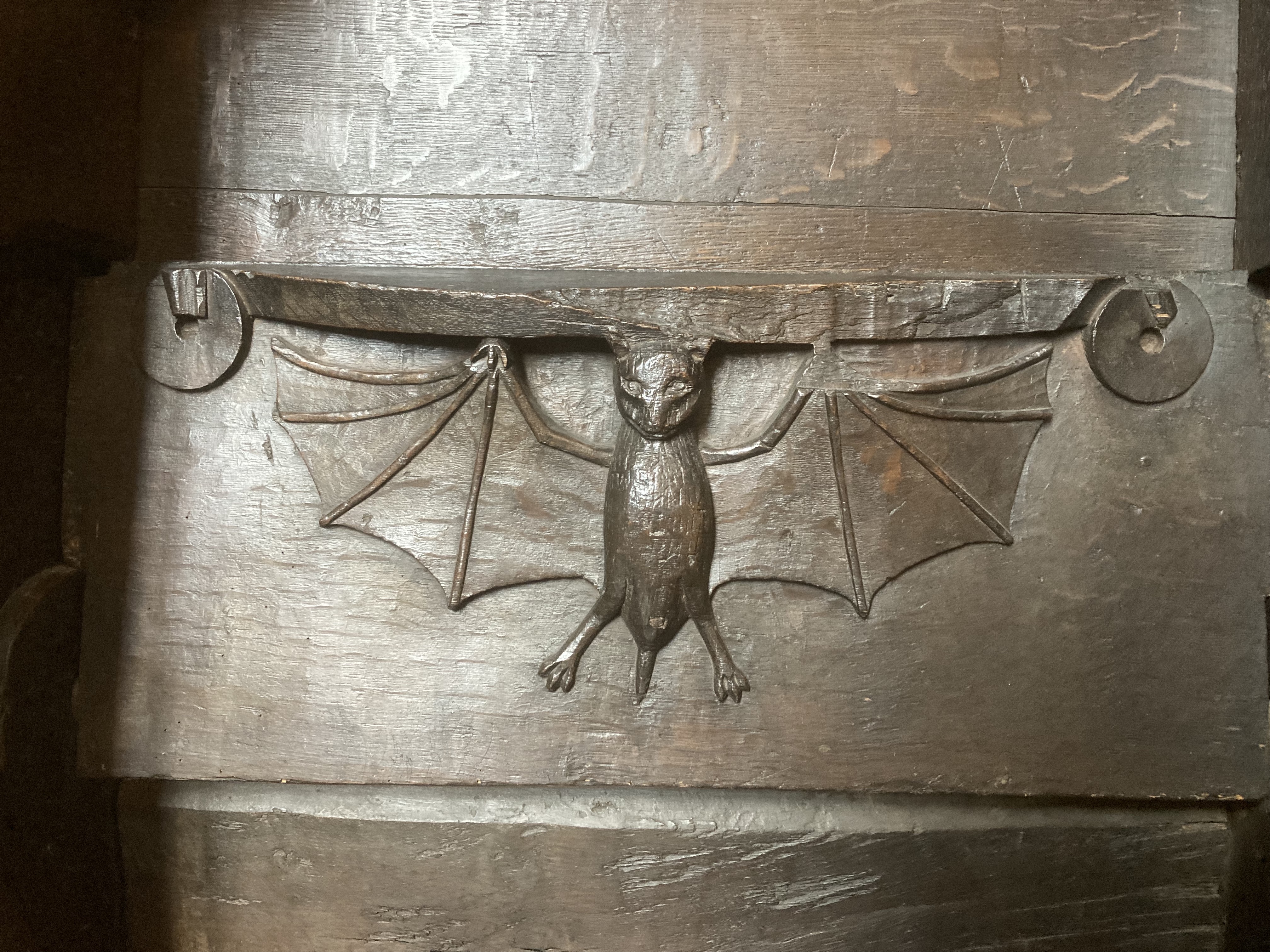
One hundred miles north of the extraordinary misericords at Carlisle Cathedral, Dunblane mounts a quiet riposte to English extravagance. Decorative wood carvings are much harder to find in Scotland, and misericords are extremely scarce here. It’s likely that we never matched the English when it came to lavish wood carvings, but an extremely uncompromising approach to iconoclasm during the Reformation destroyed the best of a narrow pool. However, an unmissable exception to this trend can be found at Dunblane Cathedral, where a tiny handful of medieval wood carvings rises to match the best of Carlisle, if not in delivery then certainly in spirit.
Being pedantic, I’ve learned that the eleventh century church to St Blane is not really a cathedral at all. A cathedral needs a bishop, and there’s no such role in the Church of Scotland. In proper Presbyterian terms, this is only “a massive kirk”, and perhaps the building retains its old title merely through habit – but it’s strange that this word (with all its High Church connotations) should still be used to describe a place which has otherwise been completely reimagined since the Reformation.
Following a period during which it lay derelict, Dunblane “cathedral” was restored for Protestant use and later remodelled in the early Twentieth century. Ornately carved choir stalls were introduced in 1912, and they’re a lovely piece of work. But I choose the word “lovely” with care to incorporate a sense of petted harmlessness – while the new wood carvings are “pleasantly decorative”, they also feel synthetic and self-regarding. In places, the choir stalls attempt to recall a Medieval aesthetic based upon chivalric motifs and hunting scenes. But that’s a hard act to follow, and seeing this potent symbolism appropriated by Twentieth Century chisels is like a short-circuit which neuters any sense of magic. They stalls are not powerful or compelling. They’re only lovely.
The real attraction at Dunblane is several fragments of genuine Medieval woodwork produced in the early fifteenth century. On canopied stalls positioned against the cathedral’s west wall, there’s a crazy depiction of fighting between dragons, centaurs and green men. Stylistically, these designs are hair-raisingly bonkers – they remind us that in the days before popular media taught us what mythical animals were “supposed to look like”, everybody imagined them differently. But in the execution of these figures, there’s a recurrent sense of clumsiness and bodging.
I’ve recently learned that many of the most talented woodcarvers came from continental Europe, and they were drawn to Britain by an explosion of finance and ambition generated by the great English cathedrals. You could make good money in the south, and few of the best carvers bothered to keep travelling northwards where money was scant. The woodcarvings at Dunblane are unusual because they survived, but they’re also remarkable because they’re… well, a bit rubbish. Perhaps they were produced by local craftsmen in imitation of greater or better contemporary work in England, but measured against the sleek, weightless wonder of misericords at Gloucester or Wells, they seem downright clunky and primitive.
English misericords established a pattern in which a central design was endorsed or embellished by a smaller “supporter” on either side. These allowed the carver to develop a theme or a narrative and tell a story. Supporters are a uniquely sophisticated English feature, but at Dunblane they’re little more than a blunt circle on either end of the ledge-seat. Between and below them, each design is rendered in large, bold, capitalised simplicity. There’s a leopard and a thistle; a dragon which looks like a painful collision between a pig and a bin-bag. Each misericord is chunky and crude, defined by a lack of symmetry and balance.
But the very fact that they’re “a bit rubbish” provides a thrilling sense of life and humanity. These “religious” carvings convey a screamingly accessible sense of folk art. I found the urge to touch them completely irresistible. Leaning across a barrier which read “Please Do Not Touch”, I touched the bat on his tummy. He was stone cold and harder than cast iron – my hair stood on end. As I stood up from kneeling before this authentic medieval woodwork, I looked over to the glossily rendered Twentieth century choir stalls and reckoned they looked downright silly.
Modern ecologists have tried to identify the species of bat depicted here. It has small ears and a free tail, meaning that it doesn’t really fit with any of the ten bat species found in Scotland. I applaud this attempt to mine Medieval symbolism for the modern scientific data, but it’s rather missing the point. We can’t ignore the possibility that this is just a dodgy piece of carving created by somebody who simply wanted to convey a simple sense of something bat-like. I say that in this respect, he nailed it – and maybe we should cut him some slack.
Who knows how these carvings survived the Reformation, when so much was torn down and smashed? There is certainly evidence that they were moved out of the cathedral for a period when such objects were being hunted down and burnt, but it’s hard to know why that happened. Perhaps the carvings were earmarked for destruction and heaped into a fire which was never lit – or maybe they were hidden away by people who placed specific value upon them. What’s certain is that Dunblane cathedral lay without a roof for many years, and even if they had not been broken up and burnt as fuel, these misericords would have suffered horribly in the rain and snow pouring down from the open skies above. But somebody chose to keep them safe, even if they only hoped to break them up for firewood later. Without knowing why they were saved, we cannot say really say that this bat and his fellows were deliberately rescued or protected for posterity. Perhaps they owe their survival to sheer fluke and good fortune, and beyond their almost magical symbolic potency, that incredible journey makes them all the more special.
Picture: Bat misericord at Dunblane Cathedral – 6/6/22

 Bog Myrtle & Peat
Leave a comment