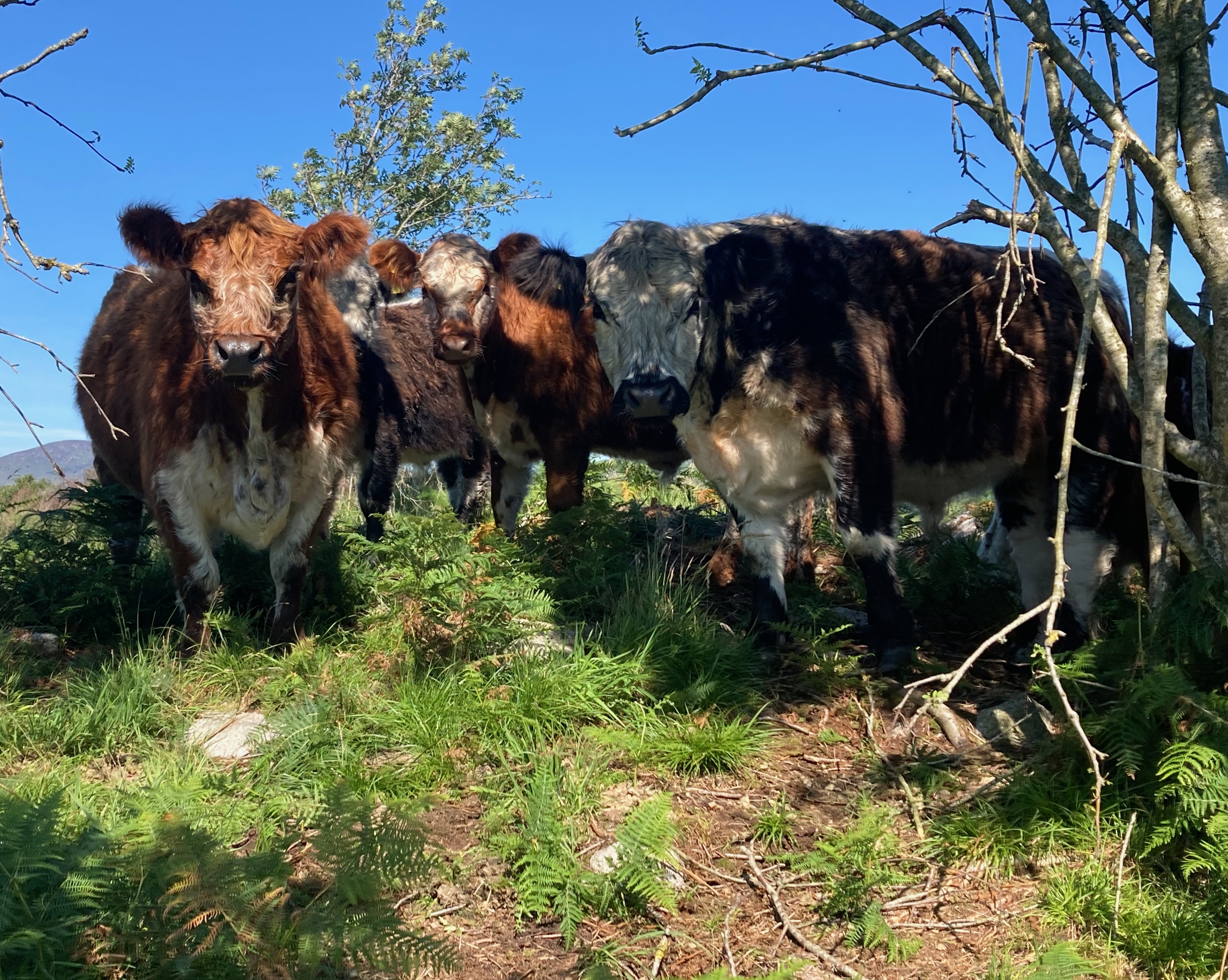
Three years into my grazing project, improvements have begun to cascade and accelerate on the hill. The grass has broken up, and the cows have made paths which crisscross back and forth around the moor. Large areas of formerly dense vegetation have been smashed, and that’s nothing but helpful for clumsy humans like me. It gave me a warm glow of pride to check the cows in my flip-flops last week, following neat and tidy tracks deep into what used to be an impenetrable jungle.
So I’m happy, but the far more significant benefit has been for birds and wildlife. Away from these paths and the areas mown down to a neat carpet by grazing mouths, significant patches of the hill remain as they’ve always been. For no specific reason I can see, the cows don’t like these places. So they graze and trample round them, creating edges between habitat types and allowing wildlife to move in and out of deep cover as they choose. Insects have boomed, and the number of birds has responded in kind. I can’t say for sure that my cows have encouraged new species to colonise the hill (although I have no record of spotted flycatchers until this year), but the abundance of almost everything has increased markedly.
I’m also enjoying the damage the cows have caused to the bracken. In their first year, I put my cows to the hill in early May. I realise in retrospect that this was too soon, and I ended up having to give them hay to supplement the early growth of grass. This hay was doled out on various patches of bracken because these were dry and easily accessible areas, but I also remembered how feeding cows on bracken can control the plant by bashing and mashing it. However, the best results come when you do this during cold weather so that trampling feet allow the frost to reach the fragile bracken roots. But this was May, and I didn’t seriously think that my handful of bales would make much of a difference. I hadn’t realised that timing is key, and that there are windows in the spring when bracken is pathetically vulnerable. In one very well established area of bracken, my diary informs me that I fed cows on May 15th 2020, just as the fiddleheads were beginning to show. I know from the satellite tags that my cows never went back to that spot all summer, but the bracken hasn’t recovered from the hammering it received during those thirty six hours. Grass has begun to recolonise this patch, and the cows now have a foothold to graze and retain the open space.
I’ve been unable to repeat this experiment because the cows now go out in June when there’s grass for them. That’s better for the cows, but it means that the bracken’s window of vulnerability has closed for the spring. There’s a balance to be struck here; the farmer-half of my brain takes such delight in seeing the cows do well when they go to grass that I’m reluctant to turn them out any earlier and see them lose condition, even if the bracken hates it. The good news is that bracken seems to hate cattle at any time of year – bracken coverage always dwindles in the presence of cows. The problem is only that bracken that’s crushed later in the summer simply springs back to life again, and the benefits are often only short-lived.
I must confess that my cattle have also damaged some of the self-sown rowan and willow trees which dot the moor. They generally seem to do this earlier in the season when the buds are coming out, and they’re less interested in mature leaves. Alongside this kind of active browsing, they also rub themselves and tear up branches as they pass through scrubby areas. Some people have warned me that this isn’t great, and that the cows are meant to augment the scrub rather than inhibit its expansion. I take an opposite view, and I welcome the “harm” the cows have done. At worst it’s only slight, and besides, I think we can be too precious about woodland aesthetics. The best and most exciting lesson I took from George Monbiot’s Feral is the idea that most trees evolved in the presence of massive herbivores which routinely smashed them all to pieces – it’s why they’re so good at being coppiced, pollarded and laid. Battered trees might look messy, but when it comes to conservation, messy is usually best.
Bison have recently made the news in Kent, where a “reintroduction project” has seen these “wild” creatures “returned” to the UK after their “extinction” during the Ice Age. There are lots of quotation marks here because the project itself is operating on a fine mist of liberal interpretations and energetic enthusiasm. The bison which have been brought to the UK were bred from captive stock and are being kept inside a fence in an area of former commercial forestry. They’re not wild in any sense of the word. And while there is some evidence to suggest that bison were here many thousands of years ago, they were a different species from the animals in question. So while headlines yell “BISON RETURN”, the reality is considerably less lurid. This project lies on the sillier scale of things, and while I’d usually support any work which aimed to raise awareness of conservation issues, this one is just too giddy.
Listening to a rewilding expert describe how the bison worked as “keystone species” and “ecosystem engineers”, I couldn’t help thinking that they sounded very like my cattle. They both break up over-mature vegetation and introduce a mix of different swards; they introduce habitat diversity and their dung supports insects… in fact, during all the revolutionary talk about how the bison would change the way we thought about conservation, I didn’t hear anything which led me to believe that bison are better than cows in any way. I’ll confess that horned animals are better equipped to bash and damage certain kinds of vegetation – bison may have the drop on my hornless galloways in this respect. But if horns are your thing, there are many horned cattle breeds available without going “full bison”.
There’s an odd confusion here when you remember that many key proponents of rewilding argue that livestock farming is a poisonous form of ecological destruction. It’s hard to see where the line lies between low intensity cattle grazing and “wild bison reintroduction” – if people object to the kind of work I’m doing, it’s probably more on the basis of principle than any criticism of the outcome.
Photo: A few of my riggit galloways pretending to bison – NB the damaged rowan trees – 27/7/22

 Bog Myrtle & Peat
Leave a comment