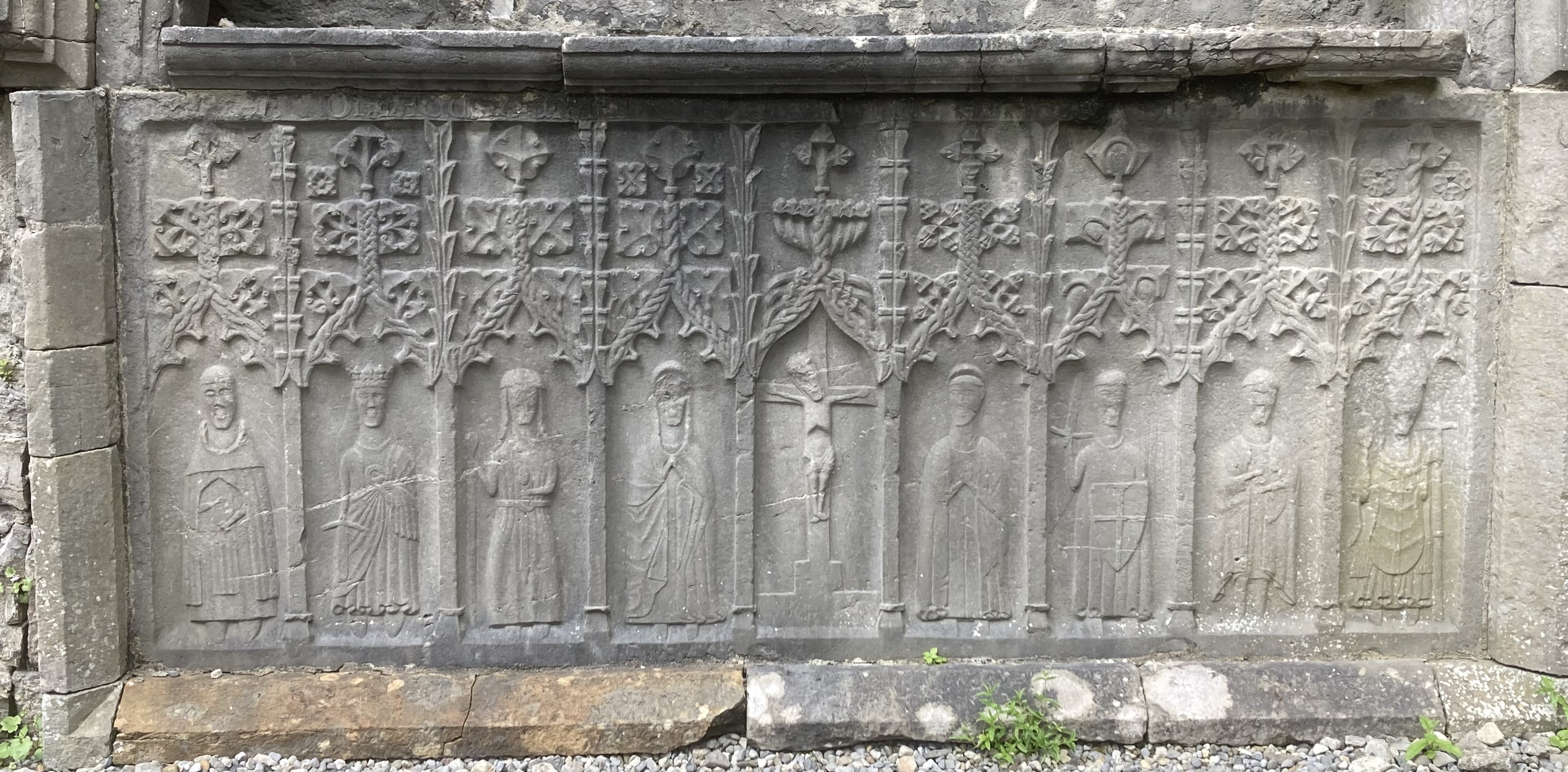
There’s a tomb for the O’Craians near the famous altar at Sligo Abbey. It’s ornately carved, and while there are several human figures knitted into the design, they’re almost indecipherable now. I could see that each figure was different, but six hundred years after these carvings were made, their meanings have become haltingly obscure.
Hoping to learn a little more detail, I went to see the folk behind the desk in the visitor centre. My tentative enquiries provoked a cascade of ever-deepening, thickening information. It was like a dam-burst, and I was nearly drowned by it. I record some of their detail here for the simple necessity of getting it down, but if I already had a sense that religious symbolism requires careful processing, I was staggered by the breadth of information required to read these patterns. You cannot simply puzzle this stuff out with patience or a pencil – you need a complete system of access codes based on folk and biblical sources. While much of this stuff would have been consumed without query or question by contemporary minds, it’s a blank wall to somebody like me.
I was shown how to interpret the eight figures depicted on the O’Craian tomb as follows:
Starting from the left, the first figure is St Dominic. He’s “easy” to identify because he’s wearing a Dominican cappuce (hood) so that he would be black on top and white underneath. If these carvings were originally painted, the distinction would have been even more obvious.
Second from the left is St Catherine, and we know that because she’s female figure holding a little wheel. Of course I’ve heard of a Catherine Wheel, but I hadn’t grasped the significance of the firework we used to nail up on fenceposts. Catherine was martyred by being broken on a wheel, and now she’s always represented in association with a wheel. In this case, it’s a particularly small and subtle wheel about the size of a doughnut – they’re usually much bigger.
After that, there’s “The Pilgrim”, identifiable because she is carrying a staff with a pear-shaped top. That’s an important tell-tale symbol, but beyond this, it’s also fair in this context to assume that this figure represents St Brigid. She’s a high profile female pilgrim who is famous enough in Ireland to go without much further explanation. I was happy to go along with this, but I did note the lack of certainty.
Then it’s Mary, who is probably one of the most straightforward to identify given that she’s a woman sitting on Jesus’ right hand.
Jesus himself is both obvious because he’s on a cross and interesting because he’s got an enormous head and tiny limbs. Stylistically, this is very much what I’d expect to see from Irish stone carvings. He fits the bill, and I liked him – but I was also told that the centralised Roman church thought these carvings were were a bit silly. At a time when they were striving for realism in their representations of Holy iconography, this was too much like symbolism for the progressive clergy. In official circles, carvings like these would have been described by the church as stylistically “Western”; not ideal, but given that it was hard to monitor and steer churches which lay so far Beyond the Pale in Ireland, this stuff was often grudgingly tolerated. That seems like a fun degree of snootiness, particularly since most of what I’m interested in nowadays is Beyond the Pale and out along the Celtic western margins.
The figure standing next to Jesus is ambiguous. This would usually be St John, but there’s no sign of a book which would normally represent both John and the gospels. He’s just standing with his hands crossed over his chest and his face almost completely rubbed away. It’s probably meant to be St John, but we reach that conclusion only because while there’s no evidence it’s him, there’s no evidence that it’s not. I’ve only just learned that by a different (but parallel) system of religious symbols, John is represented by an eagle. Complexity is deeply layered here, and you clearly need to watch what you’re doing when interpreting this stuff.
Next to St John is St Michael, who is one of the archangels and the chief opponent of Satan. That’s fair enough, because he has wings, a shield and a big sword.
Then there’s St Peter, who is clearly holding a key. That’s the key to the pearly gates.
And finally, there’s a bishop with his hand raised in blessing. It’s not entirely clear which bishop this is meant to be, but it’s fair to guess it’s St Patrick.
There’s a whole language to unpack here, and it’s all new to me. I was never taught any of this at church or at school, and I’m having to learn it all on the hoof. You could argue that there’s no real reason for me to know this stuff, but it draws me in because these carvings were designed to evoke very specific associations for a generally illiterate audience. Somebody living in 1506 would have understood all the information related above in an instant, reading the shapes and details as if they were words on a page. That makes them extraordinarily powerful in their own context, but the longer-term ripples of old symbolic knowledge bleeds into more recent times. Everything we make is rooted in a thread of continuity, even if we’re only preoccupied with a deliberate rejection of what went before. If this information is not relevant today, it’s vital to remember a time when it was.
And realising that we’ve replaced this knowledge with something else, it’s fascinating to measure that loss against what we now have instead. The ancient psychological levers of symbolism remain extremely powerful – a truth evinced by the fact that many have been purloined by modern corporate marketing divisions. If I’m baffled by how sixteenth century church-goers could recognise a saint by their hat or the shape of a stick, I have to concede that I’ve been trained to recognise beef burgers from a glance of a yellow M on a red background.
Picture: Tomb of the O’Craians, Sligo Abbey – 6/8/22

 Bog Myrtle & Peat
Leave a comment