There’s often tension when conservation meets communication. The world wants good news stories, particularly in the face of species decline and climate change. Even in my own small circles of work, I note an active hunger for upbeat stuff, despite the fact that ecology is famously complex and conditional. It’s difficult to share good news without including caveats or cautions, and it’s very unusual to find a story that’s exactly as good as it looks.
I often think of a press report released by the RSPB in Dumfries and Galloway in 2012 which celebrated a boom in black grouse numbers. It sounded great, but it wasn’t. The birds did well, but in following seasons, they resumed their decline and have now passed so far beneath that “boom” that they’re almost extinct. That headline lives on like a perverse joke because you just can’t take one decent year and turn it into a trend. But I also must concede that “Rare birds thrive” is a better headline than “Rare birds do a little better than normal on otherwise downward trajectory”.
You could say I’m being jaded here; that we should celebrate successes even when they’re part of a wider loss. But there are real problems when we attempt to soften the enormity of what’s happening in conservation with a sugary papering of good news. There’s a risk that the general public will underestimate the scale of the problem, and there’s also a danger of lasting harm when half-truths are weaponised to fuel arguments which drive us all apart.
Further east, there has been a great deal of publicity about hen harriers fledging from Langholm Moor over the last couple of days. We’re told that hen harriers are “thriving” on the land since it was transferred to a local community group in March 2021. Some commentators and activists are now using this information to suggest that harrier numbers are exploding because of the current managers – and particularly because Langholm is no longer a driven grouse moor.
In reality, the land now called Tarras Nature Reserve hasn’t been a driven grouse moor for more than twenty years. It’s not an easily summarised situation, and besides, the new managers have not been in control for anything like sufficient time to claim the credit for this “success”. The difficulty is that the purchase of Langholm was funded by a wide range of contributors which included everyone from individuals to corporate sponsors. To varying extents, these people were all promised that the new management of Tarras would be great for wildlife – it’s no surprise that the project now wants to prove everybody right. For what it’s worth, I have every faith that Tarras will be a success – but even the most optimistic observer must agree that it’s surely too soon to crack open the champagne.
Langholm’s an old bone to gnaw, and I’ve done a fair amount of gnawing myself under various guises over the last decade. I worked on projects there for three years and helped with some of the research studies during the moor’s incarnation as a demonstration moor. I know that in the last decade, hen harriers have had far more productive years at Langholm, long before the current owners took it on. And while “thirteen” certainly sounds like a big number, the information is also strangely scant without context . If thirteen eggs were laid and thirteen youngsters fledged, that’s fantastic. If one hundred and thirty eggs were laid and thirteen youngsters fledged, that’s less good. Perhaps there’s more detail available elsewhere for the specialist reader, but it’s fair to say that people who aren’t directly engaged with this material will read the piece, celebrate and then turn the page without asking for that context. Besides; a good news story like this? Who wants to ask questions…
I don’t mean to imply any sense of pessimism or bitterness here. It’s great news and I wish the new owners every success, but as the message spreads through various audiences, communications becomes Chinese whispers. There’s more than enough controversy to go round here, and certain audiences are keen to feed these headlines into arguments between wealthy aristocrats and plucky community landowners; between grouse shooting and raptor conservation. But the reality is that we won’t be able to get any idea of how successful this project is for at least a decade and possibly much longer. We also can’t ignore that in its former incarnation as a demonstration project, this piece of land proved only one thing; that when it comes to conservation it’s hard to prove anything.
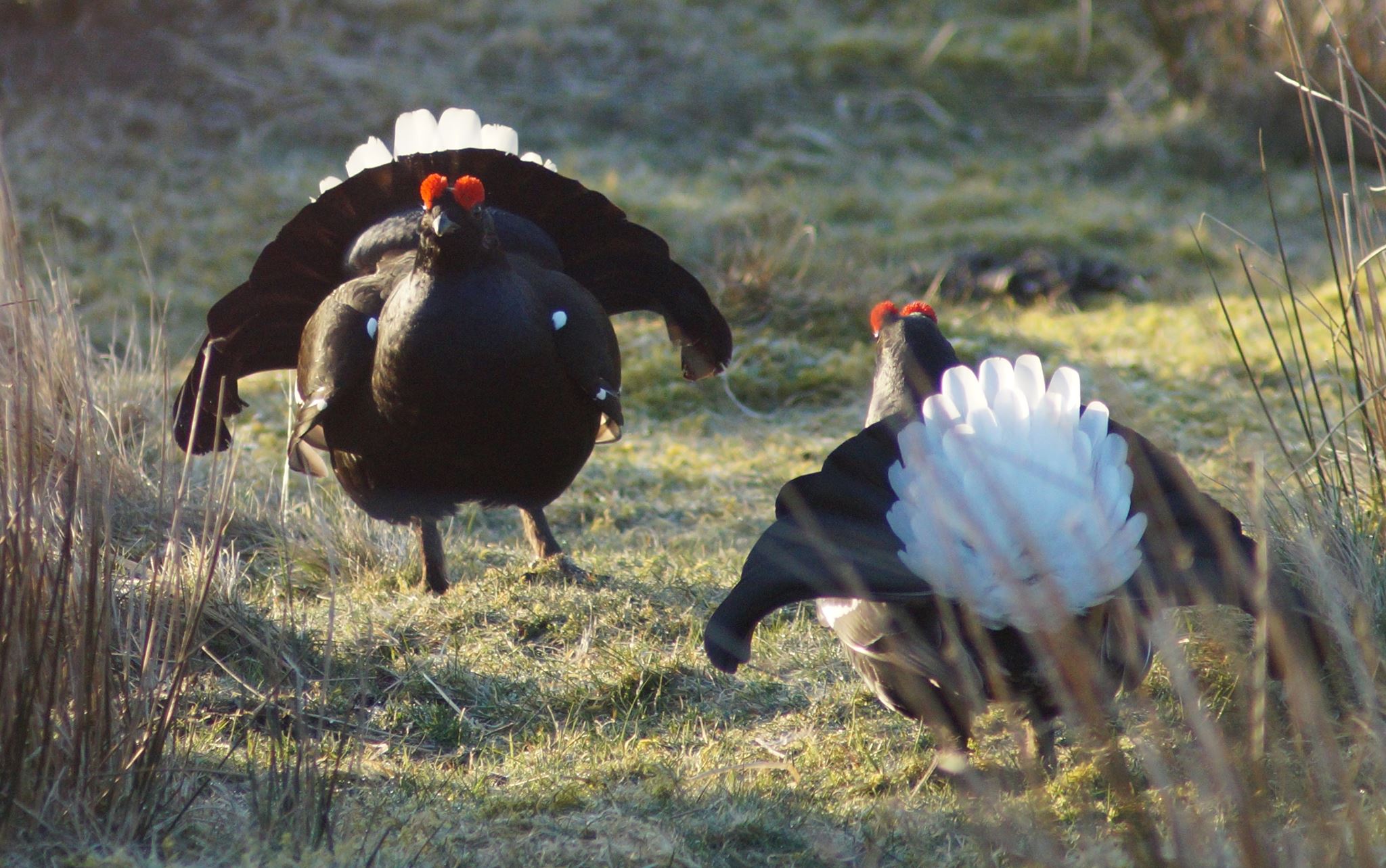
Picture: Blackcock at Langholm Moor, 23/4/14

 Bog Myrtle & Peat
Leave a comment