Carlisle cathedral is 900 years old. To celebrate that anniversary, a number of events have been held in and around the old building during the course of this summer. I’ve been to visit several times, and I start to realise how complex and fascinating this place really is. There’s always something new to make me laugh or blow the socks right off my feet, and just as I begin to focus my attention, something different strikes me amidships and sends me off on a new tangent, from bell-ringing to stone-carving, organs, and incense.
In recent months, I’ve been on a crash course learning about misericords, those tilting seats which became popular during extremely long services held in the Middle Ages. Misericords (the word’s pronounced m’SERRIcords) allow the worshipper to lean without sitting, and they were originally designed as a special relief for older priests and clergymen who might otherwise have to stand for hours during extended prayer cycles. This simple concession to the weak and elderly soon developed into an entire art form as carpenters began to decorate misericords with ever-more elaborate wood carvings. Some of these were religious or allegorical, but many are simple representations of day-to-day life. The best represent magic and folklore in all its baffling glory, and an astonishing number of these half-hidden carvings has survived to the modern day.
Probably created by two woodcarvers around 1415, the set of misericords at Carlisle is endlessly exciting. There are mythical beasts and wyverns in all their glory; a lion fights a dragon to the death, while a woman beats a man with a club. Beside these scenes, there are depictions of real birds and animals taken from medieval bestiaries; books which ascribed religious characteristics to the natural world – so we see the “pious” pelican and “cunning” renard the fox. One of the best misericords at Carlisle is the fox killing a goose, specifically because the goose is so visibly dismayed by the experience. The design appears twice, and each one makes me hoot.
But it’s interesting that these particular foxes have three toes on each foot – that’s how they were drawn in bestiaries, but it seems highly unlikely that the medieval wood carvers had never seen a fox’s foot for real. They’d surely have known that a pad has four toes, so why did they slavishly copy an error from a book? We can only assume that those woodcarvers made a subtle distinction between the literal flesh-and-blood animal and its metaphorical cypher. They’re not meant to be real foxes, only representations of one, just as modern readers have learned to interpret completely unrealistic clues and indicators from comic books and cartoons without giving them a second’s thought. Trying to get inside the medieval mind is endless puzzle, but the number of knowing disparities between real and constructed expressions of nature in art are teasingly fascinating.
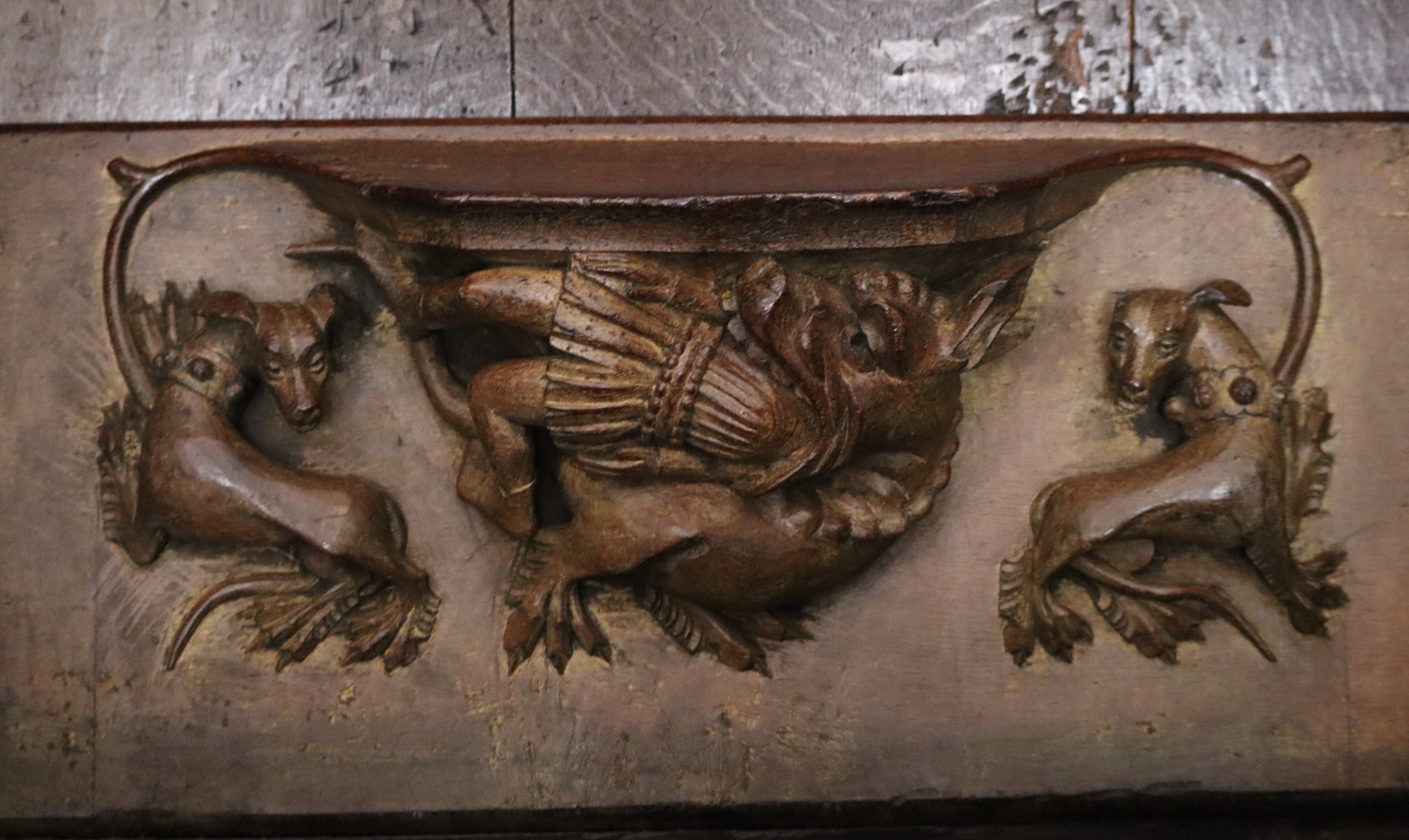
Following my most recent trip to Carlisle, I have a new favourite misericord – it portrays a monster eating a man head-first. I assumed that this ravenous predator was a dragon, but I was later told it’s really a Fillgut (or bigorne). According to expert interpretation, the Fillgut would only eat men who were good husbands. His counterpart is the Pinch Belly (or chichefache), who only eats good wives. Pity the Pinch Belly, for he is permanently starving to death – the obvious moral is that while good husbands are abundant, good wives are in horribly short supply.
The carving itself is superb, and the two “supporters” on either side are exquisitely rendered greyhounds looking back at the viewer with an expression of mute disinterest. If that’s their master being swallowed whole by the Fillgut, they don’t seem unduly perturbed by the spectacle. I loved this interpretation, but to stoke controversy, a different source has since informed me that it’s actually not Fillgut at all; merely a dragon or a wyvern. Realising that modern misericord enthusiasts can’t even agree on the most basic facts confirms a sense that while a vast store of material culture has survived from the Medieval period, much of it is madly indecipherable. If you like certain answers, this is not the subject for you – but if, like me, you’re obsessed with the word “maybe”, a whole new world awaits in the choir stalls.
Beyond the direct interpretation of individual misericords, it’s also interesting to wonder how the art form developed so far into secularity. Modern scholars guess that woodcarvers were simply jockeying to show off their skills, and there’s some truth in Johan Huizinga’s assessment that the medieval mind abhorred a plain or undecorated surface. But that doesn’t explain why these decorations are so elaborate and often so vulgar or quotidian. One badly damaged misericord I found at the Church of St Nicholas at Montgomery in Powys depicts a man holding his legs behind his head to deliver an almighty fart. Behind him, several of his friends and their dogs recoil in horror, covering their noses. This carving would have taken a great deal of time and effort to produce; too long for it to represent nothing more than simple whimsy or showboating. Woodwork like this was expensive to commission, and long-lasting too. It’s extremely unlikely that woodcarvers were given free reign to produce whatever they wanted, and probable that designs for misericords were actively selected or approved by the clients. That’s where this gets so interesting, because I’ve been trained to think of Christianity in joyless, po-faced terms – it’s strange to discover a form of religion which had space for comedy, profanity and magic.
Every single one of those misericords at Carlisle deserve to be in a museum, along with a terrific list of other curiosities and puzzles from the cathedral. It’s one of Britain’s most extraordinary wonders that artefacts like these not only remain in their original context, but they’re still being used for their original purpose seven centuries after they were created. You can go and sit on them. You can stare directly into the face of something that was made twenty generations ago, experiencing a dim fizz of connection with people who looked like us and lived where we live – but who occupied an entirely different world.
Picture: Misericord at Carlisle cathedral – but what is it? NB all the animals have three toes… (taken 15/6/22)

 Bog Myrtle & Peat
Leave a comment