I saw the famous wolfhound at the Ulster Museum. Stuffed in 1923, he stands panting in a Perspex box. Above and behind him, the petrified bones of a triceratops loom beside a narwhal’s tusk and a “Chambers” automobile with spoked wheels. These exhibits are novelties, and part of their fun is just how noisily they clash together like cymbals. I like to see them when I’m in Belfast, but as my interest focusses on specific aspects of modern and ancient Irish culture, I’ve been feeling less satisfied by the Museum. It’s more than just a laugh, but neither is it any clear statement of Ulster itself.
The Troubles are a central theme in the Museum. Some of the exhibits are lifted directly out of the 1960s and 70s – caricatures of long defunct politicians and billboard posters with extensive interpretation to put them in context. It feels jarringly quotidian; so pickily political that some of these arguments look like pedantic points of order. There’s nothing to suggest that many of these claims and counterclaims became the basis for murder and bloodshed, and it takes a bit of mental legwork to grasp the enormity of those events, particularly when they are represented by riot police costumes on mannequins and clumsily painted sandwich boards. But in some ways, that’s the essence of a conflict I can’t understand – a snarling, almost oxymoronic expression of the domestic militant – (domestic with a lower case or family “d”).
From The Troubles exhibition, a series of very clear and coherent displays allows time to roll backwards through the Twentieth, Nineteenth and Eighteenth Centuries. There are some useful stories in here, but the specific thread of Ulster becomes steadily less obvious as Partition diminishes in the rear-view mirror. There comes a point at which it’s unclear how Ulster should be considered as a wholly separate entity. That’s nothing like a criticism of the Ulster story, but the Museum is strangely imprecise on this point. Reading essays from The Course of Irish History, it’s clear that Ulster has always held itself slightly “aloof” from the rest of Ireland, but Medieval history seems to show the North as simply another ingredient boiling alongside numerous others. It becomes steadily more difficult to understand Ulster in isolation.
There are some strong pieces on display in a section devoted to the Middle Ages; cabinets of swords and beautiful ceramic tiles from long defunct abbeys. I particularly loved a lurid Sheelagh na Gig which had been prudishly tucked away high up on a wall without any signage to explain it. But as you walk between the objects, a system of posters and interpretation panels seems to place a distracting emphasis on items which are not on display. You begin to realise that most of what you’re seeing is merely a system of placeholders to evoke something more special elsewhere. As you move backwards in time, this effect becomes ever more acute.
It’s partly explained by the fact that some relevant artefacts are religious, and most of these are still in use. They aren’t available to be warehoused in a museum for the secular edification of rubbernecks like me, but they can’t be ignored either. So it seems like a fair compromise to signpost these things, indicate where they can be seen and move on. It’s surely a balancing act for museums across the world to gather treasures under one roof and also to leave them in their original context, where it’s likely they’ll make more sense and provide a richer experience. But there’s more than a failed balance here.
Many of the best and brightest exhibits are missing from the Ulster Museum because they’re on display in Dublin at the National Museum of Ireland. I struck a particular moment of disappointment when I caught a glimpse of something wonderfully familiar across the room. I actually said aloud – “Oh my god, it’s the Cross of Cong… I thought that was in Dublin!” But when I had made a beeline to the display for a closer look, I felt downright silly. Of course the Cross of Cong is in Dublin. What you’ll see at the Ulster Museum is only a Twentieth Century replica. It’s lovely, but it’s not real. Elsewhere, it doesn’t help that some of the other “replicas” are obviously artificial. Stone carvings copied from St Patrick’s Cathedral (Church of Ireland) in Armagh look downright daft, like ornaments from an abandoned merry-go-round. The combined effect is somehow cheapening, as if the Ulster Museum is just an anteroom for something better.
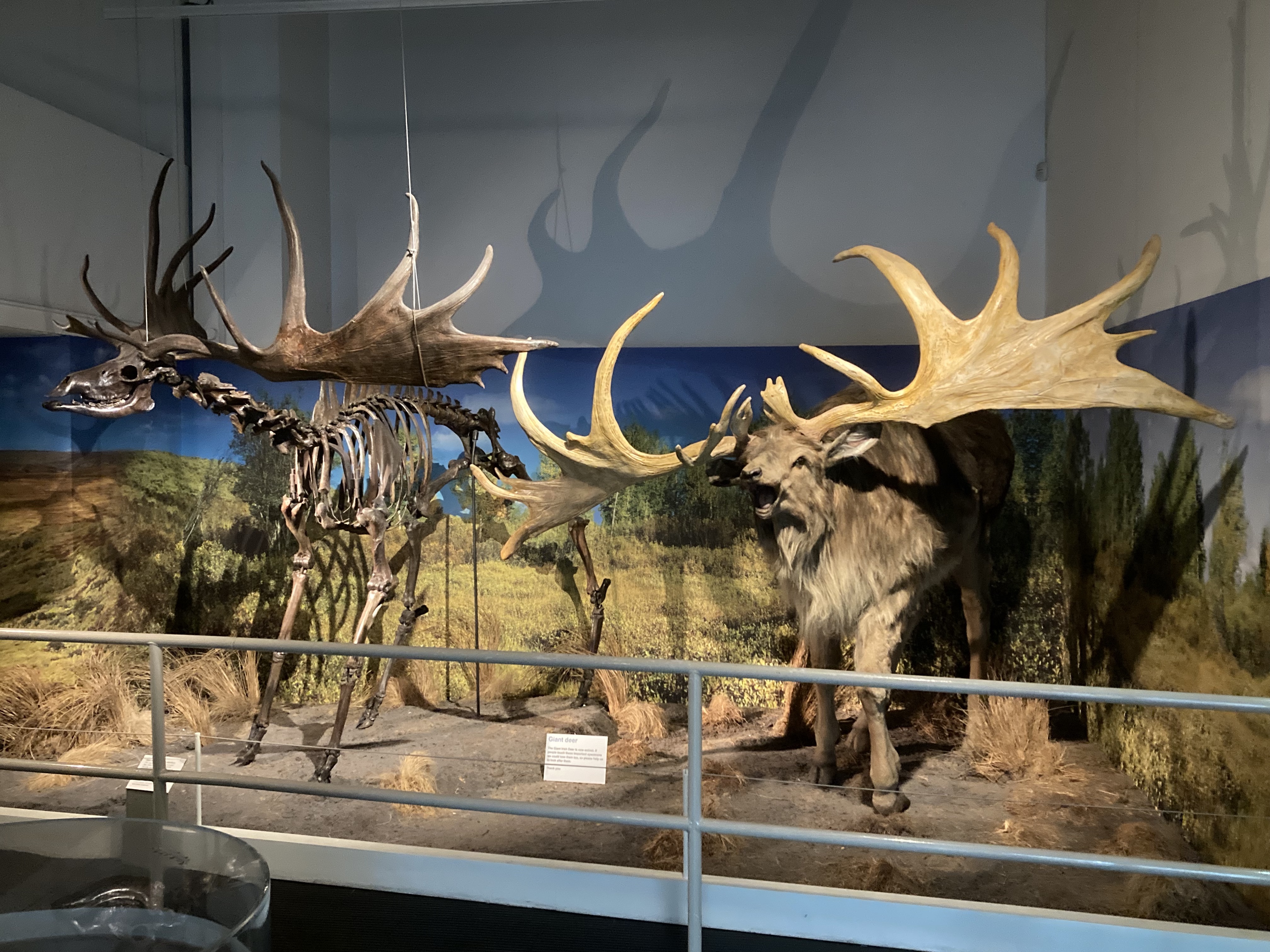
Following the timeline back beyond the Medieval room, we enter the Bronze Age, the Stone Age and the Ice Age, which permits a segue into natural history. I am obsessed with megaloceros, the Giant Irish Elk, and there’s an outlandishly thrilling skeleton on display next to a strangely bearish imitation. I loved him right down the black bones, but the wider narrative was beginning to fall apart. Doorways opened to exhibitions on Ancient Egypt and a crazily entertaining tapestry depicting the story of Game of Thrones. It was all just fun again; discordant scrap-booking. I enjoyed it for what it was.
I had misread the Ulster Museum as the Museum of Ulster, so it’s no wonder I felt frustrated. Perhaps that’s because the word Ulster has been applied to a wealth of different (and often contradictory) things during the course of its history. Modern “Ulster” is a new concept, carrying a uniquely modern weight of associations. In an older sense of the word, where Ulster jostled against other Irish kingdoms in a state of confusing interdependence, perhaps it makes sense that artefacts relating to that time belong in a museum dedicated to the entire island in Dublin.
What’s left in Belfast is a lot of fun, but as I mooched through the fourth floor galleries looking at a wild diversity of artwork from across the world, I felt steadily more confident that this building is not trying to establish or reinforce a creation story for modern Northern Ireland (as much as that political region both overlaps and fails to overlap with historic Ulster). The “Ulster” of The Troubles is essential, but the museum is broader too. So I begin to understand this place as just “a Museum for Ulster”, and any sense of incompletion is only what you’d expect from the single piece of a larger puzzle.
Picture: The megaloceros exhibition at the Ulster Museum 4/8/22


 Bog Myrtle & Peat
Leave a comment