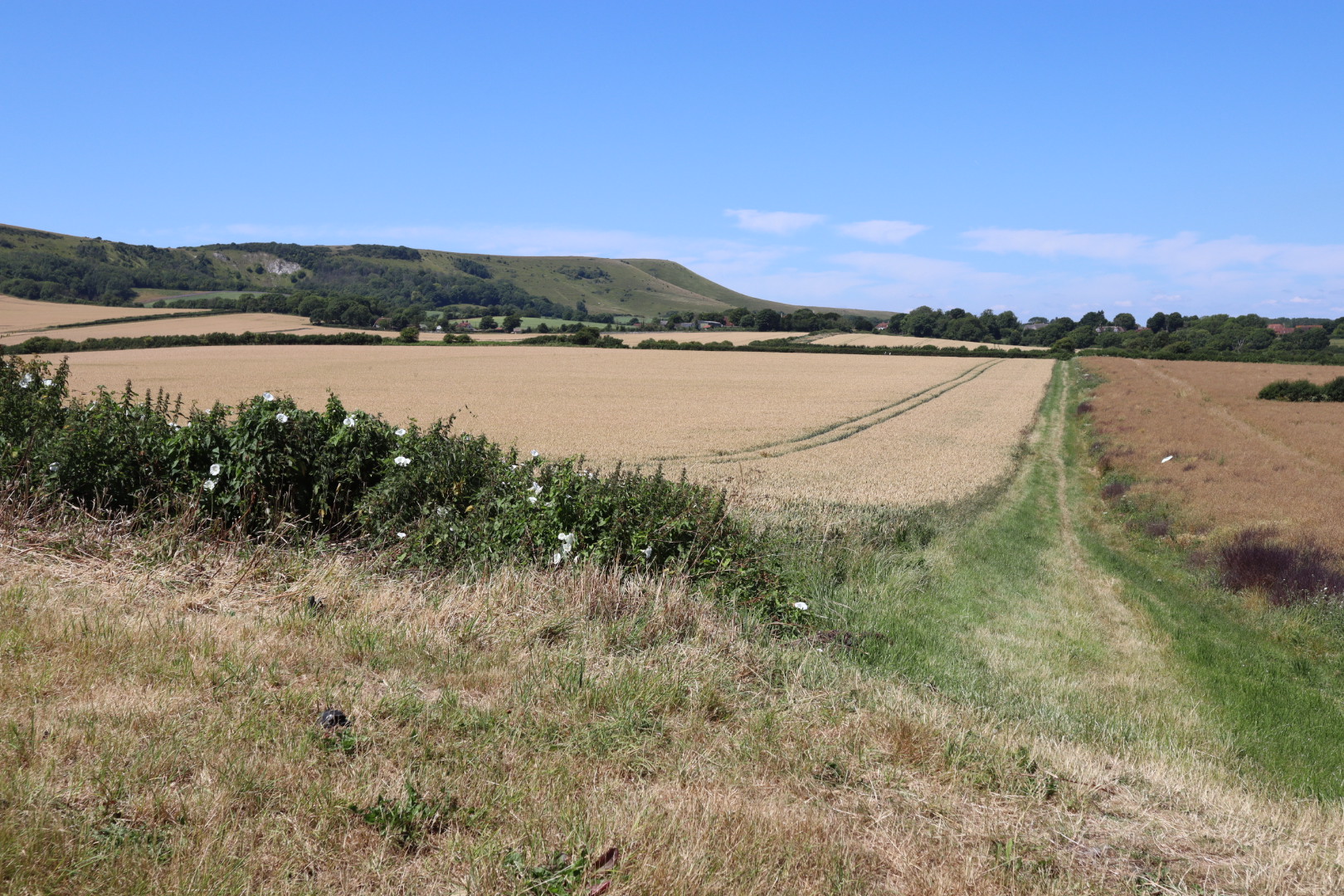
I walked on the South Downs to Firle Beacon in the sun. Beset by butterflies and forever distracted by wildflowers, I made slow progress. Almost at the top and with a view of the Channel, a riot of corn buntings rang in the dried-out crops, while english partridges chittered nearby. The sun roared in that strange, exotic land, and yet in certain lights I could recognise many of these wrong-ordered things. Then later when I passed a group of people walking home, they said “hallow” to me in a voice that was flat-sounding. I had to remember that’s how I speak myself.
In the pitch of this new fixation with Dark Age Britain, it was timely to explore Sussex, home of the South Saxons. I tell myself that I’m a tourist here in my own country, and that Saxons have nothing to do with me. I love their story, their changeable Faith and the persistent fragments of an old aesthetic, but I tell myself that I’m a Gael and look to the Sassenach story with inherited suspicion. In his excellent talk at the Montgomery Literary Festival in June, the academic M Wynn Thomas described a sense of nationality as a daily choice to renew a story. Society experiences a natural tendency towards coherence, and distinct groups of people must continually choose to draw lines around themselves, riding the marches by telling stories of themselves as something distinct. There was more to his point than this, but the nudge revealed how paper-thin our sense of self can be.
I tell myself that I’m not a Saxon because I live in modern Scotland. But if you’re into ancient lineages, my part of Scotland is strongly Irish with some heavy Norse influences. My own blonde-haired, blue-eyed presentation is decidedly Scandinavian, but I’m not entirely sure it’s relevant to steer your sense of self by ancient primary colours. We’re all a mix of this and that, and migrations or invasions are surprisingly short-lived things. Genetic and cultural assimilation has played a part in making us who we are, but as I learn more about the Reformation in Scotland, I also realise that similarly formative events take place within nations.
The varied and diverse genetic profile of Scotland hardly moved an inch during the sixteenth century, but the psychological shift which accompanied the arrival of Protestantism was monumental. The Reformation represents a deliberate and systematic reshaping of culture and belief in terms we’d nowadays recognise from the Taliban or Iran. It wouldn’t have mattered if your roots were in Norway or Morocco, if you lived through that monumental religious earthquake, you started again with a new identity. The Reformation represents a complete reset button, and it many ways it’s only slightly useful to look past it.
Only slightly, because we always love stories and it’s hard to resist the urge to peer into the Dark Age fog. Provided we accept that it’s all so desperately tenuous, there’s still some value in dabbling our toes in this kind of dreaming. So while I walked on the Downs, smiling at the chalk-hill blue butterflies, I told myself that I was a fish out of water in a Saxon world. But I also know that parts of Galloway were under Saxon control for a time. The Kingdom of Northumbria extended far into my sense of place, and the famous eighth century “Galloway Hoard” contains a wealth of Saxon artefacts to disprove a sense of modern borders.
These northern Saxons had little in common with the former rulers of Sussex, but even this fact reveals how baggy the word Saxon can be. In truth, it’s really just a broad-brush name given to an extraordinary hotch-potch of different people who came from what is now Northern Germany. They fought themselves as much as they fought anyone else, and any sense of coherence we see in their story is purely retrospective. I’m certainly no Saxon in the sense that later became a synonym for Englishness, but the Saxons themselves would not have recognised the creation myth that English people tell of them.
Learning about Oswald, the Saxon King of Northumbria, I find that his formative years were spent in exile around Iona on the West Coast of Scotland. His Christianity was developed and nurtured by the followers of Colmcille, who I know as St Columba. Celtic Christianity was quite different from the Roman Catholicism dispensed to the south by Augustinian missionaries, and Oswald was heavily influenced by Irish theologies. When he came back from exile in 634 AD to fight for his throne against the Welsh king Cadwallon ap Cadfan, I cheer him on for that Ionan connection, even though Cadwallon had a far greater entitlement to indigenous rule. Cadwallon was killed at the Battle of Heavenfield, and while Saxon histories celebrate the death of that malignant tyrant, the Welshman Ferdig offers a bitter lament for Cadwallon’s death at the hands of “strangers and iniquitous monks”. Even 1,500 years ago, there was more than one side to that story.
In the aftermath of his installation as King of Northumbria, Oswald brought monks from Iona and established them on the now iconic island of Lindisfarne, ensuring that Northumbria became a firm redoubt of the Celtic Faith. So to paraphrase Oswald’s story, we have an ethnic German and his Scottish army invading England to overthrow a Welsh King, in order to replace British Paganism with Irish Christianity. It seems like every twist and turn of that old story seems to muddy the waters of modern nationalities, making it hard to interpret any logic in the border we see on the electoral map today.
I realise that I have often fallen into a comfortable trap described in part by M Wynn Thomas; telling myself lazy stories about who I am, and perhaps more restrictively, who I am not. My interest in the Saxons also originates at least in part from the fact that Galloway lacked any clear sense of itself during the Dark Ages. We had nothing to set ourselves apart, and our treasures were gleaned from other cultures – from Ireland, Strathclyde, Dál Riata and Mann. Saxons were part of the mix that we made for ourselves, and until recently I have been glad to look in at them as a vicarious observer. But it turns out that my connections are deeper than this, and “my” North Saxon links connect me in turn to Sussex and the South Downs with only a single step removed. So it’s reassuring to remember that while old stories and more recent pragmatisms seem to offer a polarised understanding of belonging, each path leads back to the same sense of endless, unavoidable overlap and commonality.
The photo is Firle Beacon, taken near Berwick, East Sussex – 9.7.22

 Bog Myrtle & Peat
Leave a comment