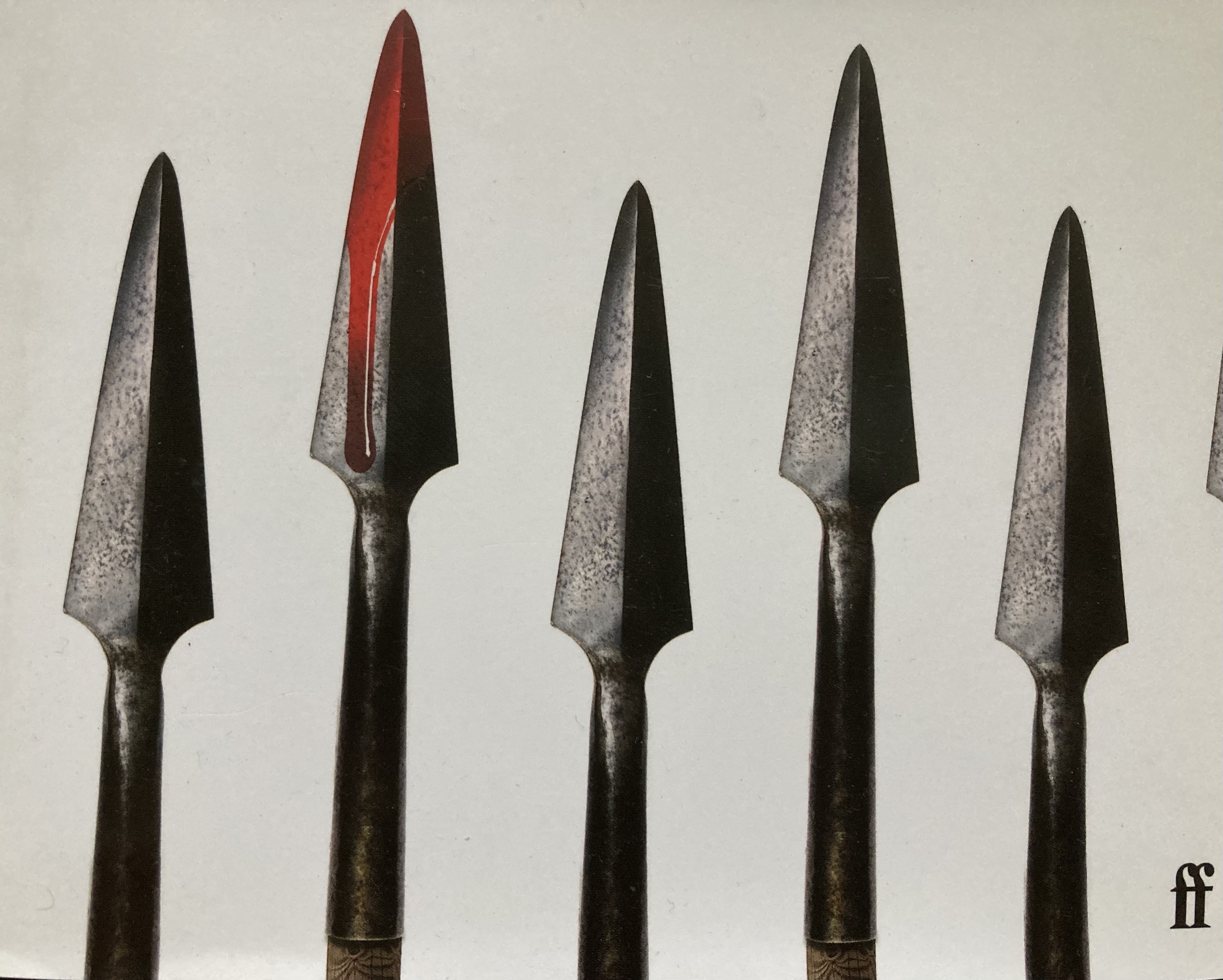
I wrote a silly article for this blog, and it seems only fair that I should amend it. Pondering the connection between ash trees and weaponry, I made out that my own experience of working with ash led me to believe that it’s a fragile, shattery wood. I reckoned it was no good for making spears, and so I was baffled by the fact that ancient folklore repeatedly averred that spears should be made of ash.
In retrospect, I should have thought harder about what a spear does. It’s meant to be pressed pointy-end on, absorbing the impact down the length of itself. The axe handle I made for myself out of ash moved in a completely different way. This force was all across the grain, rather than inside it. But a spear is not a swinging implement; it’s designed to be thrust directly into your enemy. Ash would be downright deadly in this respect.
As a tiny note of pedantry, a more-than-usually intense focus on spears and ash wood compelled me to take a close look at the front cover of Gillian Clarke’s excellent translation of Y Gododdin (shown above). It’s a pattern of spear tips, one of which is dramatically splashed with an improbably garish dribble of blood. It’s great, but a closer look reveals that these battle-hardened spearheads are all mounted on a cloned image of the same piece of wood – a rather cracked pole with an obvious knot in it. I daresay it was a graphic designer’s trick to make the wood look more like wood by showing a bisected knot here and there, but even I can say with confidence that it’s a wholly unrealistic addition. A knot like that should be revealed in this way can only be explained by a terrific amount of shaping and processing from raw timber – to a level that would have been far beyond the time or patience of a 6th Century warrior. And even if it could have been done, flaws like this knot would produce shafts so fragile they’d probably break if you dropped them, let alone attempted to drive them into a passing Brython. I’m preempting a clamorous reply of “who the hell cares?” to all of this, but I suppose it’s a marker of what seems to become important when you follow a thread for long enough.
So I was being short-sighted when I wrote that article. Ash is actually a fine wood to use in making spears. It’s not only strong in the length of itself, it’s also relatively lightweight. And when you manage it carefully, coppiced stumps can quickly grow a multitude of tall, straight poles for almost instant use. Case closed, and I can go back to my unashamed fascination with Saxon culture with that specific itch well and truly scratched. Even this morning, I giddily learned about a Saxon class called ceorls, who were expected to carry ash spears during times of war. Ceorl became the seed for the word churl, although it didn’t carry the same negative connotations then. These people often feel extremely distant, and yet it’s extraordinary how much their influence tells in modern language and culture.
Saxons are occupying a fair measure of my attention just now because they bridged that fascinating gap between ancient Paganism and the arrival of Christianity. That transition is bottomlessly interesting, particularly in the way that early Christians appropriated and transposed aspects of Paganism over many centuries. We’re often told that the transition between old and new was clean and that Christianity “won”, but the reality is a deeply wracked by controversy and compromise. Saxon rulers chopped and changed their beliefs over the course of many generations, some seeming to dance back and forth, selecting the best bits of both worlds. And while some kings devoted themselves wholeheartedly to Christ, a lack of clear continuity and inheritance between generations of rulers meant that one king’s faith could be utterly abandoned according to the specific temperament or needs of his successor.
Reading about King Edwin of Northumbria and his very complex manoeuvrings around the missionary Paulinus, it’s clear that Edwin played the game to suit himself. And it’s ironic that after such a protracted game of cat and mouse, when he finally made the decision to plump for a Christian God, he was almost immediately killed at the battle of Hatfield Chase (AD 633). All this ebbing and flowing runs contrary to a sense that Britain moved into Christianity with a lightbulb’s flare of self-aware delight. I suppose that when you make a change about some core or guiding principle of your life, there’s a risk that you’ll have to concede that you had been wrong until that point. It’s easier to say the old ways were wrong and the new ways are right, full stop, and hope that the conversation moves on – even if the truth is much less clear cut or binary. It’s no wonder that more recent Christian histories have erased any sense of vacillation or horse-trading during the transition.
While all this controversy was transacted at higher levels of society, it’s also fair to imagine that most common people hardly noticed the coming of Christianity and simply persisted in whatever faith they already had. When it came to other religions, early Christianity was extremely accommodating. In his book The English Festivals, Laurence Whistler explains that for a long time after the establishment of Christianity, common folk were largely left to do as they chose. Whistler even cites a specific Papal decree which advised Roman missionaries to preserve places of Pagan worship so that in time they could be repurposed gently, almost by the back door. Margaret Murray’s book The God of the Witches goes too far along this line by arguing that a laissez faire attitude in the early Church allowed a complete Pagan religion to survive into modernity. She is certainly wrong, but in a world of sliding scales, it’s fun to wonder how wrong. All this is relevant here because it speaks to that that overlap between faiths, and the bottoming-out of an abstract Christianity in a native, natural code of reference.
Missing the point about Saxon spears is certainly not the only mistake I’ve made on this blog over the last twelve years. This corrective is unusual because it relates to a specific point of order, but Bog Myrtle and Peat is cursed with a bigger muddle too. There are times when I have self-consciously attempted to make a narrative from a wide range of disparate material posted here. I worry that what I am writing feels like a crazy mess; that it doesn’t make sense to anyone else but me. But there are also times when I declare that I’m only writing to please myself, and on that basis, nothing needs to make sense.
I’ve agonised over this, and I’m inclined to think that both are true. I follow my nose, and some of the stuff that’s published here will seen bizarrely out-of-left-field. But I’ve also found it useful to pin this specific anxiety down because I’m starting to see how it all radiates from the same point of interest. I no longer write a neat and cohesive diary of my conservation work here in Galloway because that project has blown out into a far broader interest in people and culture.
Following a recent visit to the British Museum (where I saw the motherlode of Saxon culture in the relics of Sutton Hoo), I reviewed my camera and realised that almost all of my photographs were of animals and nature; human representations of a natural world, manipulated and stylised from Shetland to Xanthos. So there’s the connective tissue which allows me to bury myself in Saxon religion while running a farm and managing conservation projects. I realise that I’m fixated on an entirely anthropocentric sense of nature; how we look out from ourselves to the world around us, from disputes about hen harrier persecution to the analysis of Pictish rock carvings and almost everything in between.
Teaching myself and reading out from an established centre, I find I’m on the same lines as that American scholastic theory which believes it’s possible to present a complete education off the back of a single idea. The example I heard was “apple”, and how with an apple at the centre of your mind, you can access maths and physics through sir Isaac Newton, history and geography through trade links and migration patterns which brought the apple to Britain. Even a small concept can carry you far away into new terrain, so while it doesn’t make immediate sense that curlews and cattle should have brought me to the early Christian church, there’s a step-by-step record on my bookcase.
I’m not blind to the contortions here; I’m fretfully explaining the rationale behind a pattern that’s invisible to readers who I pretend don’t exist. But I set this down because that trip to the British Museum showed me how all of the dissonant context and tonality of Bog Myrtle and Peat actually does hang together. Having realised that, I can push towards it.

 Bog Myrtle & Peat
Leave a comment