Margaret Murray’s 1931 book The God of the Witches was panned by the critics. She wasn’t the first to walk on such shaky ground, but she took more than her fair share of the blame for it. I knew what to expect when I found myself a copy, and I can only agree that it hangs on a pattern that would stretch a child’s imagination.
In the book, Murray argues that western witchcraft was the visible tip of a coherent and clandestine pagan religion which originated in Paleolithic spirituality. This is the “witch-cult hypothesis” which started with Frazer’s Golden Bough and went on to grip Graves and tickle Ted Hughes, but it lacks even simple threads of evidence to back it up. You just can’t construe the existence of an ancient religion from a few church records and the testimonies of terrified women who were tried for witchcraft in the seventeenth century.
If we can learn anything from the history of witchcraft, it’s about a convergence of fears and anxieties which reside in the fundamental nature of human society. The phenomenon of witchcraft appears because it’s in us, not because a coherent, continuous religious movement ran beneath the surface of Europe for ten thousand years. But the theory is one of those wrong ideas that’s too important to forget. Like much of Jungian psychology, the “witch-cult hypothesis” has survived better outside the academic disciple which created it. Modern anthropologists and folklorists sneer at Margaret Murray, but her thinking still has mileage in literature and art.
And it’s fair to say there are some nice connections in Murray’s book. It’s surprising how frequently the image of a horned God appears in European culture, from the Greek Pan to Shakespeare’s Robin Goodfellow. There’s plenty of fun in this book, not least in the useful reminder that Christianity did not arrive in Britain like the switching on of a light. It came and stayed for a while before we rejected it again, and later readopted it. Even when it was formally established, it’s likely that Christianity was the religion of the aristocracy, but the new Faith was negotiable for everyone else. I love this blurring of boundaries, which seems to fly against that prevailing notion that all was darkness before the Light. It was well worth a recent trip to Cumbria to see Norse-Christian stone carvings in the churchyard at Gosforth. Loki was at his confusing and mercurial best on a high cross dressed in elaborate and distinctively pagan motifs.
But The God of the Witches is more than just fun. There’s a slightly ill-fitting chapter on faeries which has set my imagination on edge, and now I’m almost giddy with it. When I was a teenager, I read an article about the story of Cain and Abel, and how the symbolic murder of the pastoralist signalled the arrival of modern agriculture. The author wondered if this reflected a kind of symbolic anxiety or guilt at some ancient human conflict between old and new. Perhaps this is a stretch, but I like the idea that grand archetypes originally sprang from a germ of something true.
In much the same way, Murray traces the origin of faeries to a pattern of old, vestigial memories of ancient peoples in Britain. She argues that when Neolithic farmers arrived bearing the seeds of modern agriculture, they would have come into contact with Paleolithic communities who had been here for thousands of years. These original natives lived in simple societies based around cattle herding, but they were not unsophisticated. They would have excelled at certain skills, and it would have seemed to the newly arrived farming people like they were uniquely well adapted to their environment… almost magically so. There would have been a time when farmers and pastoralists would have lived side by side, with enough contact between the two groups for each to develop stories about the other. Of course the farmers outlasted the pastoralists, and history is always told by the victor. In this light, it’s clearly plausible that in recalling the memory of faeries, we’re listening to the most distant echo of a truth.
Although Murray doesn’t make this connection, the clearest representation of this idea comes from the Irish Mythological Cycle, which charts the rise and fall of the Tuatha De Danaan, who are said to have been some of the earliest inhabitants of Ireland. Following their defeat by the more cosmopolitan Milesians, these god-like people were mythologised as faeries, complete with their sacred sites, their cattle herds and their brilliant craftsmanship. Further afield, the original South African Saan people (bushmen) were similarly revered as magical after their traditional homelands taken over by Bantu people who expanded south more than a thousand years ago. Maybe the invention of faeries is just one way through which people experience the overlapping of cultures.
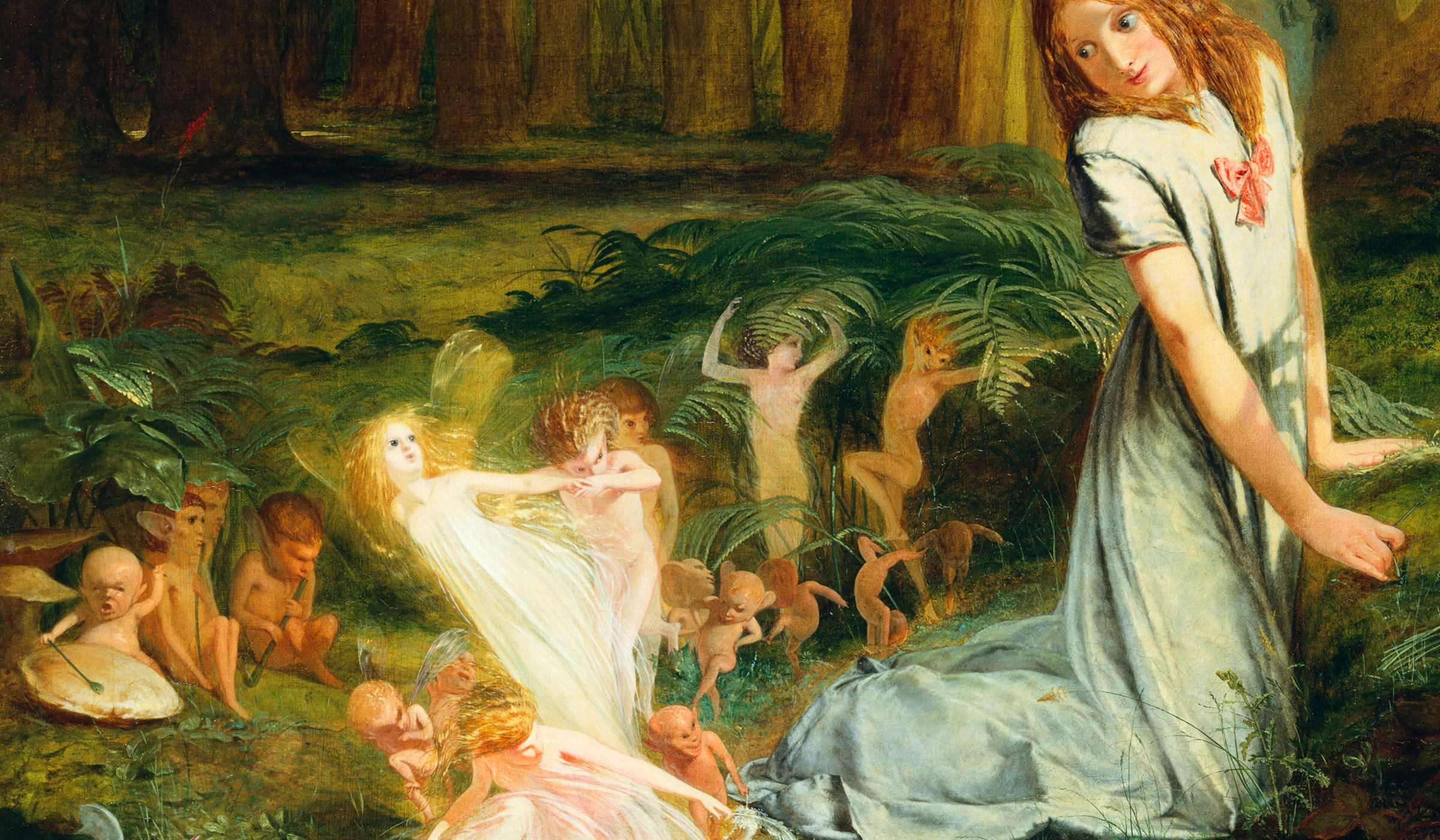
If this sounds far-fetched, remember that it was Shakespeare who introduced the idea of faeries being anything other than normal human-sized. The image of the pint-sized Tinkerbell is even more recent, and when you dig into Yeats’ documentation of faery culture, it seems like size is almost irrelevant. Some faeries are small and others are large. Even the sidheog (little fairy) grows bigger when you get a proper look at it. In the same way, all this stuff about fluttery wings and magic wands is just Victorian confection from a time when old men took an uncomfortably detailed interest in young girls.
Chased back to its roots, most original Western folklore experiences faeries as magic people; frequently the fragmented or declining remains of older civilisations defined by a specific proximity to nature. Murray goes too far to endorse this idea, and she even suggests that Paleolithic people literally survived in separate communities alongside farmers for many thousands of years; she identifies their proto-religion as the root of witchcraft and that’s just not plausible… but it’s not completely rubbish either.
Of course I’m only just beginning down this line, but there’s more than enough here to draw me on.

 Bog Myrtle & Peat
Leave a comment