I stayed with a friend in a cottage on Donside. He was doing survey work for wading birds, and he’d made the mistake of offering me somewhere to drop a sleeping bag for the night.
I’d been nearby in 2010 for a number of days at work on the hill, but never this glen with its wealth of heavy heather and hares in the sunset. As I drove to the place, I found it lay within a stone’s throw of the famous Corgarff Castle; the kind of building you see on the adverts which tell you to Visit Scotland. I only learned in retrospect that Corgarff is linked to the Marquess of Montrose, who’s recently become a hero of mine. That was frustrating, because all I did was gawp at the place and take photos from the car. If I’d known, I might have gone up for a closer look, but I console myself with the thought that even if you could know everything from a place at first glance, life would be unbearable, chucking matches over your shoulder all the time. So Corgarff is one of many things to see and do again.
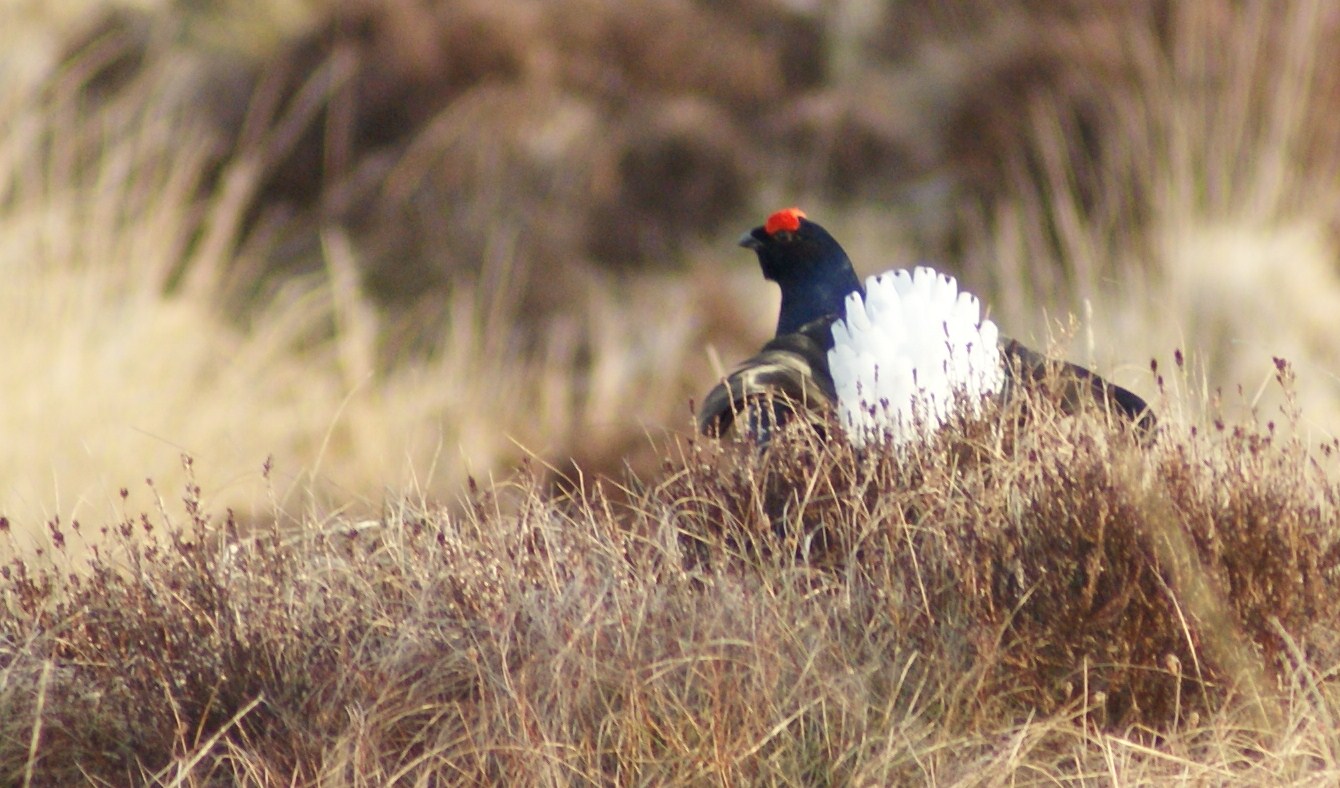
Every time I use my sleeping bag, I resolve to destroy it. It’s hatefully uncomfortable, and a community of mice used it for digs when I was a student. But the heat of my hatred fades in the day. The fight goes out of me, and the bag always survives until the next time I use it and the hatred is rekindled anew. So I hardly slept a wink, and it was two o’clock the following morning with a drab light guttering in the curtains when the curlews began their day, and in such numbers I can hardly set them down. Their calls were a constant contact reassurance between themselves, and long displays grew to a crescendo by three when the blackgame joined them and I sat up in bed to catch a glimpse of a lek by the river below the house. I looked for some time, assuming they’d be half a mile away or more. In reality, the closest bird was in the garden beneath my window. That made me jump. I realised I could’ve touched him with a scaffolding pole, and dawn was still so far away that his tail shone baby-blue in the darkness.
It was hard to sleep after that. I lay in my “bag” and watched the day come on, listening to the birds call and once I heard a shower of rain which came down from the glenhead like a train over many minutes, rushing past the house and smudging the windows with runnels of sleet. I realised that I’m used to hearing curlews complaining, or in some state of anxiety. That’s reflected by their calls, and I’ve begun to think of waders speaking in jagged and staccato voices. But the stressed-out birds I know from home are merely responding to the many pressures they face. Those Donside birds are cool and easy. There are two gamekeepers in the glen, and everything in their favour. They sang for the pleasure of singing, and the descriptor I could not shift was confidence; what confidence they had to sing like that, never caring that they’re a red listed “priority species”.
By six o’clock the leks were boiling down and the curlews off to work. I later learned that there are more curlews nests in this 30km2 glen than in all the 650km2 I counted in Galloway this spring. It’s not even a ridiculous density here. They do even better in other parts of Angus and Aberdeenshire, but this made a startling comparison against my own place where I nearly roll my truck in the ditch every time I see birds standing by the road.
The curlews were grand, but I was more fixated on the blackgame; birds which have passed beyond the point of no return in Galloway now. I make a grand fuss of curlews, but I can’t forget the fact that blackgame were always first and foremost for me. They vanished here, and I only approached curlews because they were second best.
In many ways, curlews are a better bird to stir the popular imagination and raise the alarm for conservation. They look right and feel like they should belong here. Everybody’s heard the call of curlews, even if they hardly care for talk of birds. But blackgame are a harder sell. They’re too outlandish and extraordinary for this place. Nothing comes close to them, and even if you live near these birds, the chances are you’ve probably never seen them. It’s fair to say that a decent lek is one of Europe’s greatest natural spectacles, but it’s not always available to passers-by who choose to keep more normal hours.
Blackgame are amazing, but just like any novelty or point of curiosity, they lack the common touch. When curlews decline in Galloway, it can be explained as something of us that we’re losing. When blackgame decline, our sorrow is tempered by a sense that perhaps they never really belonged here anyway.
I loved those birds in the predawn Highland glow, but when I heard them calling, I thought of my own place, which has fallen almost silent. I remember the long-gone leks right here where I’m standing now, and it’s a sad day when all you have to balance the loss of a species in one place is the consolation that they have not been lost everywhere. Because until very recently, blackgame belonged to Galloway in a way that felt very pressing and close. Now they’re just lovely birds flying in a place I hardly know.

 Bog Myrtle & Peat
Leave a comment