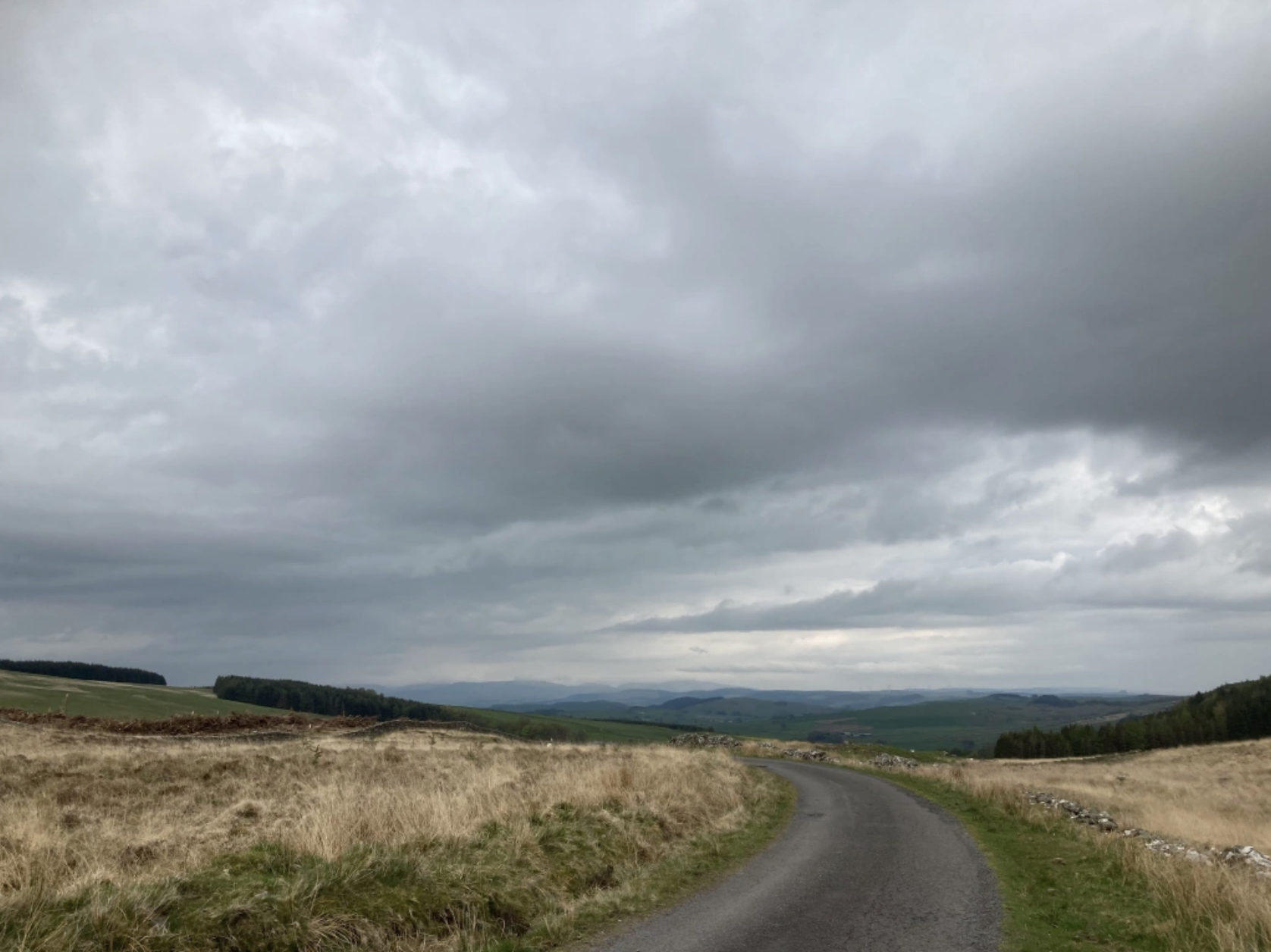
Now the grass is up and most curlew pairs have failed, it’s hard to see what’s happening. At first I reckoned to keep this project up until May 15th, but the picture is now so confusing that it might make sense to stop.
I’ve only found twenty six pairs in all the great six hundred and fifty square kilometres I attempted to cover, but I don’t know of any that made it through their first nesting attempt. Over these last few days, I’ve been watching three pairs which are sitting well on their second nests. One had failed by this morning, but I’m not yet clear on how or why. I’ll do a proper investigation this coming week, but there’s no great chance of that pair trying again for a third time.
I hoped the hills and moors of the upper Urr would serve as a stronghold for curlews, but these have provided devastatingly slim pickings. As I’ve seen on my grandfather’s farm in 2022, I get a sense that many upland sites have lost their curlews either this year or last. It’s been a devastating couple of seasons, and only a few pairs are left to cling on. Despite enthusiastic support from a number of shepherds and hill folk, it’s clear that many reports of curlews refer to the same birds being spotted by several observers. In one case, six people reported the same pair towards Loch Urr – at first I counted them as six pairs, but lots of patient follow-up revealed just two birds with a possible third displaying across a surprisingly vast area.
It’s been interesting to search for birds in areas of newly planted forestry. Anecdotally, curlews will return to breed on hills which have been ploughed and planted, but their enthusiasm wanes as the trees mature. This hasn’t happened at two locations which have been planted for spruce forestry in the last year; the curlews have simply gone. It’s fair to expect a degree of persistence and resilience from birds in healthy populations, but where habitats are already fragmented and curlews are declining to a dangerously low level, they seem to abandon a place altogether very quickly when it’s ploughed. I’m not sure what the protocol is for birds hard-wired to return to their place of birth in situations like this. There is a bit of flex on where they’ll go, and maybe there’s a chance they might try elsewhere – but the certain truth is they’ll never be back.
Curlews are a priority species and foresters have an obligation to conserve the birds. It’s not easy to run trees and waders together in the same place, so there’s been a trend in forestry to talk of birds being “displaced” by new plantations, rather than lost. That’s a vaguer, softer word which implies that curlews can always go to some undefined “somewhere else”, but as above, this feels like a distant second best and something like a last resort. Besides, it’s almost laughable here in Galloway where so much has now been taken that curlews have nothing more to give. Displacement is probably always loss, but in that ambiguity there’s room for many foresters to deny that the cause and effect of forest creation and curlew decline has even been proven.
Before a new forest is planted, ornithological surveyors are employed to provide the developers with a baseline survey of what is where. When curlews are found on a site, there’s often some attempt to make room for these birds by leaving open spaces of suitable habitat within an area that’s due to be planted. I’ve often seen “open areas” mentioned as a mitigation against the impact of planting, and I suppose it makes sense to leave a bit of space unplanted for birds that don’t like trees. The downside is that open areas do not remain open without proactive management, and it’s very hard to graze animals or work machinery inside forestry blocks. It tends not to get done, and even the best and most beautiful areas of curlew habitat soon grow-over with moss, scrub trees and rank heather. The bottom line is that you can’t just conserve curlews in little pockets here and there where it suits you, particularly if you don’t want to pay for ongoing habitat management or predator control.
At the same time, there’s an odd wrinkle in some of these mitigation techniques which claim to help curlews survive the transition into a forested landscape. Surveyors are employed to count birds in year one before the trees are planted, but developers are under no obligation to keep on counting them once the forest has been created. The science tells us that we can mitigate this loss and retain a population of birds by performing a number of management tasks like retaining open areas or allowing forest drains to flood ditches and bogs. The problem is that this science is old, and we don’t have any data to prove that those management tasks actually help – we just assume they do.
The reality is that these techniques are generally inadequate, but we only have a handful of case studies to prove it. It’s only in the last eighteen months that scientists have started to look into this subject, and it may be some time before we can overturn the credo that “off the shelf” mitigation is effective. It’s also a certain truth that curlews require additional protection from predators where their habitats have been fragmented by trees. Predator control is not only politically unpleasant, but it’s also one of the most expensive conservation tools out there, particularly when it becomes a necessary running cost to be met every year. It’s very easy to ignore it or play it down.
I can think of some foresters for whom curlew conservation is merely matter of lip service, but there are others who genuinely believe it will be possible to retain their birds after planting by following the best practice guidance. It will never occur to them that their best practice guidance does not go nearly far enough, and these people are in for a nasty shock. By the time they realise, it will be too late.

 Bog Myrtle & Peat
Leave a comment