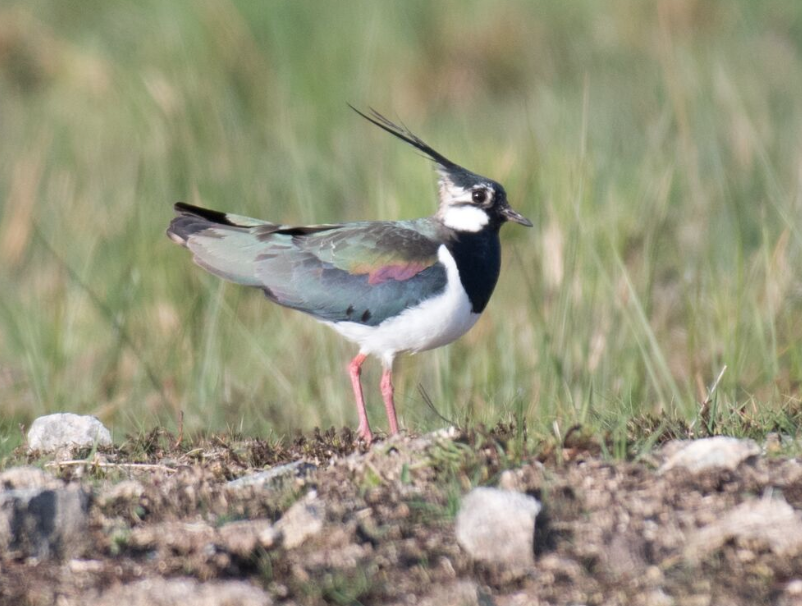
It was too dry when our lapwings came in March, and then the fields were sprayed with slurry. The birds went away on a cold night, and I hoped they’d come back but they never did. Now it seems like the grass is too long for them to have a second chance, and I’m sorry about that. It seems likely that these birds went to breed elsewhere along the coast, and that’s a small consolation. It’s when they don’t come back at all that you really start to worry.
These were the last few lapwings in this parish, and I’ll miss them this spring. There weren’t many birds in this residual pocket, and even if they intend to come back another year, it wouldn’t take much for them to vanish altogether in the space of twelve months. I read my own emotions into moments like these; I imagine that the birds are aware of their plight and fight to resist it. But when disappearance comes, it is never the result of a bird’s decision to resign or throw in the towel. Reduced to low numbers like these, they hardly understand that every time they leave these fields, there’s a chance that they’ll never return; and in future years a passer-by will find the kettle boiled dry and a book laid open on the table at the page where it was left.
But it’s not all gloom and memories of Blue remembered hills. I’ve been astonished by the number of lapwings I’ve found over the last few weeks on days spent hunting down curlews. I never thought to count lapwing pairs because I always believed that their numbers were too few to warrant it – but it turns out that I’ve almost seen as many lapwing pairs as curlews. It’s all relative and linked to expectation – but in two locations I’ve found clusters of lapwings in surprising numbers, and once eight pairs in a single upland field.
I always thought that lapwings were knackered in this part of Galloway, particularly in the uplands. These very isolated clusters give cause for hope, and it’s worth noting that both are based on estates where top-notch gamekeepers are working. I’m starting to realise how sensitive lapwings can be to predation, and one of the biggest differences between “having birds” and “not having birds” is often predator control. It’s extraordinary what keepers can do within the confines of the law, but some challenges lie beyond the reach of simple dedication. It’s worth noting that the single biggest cluster of lapwings in this part of the county exists at an RSPB reserve where the birds are surrounded by a badger-proof fence. That fence was extremely expensive to build, and it would not exist if there was not a substantial amount of data to prove how vulnerable these birds are to badgers, even when the habitat is perfect and all other predators are managed.
Away from a couple of big upland clusters, there’s a thin scattering of lapwings across a range of farmland habitats from Castle Douglas to Dumfries. I’ve marked as many as I’ve found and benefitted from useful tips sent in by others, but I’ll need to work fast if I want to capture the full picture. The reality is that as these birds inevitably start to fail over the next couple of weeks, they’ll drift away and become less obvious. It’s useful to have a picture of where lapwings intend to breed, but this information is no proof of the fact that they’re successful.

 Bog Myrtle & Peat
Leave a comment