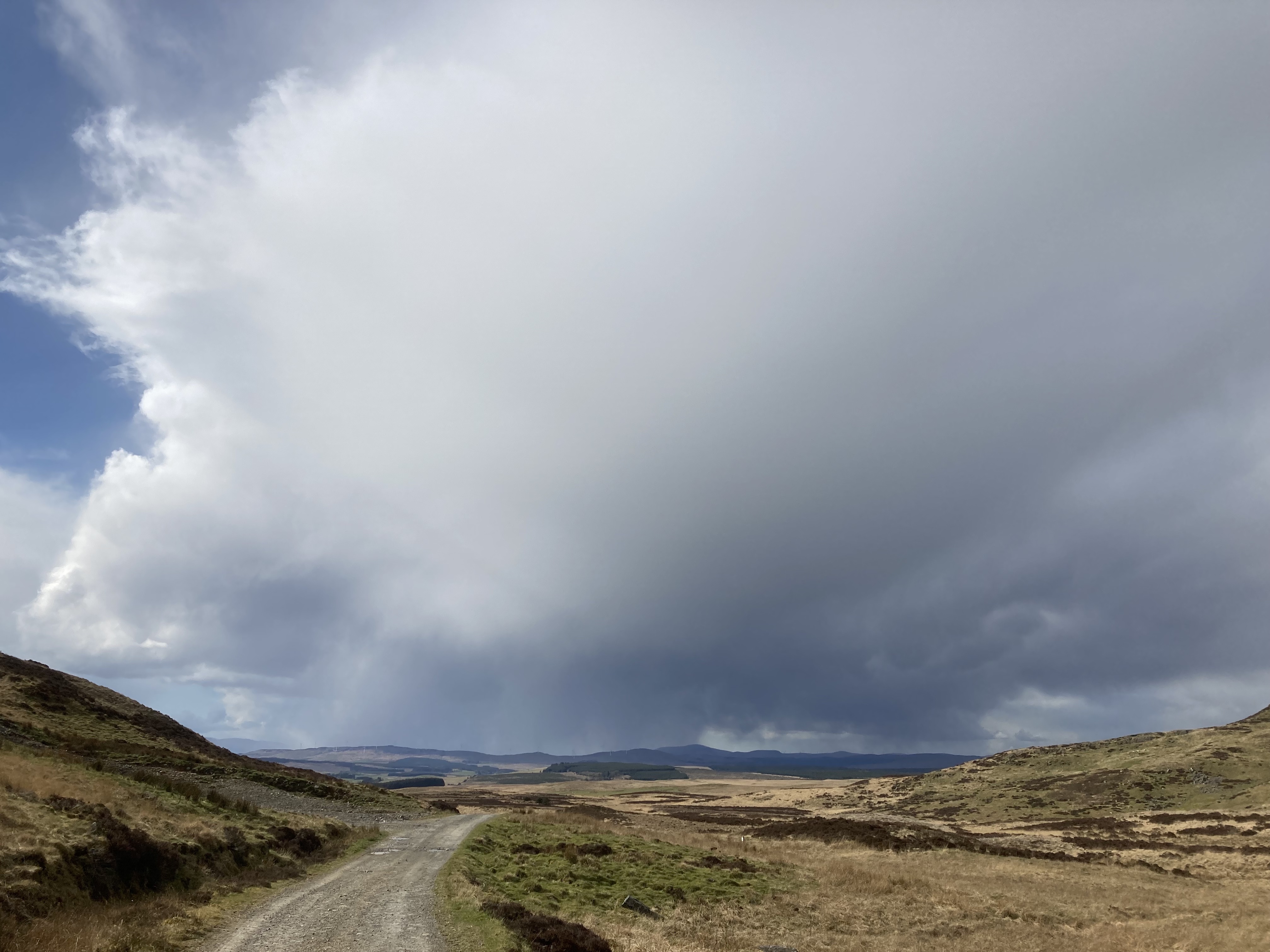
Having set myself the task of finding curlews, the last few days have been strangely disheartening. Following guidance from BTO Scotland on surveying techniques, I’ve been out and dawn and dusk, listening carefully for the sound of birds displaying in a large sample of habitats from the hill to the shore. I’ve found a wealth of mallard in the gloaming, and the brightening sky is always humming with snipe; there have been hares in prodigious numbers, and even trips of golden plover passing through unlikely places – but never very many curlews.
Recognising that in the interests of fairness, my search cannot simply home in on the best and most likely places find the birds, I’ve walked and pedalled far beyond my usual rounds. Thinking outside the box has revealed one or two curlew pairs that I never knew existed, but the majority of these explorations have been wholly fruitless. In a small way it’s rewarding to realise that there aren’t too many birds in places where I wouldn’t expect to find them – my preconceptions are being confirmed in this respect. But when I go to places I’d forever associate with curlews, I’m finding many of them deserted.
This has now happened so often that in order to cheer myself up, I went to three hill farms lined up in a row towards the north of the Urr catchment. I reckoned that these places were a dead-cert for curlews, and I hoped that time spent around the motherlode would boost both my morale and my survey figures simultaneously. But I was met with a deafening silence, and in four hours of watching across a vantage point commanding almost three thousand acres, I saw nothing at all.
So having set out to reach one hundred pairs, I’m stuck at fourteen. There are still five weeks to go and it’s fair to bet that when this cold, dry weather breaks, more pairs will come swarming back to their breeding grounds, but this early scarcity is an unmistakable setback. And I could ascribe it all to the cold if some pairs weren’t already well-advanced in their displays, proving that it’s not so bad to end the game for them altogether. Most of the absences are in the upland areas where it’s still been down to minus fo weather’s crucial, but it’s not an entire explanation.
I can’t resist measuring this shortfall against the certain memory that even ten years ago, curlews would return in the first week of March, come hell or high water. They had a critical mass back then, and a clearly defined sense of purpose. Only the worst of snow would drive them away from the hills, and they’d always be back within a day or two. But as their numbers have declined, that sense of certainty has seemed to waver. Their arrival date is no longer set in stone – a handful might arrive in early March but move away again; lone birds might drop in from time to time until the start of April, but there’s no focus or clarity anymore. It’s also important to note that if they’re late to arrive, nesting times don’t seem to have moved at all.
In the last two or three years on my own place, breeding pairs have dropped in and nested almost immediately thereafter; within a matter of days. Measure that against the slow, traditional preamble which the curlews used to have on the same property – some birds would occupy territories for six weeks before they would even lay a single egg. I used to think that was a flattering gesture of confidence. Couched in subjectively human terms, I felt like they wanted to be on the hill and were excited by the challenges ahead. That’s been replaced by a sense of reluctance; it feels like the birds have begun to grudge coming back – it’s a point of anxiety for them.
I doubt that even a single curlew’s egg has been laid in Galloway yet this year. The earliest egg I ever found was April 18th. But I have a feeling that declining numbers coupled with a sequence of cold, dry springs means that 2022’s breeding season is already less promising than it should be.

 Bog Myrtle & Peat
Leave a comment