I planted a hedge in 2010, and now I’m on the second cut for kindling and stick shanks. At the stick-making class in the town, there’s always a hunger for blackthorn shanks. We all learn with hazel, but it’s a well-kent thing that your best dress is blackthorn, even if the jags poison you. I once had a blackthorn jag slip under my thumbnail to lodge itself against the quick like a trinket buried in resin. The thumb swelled up to three times its natural size, and in the end we dug that jag out with a hot pin and freed up a wealth of mashed potato from the meat.
Seeing me in the hedge, my neighbour came down from the hill and we stood in the sun. It was a day for the larks, and a stonechat stood happily on the bridge blinking. We talked for a while, and he agreed that your best dress stick is blackthorn, right enough. And better, one of his jobs for the day was to recover the corpse of a tup from the hill. The animal went missing in March, and he’d found it drowned in the burn above the watergate. It was only a two shear, but I could have the horns if I wanted them.
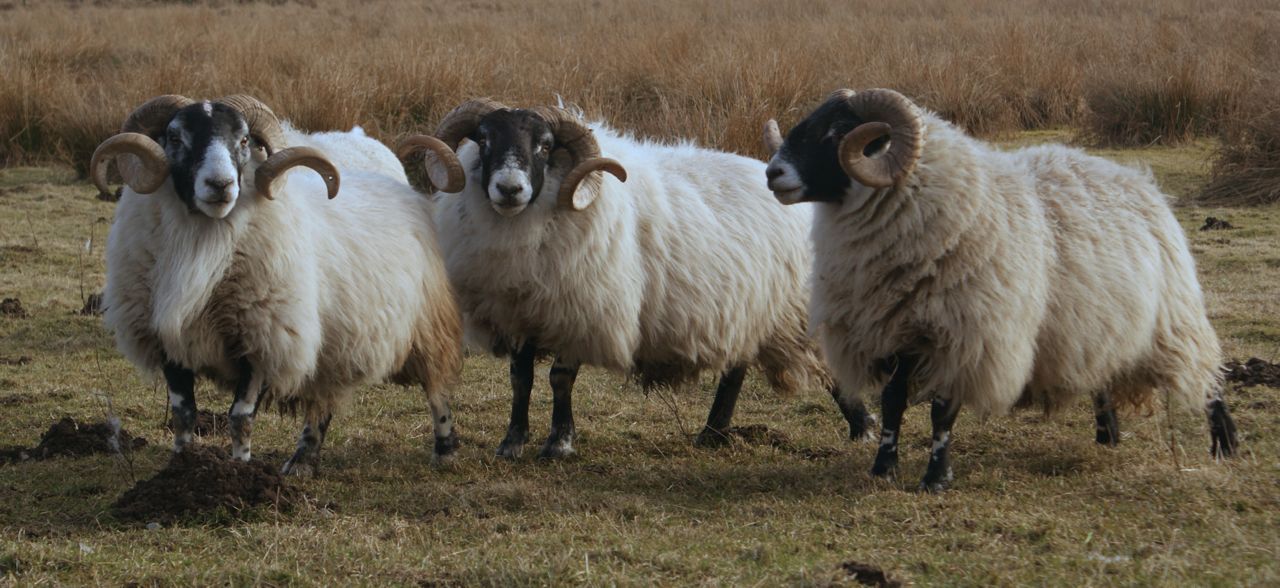
I bet you know this already, but when you’re working with horn, you want a solid block of the stuff to rasp and sand to a polish. The way horn grows, it gets to a certain length and then it fattens, so the best horns for sticks come from old tups. I had a one-shear tup that died and I pulled his horns off like socks when he’d rotted. They were completely hollow, just like a viking’s mug. I took them to the class and the master said NFU, boy – which means nae fuckin use, because when it comes to shaping a crook head, you need fat curves of horn from the oldest tup you can find. The two-shear means it’s been clipped twice, in July 2021 and exactly a year before that. So it was born in April 2019, and that’s borderline. You really want a five or a six shear, and just like anything worth knowing, there’s far more to horn and what it is than meets the eye.
Either way, we went to the tup where it lay, and it was hard to see how my neighbour had ever found it wedged in a dark pool in the shade of ash twigs and willows. The body was knitted into the roots, and the current curled around it silkily. Long streamers of wool trailed away downstream in the black, bone-cold water, with the surface all laced with little nets of foam and balled up wrinkles of rushes and heather. At the angle its head was held, the dead tup’s nose was the highest point standing out of the water. A dipper had been standing on that prominence, shitting into the puckered lips. Given enough time, that tup might have washed away altogether, steeped into nonexistence like a sugarlump. But we hauled him onto the bank by his horns, and great screeds of his skin peeled off behind him like wet bog roll.
There was still some weight in the the grey meat of that body. I turned and looked over my shoulder as we pulled; at the tup’s white eyes and the droll slump of his jaw slung loose on the last of his cheeks. With the sun behind him and the light in the turning water, it made a fine picture. Perhaps not the kind of thing you’d hang on the wall, but strongly of this place, if not bonnie.
And soon I was working through his bone stubs with a hacksaw. Wool burred in the blade’s teeth, but the horns came away looking fair enough with the ends weeping something like currant juice into my overall cuffs. It’s too soon to tell if they’ll make a decent stick head; I’ll have to let them dry so the bone falls out before I can see how much is available to work, but with half a dozen blackthorn shanks in the truck and a set of horns to work at, I almost imagined that the tables were turning in my favour.

 Bog Myrtle & Peat
Leave a comment