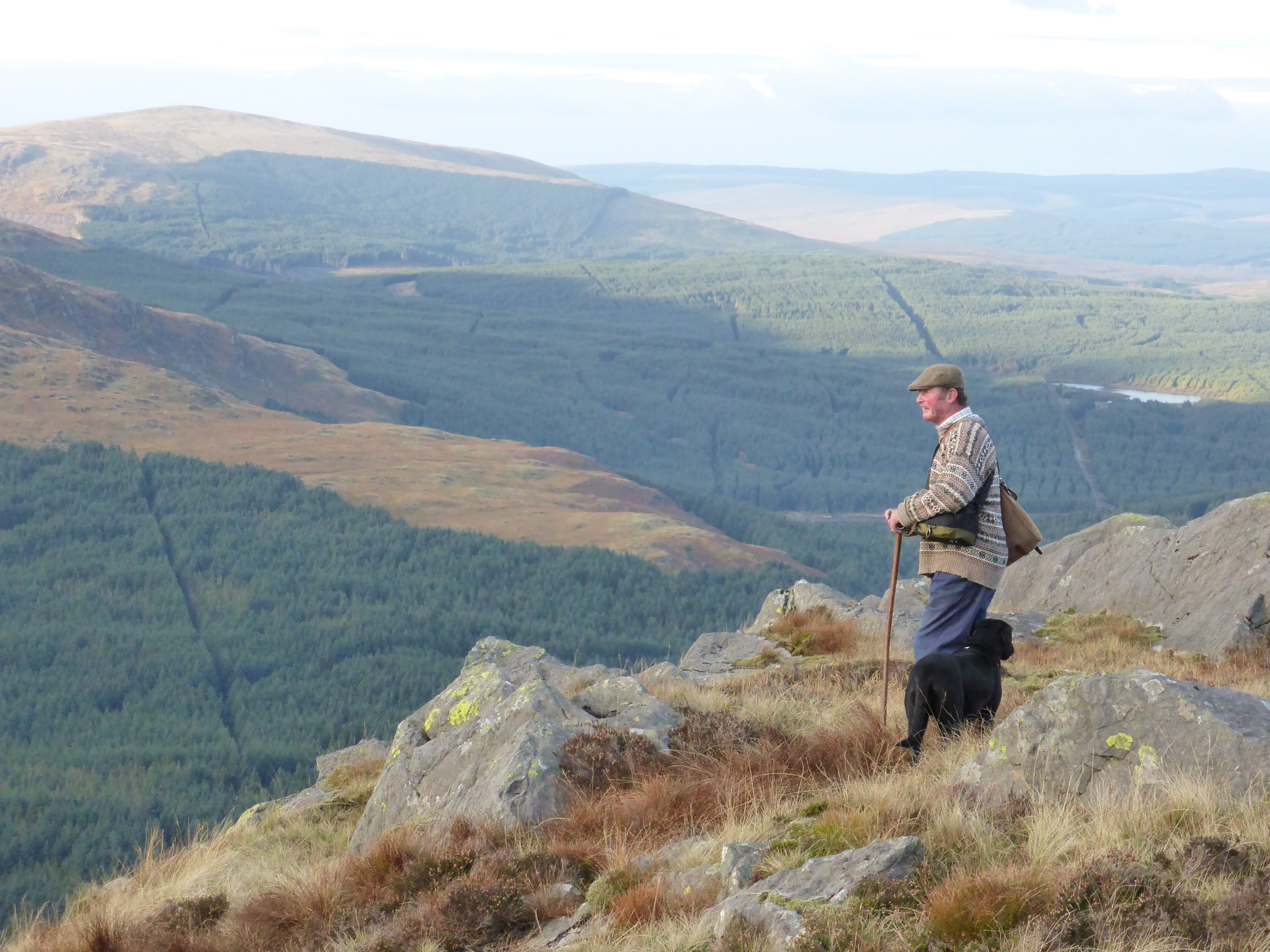
I’ve often felt uneasy about the expansion of forestry in Galloway. When I’ve written to explore that sense of unease, readers have agreed; the massive increase of commercial woodland is worrying, and in recent weeks, I’ve heard from people in Scotland and Wales who sympathise with Galloway’s plight. These people share the fears I have and the see signs of the same in their own places, but I have to stand back from these anxieties to see my own landscape in context.
What’s happening now in Galloway is not the same forest expansion that threatens to alter the balance of Wales or Perthshire. We’re in a different league of enormity here, and I don’t lay claim to more than my share of suffering without qualification. Since 2016, we’ve seen almost 14,000Ha of new softwood planting here. That’s double the amount of softwood planted in the rest of Scotland put together. It’s a shame that if you’re seen to complain about forest expansion of this kind, you’re accused of NIMBYism. But Galloway is uniquely entitled to express concerns because we don’t have a “Back Yard” anymore. It’s a spruce forest.
When you look at maps which combine existing forest cover with current plantings and projected ones, it’s clear that some parishes will soon be covered from the lowest stream to the tallest fell-top. The damage is done; the canopy has closed across entire water catchments. It’s too late for these places, and we can never go back.
It’s telling that a handful of government-level land use strategists have recently woken up to the idea that we’ve gone too far and too fast. They’re worried. Reports and enquiries have been commissioned, but even the biggest big-wigs will be unable to turn this ship around in time to save us. We’ve never had to wonder what too much woodland looks like in Scotland. We all share a sense of national guilt for felling the ancient Caledonian Forest, so it’s hard for many people to approach the prospect of “too many trees” without some confusion. But that’s exactly where we are in certain parts of Galloway, and that would require little more than an adjustment of expectation if we weren’t “quibbling” between the words forest and plantation.
What alarms me most is that many of these changes have taken place with a minimum of consultation and only the slightest gesture towards a strategic overview. It’s simply an international feeding frenzy. Properties are being sold for eight, nine or ten times their agricultural value and planted with trees on a case-by-case basis without any coherent plan. If all your neighbours sell up to foreign investors one by one over many months or years, there’s never a single cliff-edge moment of change. You simply endure the accumulative impact of a thousand little losses until the world has vanished beneath your feet, and if the end result is death anyway, what do you prefer?
This blog was originally based around happenings at my grandfather’s farm, The Chayne. In the current climate, that property is now theoretically worth almost nine million pounds – an increase in value of around ten times since this blog began in 2010. That figure is theoretical because it will never be sold for forestry – however, I don’t blame my neighbours for selling up. This is a hard place, and money from a corporate investment company is like a lottery win for a generation of farmers facing retirement. It’s the system that’s broken, and the open secret that you can do things in Galloway that you’d never get away with elsewhere. My heart is still broken for this place, not least because we never had the opportunity to think about what we wanted. Other people made decisions on our behalf, and the floodgates opened. It was inevitable that sharks would ride in for the scent of blood.
I’ve thought long and hard about how I can justify turning down a lottery win of my own. Why not sell up and have done with it? The prevailing financial climate makes me look like a lunatic; mailings drop through my letterbox once a month addressed to “the landowner”, asking me to consider forestry “for the future”. Resisting this, my use of words like “responsibility” and “custodianship” sound pathetically whimsy. But I’m not just being a stick-in-the-mud. Sentiment aside, I genuinely believe that the world will be better served by a new generation of hill farms providing food, carbon storage and biodiversity. I don’t resist the change for negative reasons. It’s not because I don’t like forestry; it’s because I do like a thousand better options which vanish forever as soon as you hand over the keys to investors from Denmark or Texas.
If you’re worried about commercial plantations in other parts of the UK, it’s not for me to belittle your fears. You’re right to take it seriously and push back where you have to. But I need to be clear that you have hope where I do not, and what’s happening here is a storm of its own.


 Bog Myrtle & Peat
Leave a comment