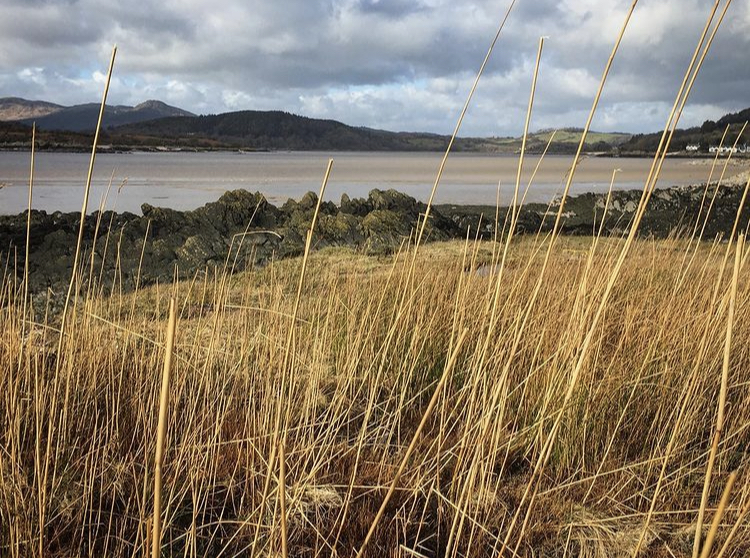
You can walk to the island when the tide goes out, but it’s a mile or more to the shore and the mud’s all scored with reefs and quicksand. I wouldn’t make the trip lightly, and I’d time myself to start and come off carefully between the tides. For thirty years my grandfather walked his sheep to this island for summer grazing, and even he was caught by the heels in the sea once and had to swim for the nearest beach. Then he walked five miles round the coast to a neighbour’s farm and shamefacedly asked to be driven home dripping. We laughed but it’s not a game, and he was lucky.
Heading down through the hazels above the bay last week, I saw a figure far out on the edge of the tideline. It was little more than a speck in the backlit horizon, but this is a quiet place and it’s odd to see another soul here. I reached for my binoculars and saw it was a dog in the distance, walking on its own towards me. At first I looked for its owner, but there was nobody to be seen on the flats. And as I watched, I began to feel the hackles rise on my neck, because dogs don’t walk and wander at once. They blunder and caper, rollicking in the novelty of false freedom. The animal I saw was used to the world, and acclimatised to its own decision-making.
Foxes are on the move at this time of year, but it was clear that this one had made that trip to the island a thousand times before. There are rabbits out there after all, and sometimes dolphins dead and spoiling on the shore. It’s worth the walk, and while I was surprised to see him in the bay, I suppose the only strange thing was that he’d make the trip in the bright enormity of broad daylight. He was allowing himself to be seen, and I find it hard to make sense of that given that I’ve spent so long chasing these animals across great distances, expecting always to be rumbled and evaded. A fox will never make it easy for you to find him, so it’s puzzling when you see him laid bare out of context, and I’m likewise puzzled when you pass a fox on a street in the city and he doesn’t give a damn that you could strike him with a stick.
Resolving from a speck to a figure like the first arrival of Omar Sharif in Lawrence of Arabia, this fox approached the coast where I was standing. As he came near the shore he began to bump birds feeding in the creeks and ditches. Curlews rose up wailing to land behind him; oystercatchers squalled in a gang to catch the wind and away. The boldest complainants were redshank which screamed and flew above the walker like sirens. He’d struck upon a hornet’s nest, and soon the idle crows dropped down off the rocks to mob him too. They’d been picking the kypes of kelts washed up on the shore, and they welcomed a distraction.
On his final approach to the land, the fox had to cross a deep saltwater channel running parallel to the rocks. His resolution failed. He dithered and walked up and down the water’s edge with a sour expression curling his lip. Until this point, his journey had been easy, but even when the tide is right, a person still needs wellies to make it home.
He stepped slowly into the brine to the height of his belly, holding his tail up crooked like a cat that’s just had the thing dry-cleaned. The water was deeper than he’d have liked, and the rocks a little further than he thought at first. Reaching a mid-point almost to the height of his chin, he sprang in a desperate jump for the shore and landed with two front paws gripping the barnacled stone and his brush lashing the water like an outboard. He was eighty yards away from me with the sun behind him, and the redshank decked yelling above the spray like an audience in the balconies. It looked like he might fall back upon himself, but from there he was able to climb onto the rocks and immediately he’d vanished into the wracks of seaweed and driftwood.
When I later looked for his footprints on the shore, I couldn’t find any sign that he’d crossed back from the island. That could mean the mud’s too firm or sloppy to hold a mark for long, and anyway the tide soon rose to cover the bay again, and the walkway held its breath beneath three metres of water.

 Bog Myrtle & Peat
Leave a comment