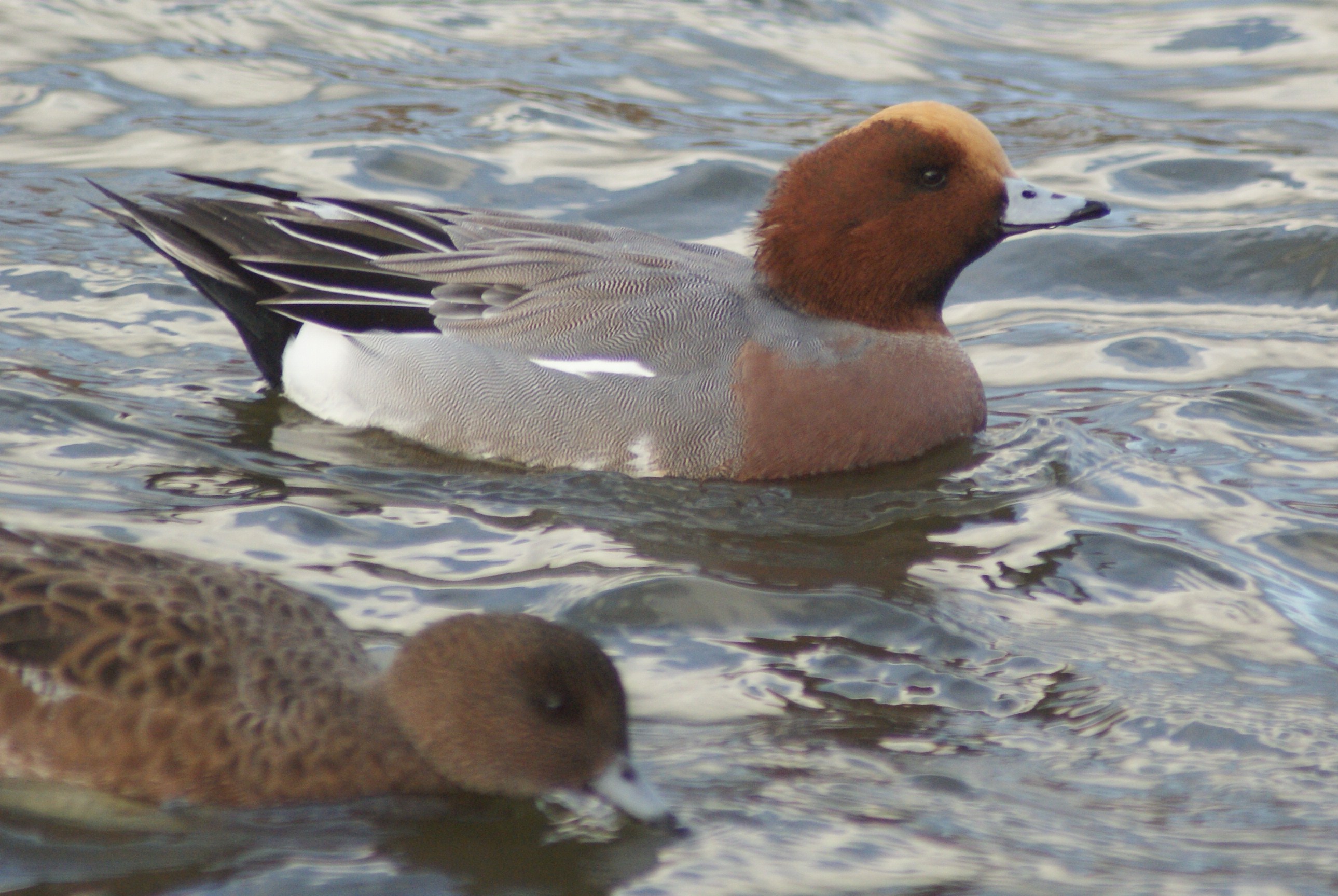
Say Wigeon, I said as I sharpened the knife and pulled skin away from the bird’s breast. He tried, then I revealed the meat and asked him how it felt to press the tip of one small finger to the slackened muscle. Cold he said, and he leaned on the table top with one leg propped above the other like his grandfather does when he’s listening.
Then off with the head and snap to the wingbones, Snap! Snap! and sustaining sound, I prattled on and told him how these birds had first seen daylight in Russia; how the sound of them reminded me of Lindisfarne and Strangford Lough; places he’s never seen and even our own beloved Solway Firth is still beyond him, and only The Sea. Then recalling Heaney’s lines for Paul Muldoon, I cut the bulb from the cock bird’s throat and placed it wet beside my lips. I blew into that translucent shape, making my own small wigeon cries as his eyes widened beside me.
I offered him the chance to blow, but he didn’t care to. Besides he was distracted by a twist of green material which burst out strandily from a hole in the crop-skin. I pulled it out and unpacked the bundle, saying Eel grass, aren’t we lucky? And that’s what this bird’s been eating in the dark and the wonderful moon! We’ve talked about the moon before, and holding this bundle of grass to the light, he teased it apart like the weavings of string. Eel grass, I said again, and Isn’t that something? But he only said Moon and left those fibres to make their own connections.
And after that then up came guts in blue and interlapping coils. Clots of blood flopped out like jam from the wrecked interior, and I said simply Guts because I’ve learned that he will take my lead. And knowing if I curl my lip and make this seem disgusting, he will see me. A thousand times I’ve felt him watching even tiny gestures; gleaning information which allows him to pursue that misguided desire to copy me above a world of better men.
So I make pretend that this is everyday, because we learn to be disgusted. It’s not in us at birth, and it adds nothing to the richness of our days. Protected from disgust, work like this is free to be familiar. If I can play my part and play this down, perhaps in time he’ll turn flesh into food for himself without thinking twice about it. And relaxed in that acceptance, he’s more than usually available to the shock of joy when, looking down upon his own bloodstained hands, he’ll see there stained some honest memory of the moon; of the eelgrass and the smell of down from the mud.
It’s not for me to flag this work as a miracle. He must discover that himself, and find in this ordinary task a sense of continuity that was ancient here before his oldest ancestor ever held a name.
Widgeon
for Paul Muldoon
It had been badly shot. While he was plucking it
he found, he says, the voice box –
like a flute stop
in the broken windpipe –
and blew upon it
unexpectedly
his own small widgeon cries.
Seamus Heaney, from Station Island, 1984

 Bog Myrtle & Peat
Leave a comment