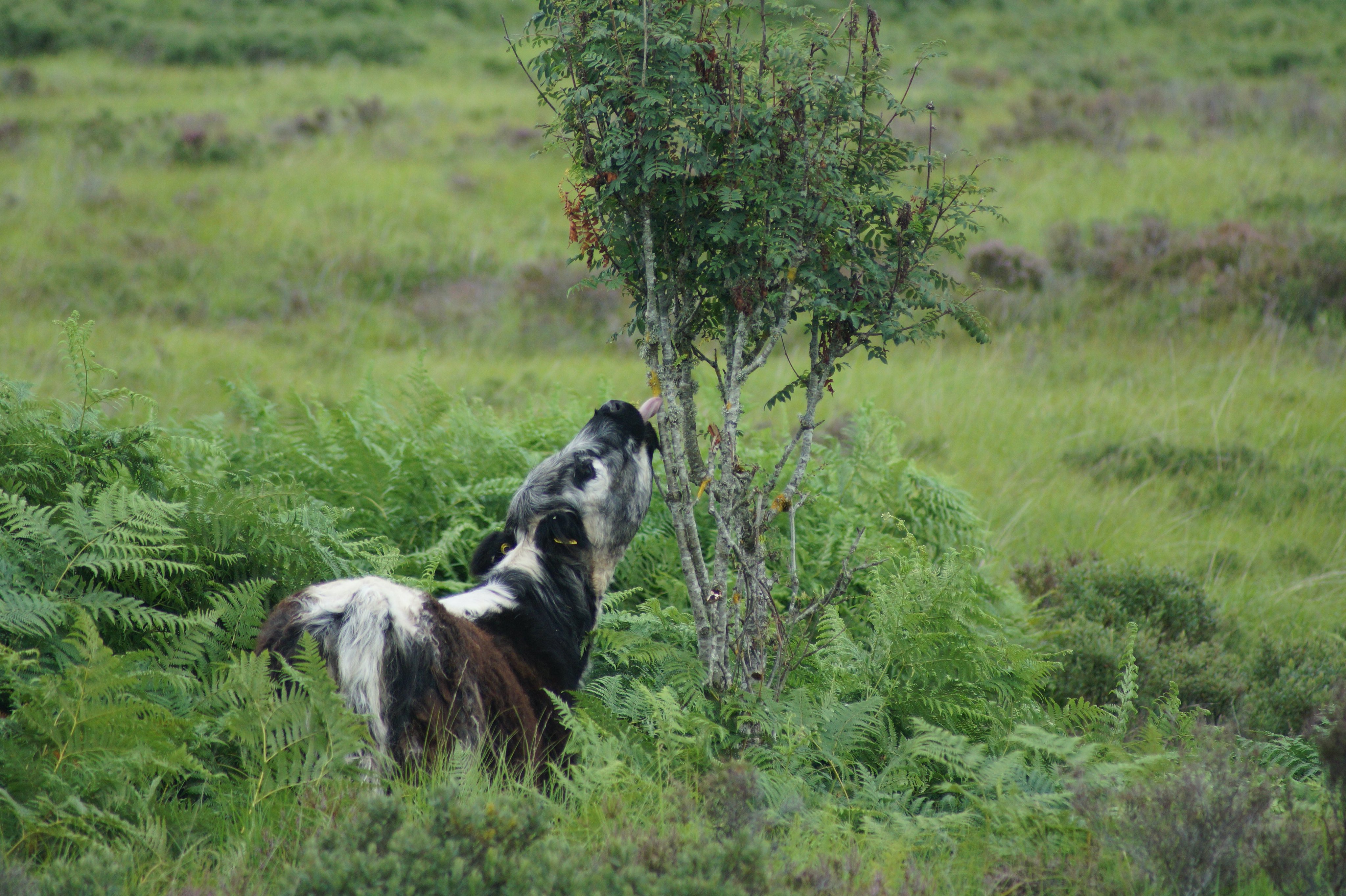
It’s been a better year on the hill. For several accidental reasons, the cows went out more than a month later than they did in 2020. The grass was there to meet them, and they swam into it. I dropped them off on June the third and they’ve never once looked back.
Two factors have really helped their progress. The first relates to the age and dynamics of the group. Last year, I worked with a cohort of very young stock. Most were under a year old and they had only recently been speaned from their mothers. That made them cautious and uneasy. They patrolled the perimeters of the hill and moved in a constant state of restlessness. This time around, the young beasts are accompanied by two empty cows and two steers which were on the hill last summer. That’s given them a sense of calm and focus which they sorely lacked before. They move with confidence and it’s easy to summon them up by shouting and waving a bag. I had to train them to this last year, and that was a lot of work. But they know the score this time around, and what a difference that makes.
The second change is that we’re now in year two. I felt like ten young beasts would be lost in a two hundred acre block of rough moorland, and it’s certainly true that they ricocheted around without seeming to leave a trace of their passing. But it turns out that they did make a difference. They grazed many of the best and most productive areas of the hill, and the action of their grazing went to improve the quality of the forage on offer. The hill is now greener and more diverse, and new grass grows through the punctures which the cattle stamped in the old mats of dead grass. Some of the strongly-established tussocks have been trampled into stumps, and wildflowers rise around them. The quantity of scabious and knapweed I’ve seen in the last few weeks is staggering. It’s a delight to see all the well-kent theories of conservation grazing in action, and it’s also clear that in the most popular areas for cattle, bracken coverage is in drastic decline.
Perhaps the most telling change comes from the satellite collars, which tell the story of where the cows spend their time. Last year, the tags would ping almost at random anywhere inside the two hundred acre enclosure. The beasts were constantly on the move. This year, the cattle have stuck to a single fifty acre patch. They could head further afield whenever they want, but they’ve never even tried. And the harder they graze, the better this piece of ground is able to cater for them. We often talk about finding a balance between farming and nature, and most farmers are trying to drag their management in a more environmentally friendly direction. I’m doing the opposite; working to fit livestock into a landscape so wild that many visitors can hardly believe that such a place exists. I will find a balance, but my start-point is very unusual.
In the heart of the most popular area, there is a greyhen with chicks in the myrtle. I doubt she could have raised young here without some grazing assistance, and I notice that the young birds often hang around under the bigger willow trees where the cows often lay for shade in the hotter days. The vegetation here is mown short as a bowling green, and the black grouse enjoy the ability to duck in and out between different sward lengths. That’s just one of many interesting and unforeseen side-effects of livestock grazing.
In the midst of all this progress, the cows are in excellent condition and I feel confident enough to enjoy the process at last. Last year was a constant source of stress and anxiety, but this time I’m finding things a great deal more peaceful. It’s interesting to see such a clear expression of the idea that grazing begets more grazing, and I’m surprised at the level of change which has transpired in two grazing seasons. From a distance, the hill looks almost exactly the same as it did when I started – but walk through the grass and it’s hard to ignore the enormity of the change.

 Bog Myrtle & Peat
Leave a comment