
I’ve spent the last few weeks looking at wading birds as they go into the breeding season. My eye is naturally drawn to lapwings and curlews, but I mustn’t overlook the oystercatchers which breed here. I’m conscious that these birds have declined by almost forty percent in Scotland since the mid-1990s, but that’s misleading for those of us who live along the coast and see them every day. It’s easy to imagine that all is well, but the reality is that oystercatchers are struggling with poor breeding success and they often need a hand.
Since I took over a new hayfield in 2018, I’ve reduced the intensity of grassland management to boost biodiversity. That’s been an exciting journey, but it has also meant that productivity has declined by more than a third. It’s hard to justify that loss, but I was encouraged to find that a pair of oystercatchers decided to make their nest in the field last year. It was a nice endorsement of my work, but I was anxious about what impact the nest could have on the field’s management. It turned out that the oystercatcher had laid her eggs near the gateway, and while I didn’t want to disturb the nest by mowing too close, I was also concerned that a great deal of tractor-work would have to take place right beside it. My concerns were immaterial in the end – a badger raided the nest and ate the eggs – but it set me thinking about finding a better balance in future years.
Speaking to a fellow wader-enthusiast near Balmaclellan last year, I was interested to hear that he had dug a series of wildlife ponds around his farm. He noticed that oystercatchers were keen on his ponds, and he wondered if they would benefit from some extra encouragement. Knowing that oystercatchers originally bred on the seashore, he scattered some small patches of gravel around his ponds in a bid to simulate a vaguely coastal feel. When I saw these patches, I would guess each one covered roughly two square metres, and the gravel had been laid on some anti-weed matting to keep them clear. Excitingly, the birds seemed to love them. Not only did the oystercatchers spend a great deal of time resting on the gravel patches, but when spring came, they also showed a marked preference for nesting on them.
Not only did the oystercatchers spend a great deal of time resting on the gravel patches, but when spring came, they also showed a mark preference for nesting on them
Oystercatchers breed in all kinds of funny places; there’s a pair nesting on the roof of Tesco in Castle Douglas as I type this. That ability to innovate has saved them from what might have been more devastating declines, but I began to wonder if that experimental nature is simply a reflection of their ability to accept second-best. If oystercatchers prefer to nest on gravel banks and coastal shores, then perhaps they’re simply making-do in a meadow. Maybe it would be possible to provide them with a simulated nest-site, away from the risks and hazards associated with commercial grassland. After all, it’s common practice to build bird boxes; a bit of lateral thinking should allow us to create nest sites for birds which prefer the seashore.
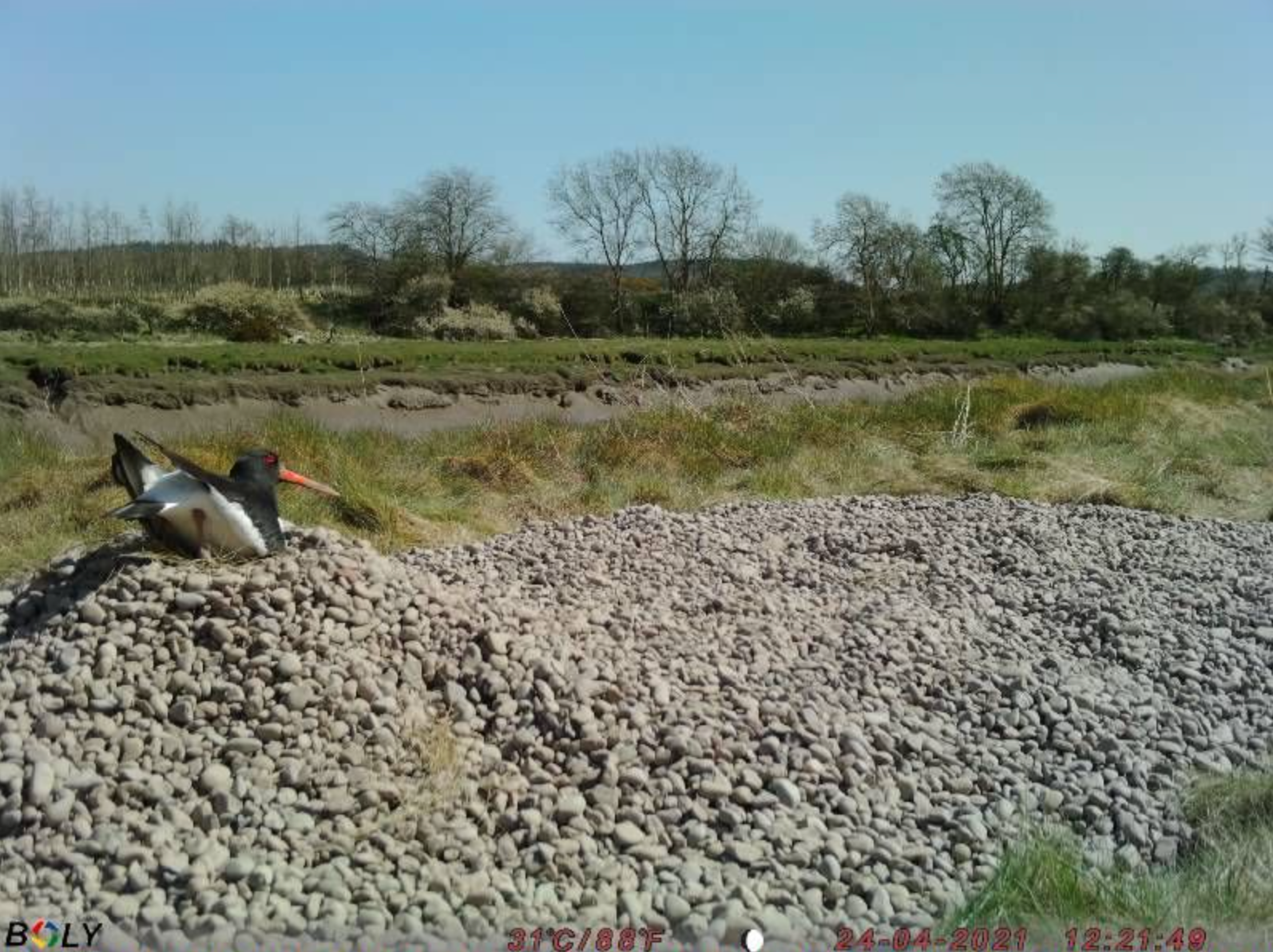
Building on the recollection of those little gravel patches at Balmaclellan, I decided to see if a bigger patch would draw the oystercatchers out of the field to breed in the margins where they would be safer. Sure enough, I dumped a ton of 20mm washed gravel on the saltings last Wednesday. As a bit of fun, I even built a rough nest in the gravel; a raised heap with a little dip in the middle like a miniature volcano. Within seventy two hours, the oystercatchers arrived and one of them sat for twenty minutes on the top of my experimental mound. When I went back to look at it, she (I assume it was “she”) had improved upon my original design, making a neat little cup. The pair seem to like what they had found, and they’ve already returned to it several times.
It’s too early to tell what will come of this experiment. To get the full effect of this project, I should’ve dumped this gravel in February and allowed the birds to find it at the start of their breeding season. At least one pair of oystercatchers is already sitting on eggs nearby, and it’s a tall order to interrupt them halfway through the spring with a new attraction. Perhaps this is more of an experiment for 2022, but initial signs have been so encouraging that I start to wonder if this could be a really helpful tool to integrate wader conservation into more intensively managed farmland. Laying down heaps of gravel in suitable oystercatcher habitats is extremely cheap and takes no time at all. In practical terms, it could add major value for minor investment, and while the benefits will probably be restricted to one species, it’s a further recognition of the fact that all waders are different and there is no “silver bullet” to address their declines.
Of course more updates will follow…

 Bog Myrtle & Peat
Leave a comment