
Cwa’een like milk-wort and bog-cotton hair!
I love you, earth, in this mood best o’ a’
When the shy spirit like a laich wind moves
And frae the lift nae shadow can fa’
Sine there’s nocht left to thraw a shadow there
Owre een like milk-wort and milk-white cotton hair.
Wad that nae leaf upon anither wheeled
A shadow either and nae root need dern
In sacrifice to let sic beauty be!
But deep surroondin’ darkness I discern
Is aye the price o’ licht. Wad licht revealed
Naething but you, and nicht nocht else concealed.
Hugh MacDiarmid, from Scots Unbound, 1932
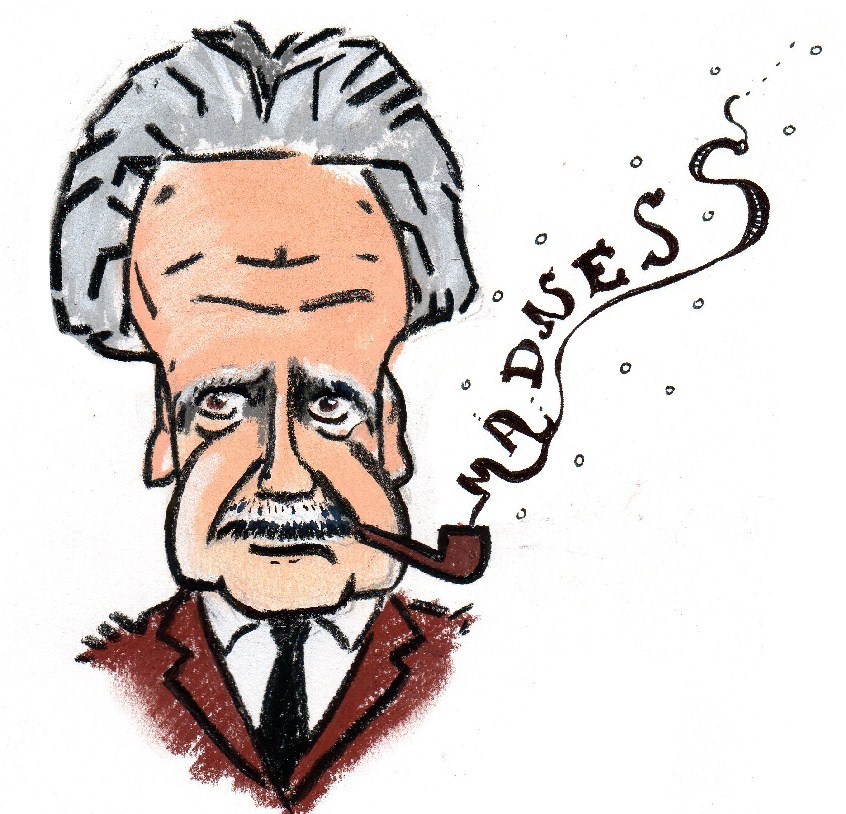
In cutting peat and turning turf towards the wind, these late spring days continually draw me back to this poem which I learned as a teenager. I never liked MacDiarmid much, and I raged against him in articles I wrote and illustrated for the student magazine in Glasgow. But as I grew up, I began to realise that he had an eye for the hills of home and wrote better and with more clarity on the Southern Uplands than anyone since Robert Louis Stevenson. I’ve often leaned heavily upon Milk-Wort and Bog-Cotton, and it has never failed me.
MacDiarmid spent his early life at Langholm. His work was drawn from the hills around that “muckle toun” – but those hills are merely a single thread in a bigger bolt of moorland country which runs across Dumfriesshire, Lanarkshire and the Borders. Draw a square with corners in Cumnock, Moniaive, Biggar and Newcastleton – it makes sense to think of that space as a single, blue-remembered whole which supersedes county boundaries.
When June comes, MacDiarmid’s land is soft and curlew-sounding; distance mounding with cloud and the hurl of sheep-sweat. It’s powerfully distinctive, but in recent years this landscape has become a place to build wind-farms and produce commercial timber. It clings to life in shreds and remnants, and while thousands of people pass through it in trains and cars every week, few will do more than blink at deep railways cuttings and the wreckage of industrial development. This land is living the eternal tragedy of Southern Scotland; to be overlooked and under-valued as an obstacle between bigger and better things. I was born and raised to look in at these hills from further south and west, but I know it well and a handful of my outlying ancestors recline in graveyards from Kilmarnock to Drumelzier.
MacDiarmid’s land is obscure to the point of fault, so it’s right that he should mark it with an emphasis on tiny, telling details. Milk-wort is a moorland flower no bigger than a bee’s head. It glows in shades of blue and purple, and it loves the old cattle-trods of the south. Bog-cotton is a more familiar plant, but it grows so thickly in the moss and peat haggs that it’s easily ignored. In merging the sunless combination of these two immaculately understated symbols, MacDiarmid is unearthing a live-wire connection to a very specific place. When an east wind blows down over the Nith into Galloway, there’s a tangible reek of milk-wort and bog-cotton in the air; the crazy old poet moves in a laich wind. And like him, I love the earth in that mood, best of all.
I used to think that life lay elsewhere. When I began to write, I always imagined myself on some adventure in California or the African veldt because I was bored with my home and it seemed impossible that anything valuable could ever happen here. But in this poem and a handful of others, MacDiarmid showed me that enormity lies wherever you look for it. And perhaps the best I can do is love my own place truly, then tell.

 Bog Myrtle & Peat
Leave a comment