Low Airie, Glenkens – 2/4/20
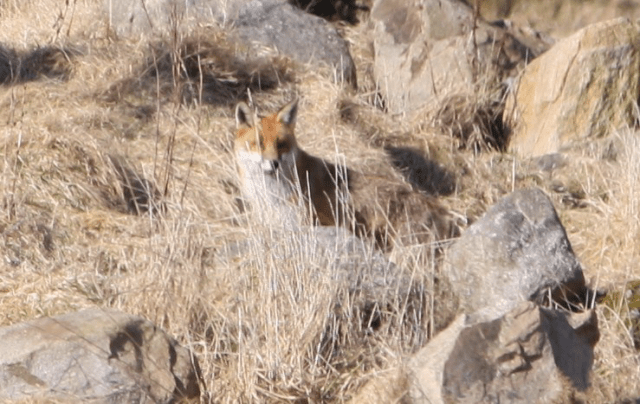
I’ve now been working at Low Airie for a month, and it’s been fun to get a feel for the place. Between golden eagles and greyhens, there is plenty to think about on the hill when silence descends. I realise that in all the intrigue and excitement of this place, something is missing – I have not seen a single sign of a fox.
Under normal circumstances, I would expect to find signs, scats and tracks in the long grass, but there has been nothing. I have set my trail camera in what I felt would be a likely spot to find a fox, but it has revealed little more than a robin along that path in a fortnight. Before I start work each morning, I generally pull up the truck and watch the hill with binoculars for half an hour with a mug of coffee. Patient observation would surely have turned up a fox on any other piece of ground by now, but they are strangely absent here.
I could read this in all sorts of ways. It’s tempting to think that foxes are scarce where eagles are hunting. Eagles regard fox meat as a delicacy, and perhaps the local foxes have grown tired of watching the sky for signs of danger. But then I realise that any fox worth his salt would simply avoid hunting during the day when raptors are working. And nocturnal foxes still leave signs and scats to indicate their presence, even if you don’t see the foxes themselves.
A more realistic explanation lies in the condition of the hill itself. When I walk out to work on the dykes, I trudge through tussocks of grass which are almost waist high. My dogs try to bound and hunt ahead of me, but they soon drop back and I find them walking to heel. There are very few tracks or paths to follow when you’re out in the open, and most are made by red deer. These are deep, pockety trails which actually make life harder for the dogs to follow than if they just pushed through virgin ground. I start to reach the conclusion that foxes are missing because this place is such a mat of thatch and undergrowth that they simply cannot work with it. Besides, why should a fox bother to fight through tussocks which stand over their head? The chances of finding a greyhen or a grouse are slim, and there would be no chance of pouncing an ambush without an awful lot of tell-tale rustling. The hill is full of mice, but these are being eaten by an array of raptors which can drop in from above and don’t care a damn about thickness and tussocks.
I suppose this roundabout thought process leads me to an odd conclusion. I’d like to break this place up over the coming years. My cattle will help to smash up the dense beds of deep grass and they should do a power of good to help the black grouse, but I can’t ignore the fact that the balance between predators and prey has currently reached a steady equilibrium. A paltry handful of black grouse work away where they can, and they’re safe from foxes because their habitat is such mess. That could be a good thing for them, but I simply cannot understand how any young chicks survive at all in this place in its current state. Cattle will surely help increase brood size and survival, but as soon as I open up the habitat and make it better for black grouse, I start to make it better for foxes too.
I have to balance this concern against the reality that predation is rarely the sole cause of decline. I have to balance any advantage to foxes against the enormous benefit I’ll give to the birds. Some predator control is being undertaken on the wider estate, so I have to trust that what I’m doing will deliver more good than harm.


 Bog Myrtle & Peat
Leave a comment