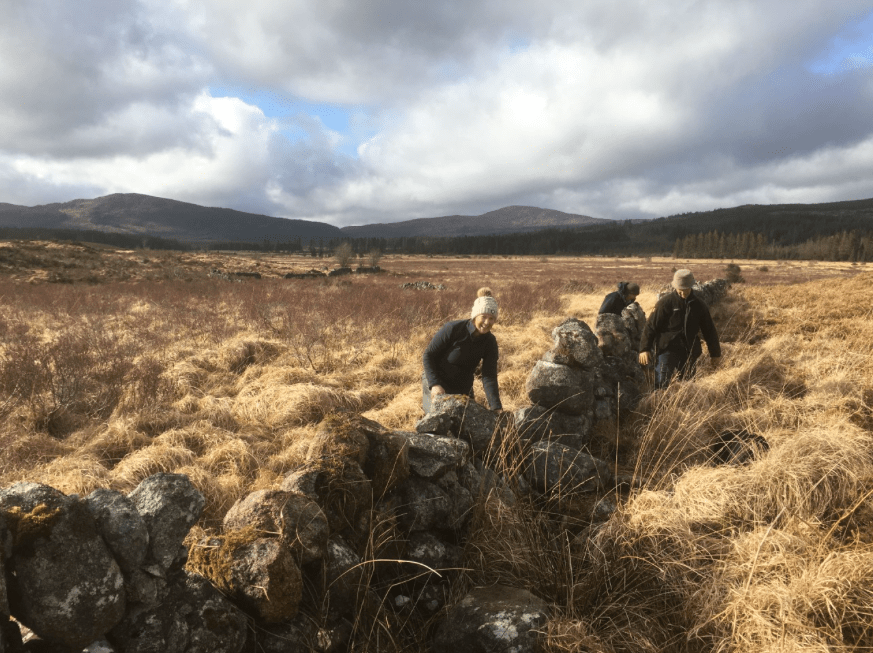
Low Airie, Mossdale – 12/3/20
The main obstacle at the new place is a lack of hard boundaries. The two hundred acre moor lies in a thin, rectangular slice, bounded to the south by the old Dumfries to Stranraer railway line and to the north by a deep, treacherous coil of dark river. There are some good stretches of dyke along this perimeter, but the overall effect is decidedly porous and gappy.
It’s my job to restore this boundary to full working order before the cattle can return here after an absence of almost forty years. It was always going to be a major piece of work, and I knew that I would have to stomach it sooner or later. Stock-proofing is a constant obstacle for conservation in marginal places – without the means to manage their livestock, farmers cannot get their animals into places which need to be grazed.
Repairing a crumbled network of dykes is slow, skilled and labour intensive work, but it is usually the best option. Properly maintained, dykes can last for centuries with very little input, and they often have the added bonus of being beautiful too. Some dykes are so badly knackered that resurrection seems impossible, but it’s worth remembering that all the component parts are still present and usable, and a steady approach towards reconstruction can soon add up. Restoring an old dyke seems like a forboding challenge when you have to dig each boulder out of the ground with a shovel before you can even lift it, but it’s surprising what can be achieved with a half day here and there.
Of course much of this is my own personal whimsy. In this day and age, nobody has the time to lovingly reassemble dykes in far-flung places. I can make emotive arguments to endorse the value of traditional stonework, but the normal “go-to” alternative is to build a wire fence. I think that’s a shame, but given that I am writing this with aching shoulders and badly torn hands, I can understand why people make that decision. I’m also conscious that I’m splitting hairs. If it’s a choice between a dyke and wire fence, I would choose a dyke. If it’s a choice between a wire fence and not getting livestock onto the hill, the answer is obvious.
Cost and speed dictate the proliferation of fences, but even on fair ground wire fences can cost seven or eight pounds per metre, that cost flies through the roof where there are boulders and bogs to navigate. A trend towards cheaper, shorter-lived fencing materials also means that the whole lot will have to be remade in fifteen or twenty years. Plus, there is the additional concern that fencing can be deadly to wildlife; particularly blackgame and grouse when they are flying at low level. I have seen enough grouse killed by wire fences to argue in favour of steel or plastic markers to increase visibility, but these simply add more expense to the business.
It’s also worth saying that while stock-proofing is the single greatest financial obstacle when it comes to grazing rough land, it’s unfair to view that cost without context. Native cattle on rough ground are famously cheap to run. While fencing seems expensive, it is often the only meaningful expense for a hill grazing project. Measured against the extraordinary costs involved in housing and managing intensive commercial cattle which spend part of the year indoors, the cost of a fence around the hill is close to negligible.
I have decided to restore the dyke around Low Airie, partly because I am stuck on the idea that my time is free and can be spent in lieu of money. I’m also drawn to undertake this work because it gets me outdoors in a staggeringly beautiful and important piece of countryside. It’s a rich buzz to look up from the stones and find hen harriers hunting in the sunshine, or the weary turn of a bog owl on his beat. In a matter of days, I will be dyking to the drone of blackgame at the lek, and that will be worth getting up for.
The condition of the dykes at Low Airie is worst in bracken and through the wettest ground where the stones have fallen and been buried in deep grass and litter. Each boulder has to be levered up from the sucking mud and replaced, and the end result is by no means beautiful. The men who built these dykes two centuries ago did a crisp and mathematically stunning job, and my efforts are badly staggered and gappy by comparison. In my defence, I have a lot to do and very little time to do it, even when friends come to lend a hand. Provided the dyke is impassible to cattle, I am happy to leave it a little lumpy. There will be time in due course to revisit some stretches and pull them down again in order to do a proper job, but for now it’s “patch it and move on”.
There is also plenty of wire work to do by the railway line, and there is an argument for using some electric tape to keep the beasts where I need them. All of this is to come, but I am haunted by the idea that I have been banging this drum for years, exhorting farmers and landowners to get livestock back into remote and awkward places. I’ve been given a chance to do some real good, and it would be a sad situation if I quailed from doing it myself.

 Bog Myrtle & Peat
Leave a comment