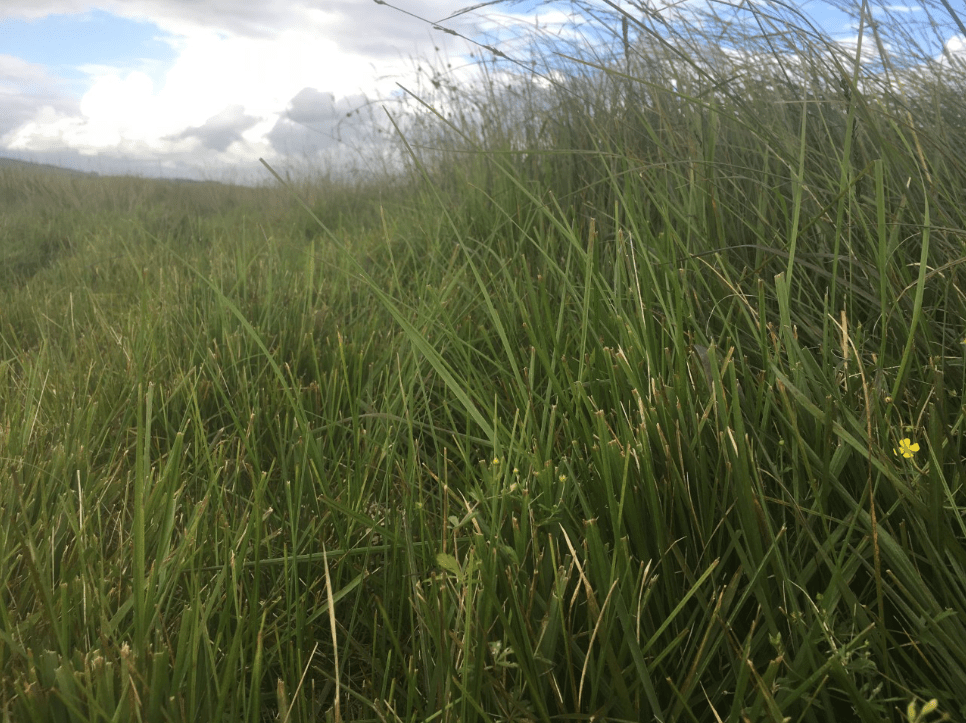
There’s a wide moss at the back of the house. It’s deep and wild and punctuated by enormous granite boulders. This is an excellent habitat for all kinds of wild birds; the grazing is usually deferred until the autumn and the grass grows deep and thick all summer. This system suits the farmer who owns the land and lives next door, and the winter grazing is a real asset, both to him and the birds which live there.
As a gesture of sympathetic generosity, I’ve been allowed to fence off and graze a small area of this moss for the last two summers. It’s been extremely interesting to keep an eye on the impact this has made to the conservation value of this land. My cattle have brought in some aspects of diversity to the summer sward, and now that they have all gone away to the bull, I had a chance to take a proper look yesterday as I fetched back the electric wires and poles from the summer’s fence.
For all it’s rough ground, galloways are designed to prosper on coarse moorland grasses. I had two calves born on this little patch, and the bull was grand and fat as cream after three months in the bracken and rushes. Their grazing has opened up the sward and introduced a whole wealth of botanical variety, but the cattle have also made a fine difference to the structure of the vegetation. They’ve broken up the uniformity and cut a little summer freshness into the place.
As I wound back the electric wire to pack it away, I was able to see the browse line between the grazed land and that which remains untouched. It was as clear as day; a “step” between short and tall. People talk about the “edge effect” for conservation; the attractive flux which springs up in the line between two different habitat types. By running an electric wire around a small piece of the moss, I managed to create almost seven hundred metres of “edge” between thick grass and short stuff. And so perhaps it’s no surprise that this is where I have been seeing pheasant and curlew chicks, young hares, snipe and rabbits. Pipits gather in their hundreds on the short grass, then birl away to the safety of the rushes when the sparrowhawk comes. By night, the owls hunt across the long grass and return to the short stuff to eat and preen. Adders love it short for basking, then they slip away into the tussocks to seek for mice and voles. There is hardly a bird, mammal or reptile which does not benefit from the spice of variety.
It’s hard to convey my excitement about tiny nuances of habitat management like these. I’m the first to admit that I’m still playing around in the shallow end of this work with a few beasts and some small pieces of land. I know the theory back to front and I’m up to my neck in projects like this across the country, but that does nothing to diminish the thrill of seeing it in my own place; conservation and habitat improvement work undertaken by my own beasts. By the time my neighbour puts his own beasts onto the moss in September, the grass will have grown again. The line will have blurred away and you will hardly be able to see where my cattle have been, but the benefits will persist.


 Bog Myrtle & Peat
Leave a comment