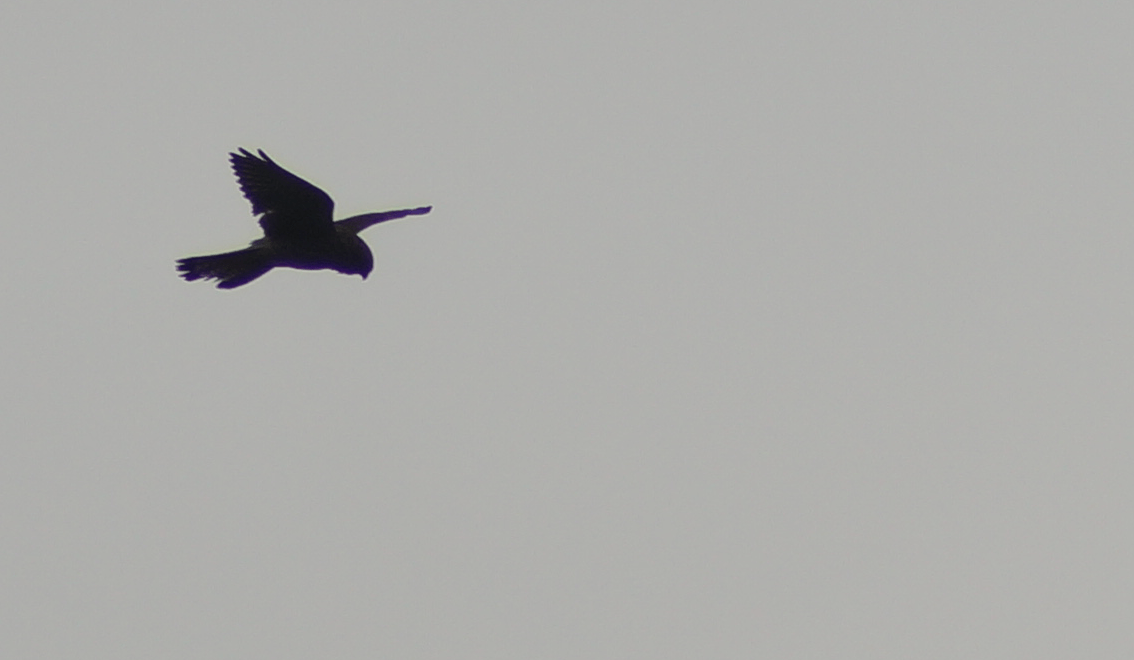
Kestrels have come to breed in the scots pine which stands above the byre for three years. It’s fine to watch the birds turning in the early days of spring, and I’m given a front-row seat in the neat complexity of their routine. The pair flies in high parallel lines across the moor and by the rough ground, then they bomb into the yard and harry the pigs with shrill, girlish laughter. This is a good place for mouse-hunters, and the wealth of kestrels is matched by the richness of owls and weasels. They’ve all done well with the oat crop, and while we’ve been spared the greasiness of rats, the chirping mice have ridden the wave of that crop like pirates.
The scots pine tree is an obvious spot for a nest. It has a commanding view across this place, and you can even see the sea from its crown. The kestrels build their nest in the gnarly old branches, and they begin the business of incubation. But they’ve failed now for three consecutive years because kestrels are not the only birds to grasp the strategic importance of this tree. Crows look on with envy as April begins, and they’ll soon start building nests of their own. The kestrels have to defend their claim.
The conflict is noisy and hard to miss. In our first year, the crows pressed the kestrels so hard and long that the little hunters abandoned their nest. In the second year, the eggs were stolen and I found them eaten out on a favourite boulder nearby. I don’t know if these eggs were eaten after the nest was abandoned or whether they were stolen from under the female, but a crow’s nest soon appeared in a different part of the tree. It seemed like history would repeat itself this year, but that honour went instead to a team of jackdaws. Five of them came to the tree as I fed the bull this morning, and in the chaos which ensued, a jackdaw quietly stole away with a small egg in its beak. The chances are that their nest will fail again this year, and soon there will be a crow on eggs of her own.
I used to see this as a power struggle. Kestrels and crows competed for the same tree and kestrels came off worse. It’s probably quite unusual for crows to eat kestrel eggs, and I used to interpret this kind of predation as the logical, opportunistic endpoint of territorial aggression. But seeing the jackdaws raid the nest served to remind me that kestrels are small and fragile birds, and notwithstanding hooked claws and a sharp beak, they’re a long way from the top of the foodchain. And it made me think back to the Langholm Project and the many harrier nests which were robbed and burgled by foxes and crows until the gamekeepers came back and helped to protect their eggs.
Having written about predators and predator control in the last few days, I’ve been thinking about the politics of killing to conserve. The subject is often bogged down in arguments about field sports and land management, but the kestrel’s disappointment brings predator control into a slightly different sphere. There’s no real incentive to protect kestrels as part of a wider fieldsports agenda, so I wonder how killing crows to save this nest would play with a wider audience.
The normal conclusion of our situation is that the kestrels retreat to a less good site; a sycamore tree on the edge of the forest. They’ve bred reasonably well there, and it seems like there’s no lasting damage. I try and catch the crows which nest in this tree, but the often understated truth of predator control is that it’s not easy. I always catch them, but I’ve never yet been able to do it before the kestrels are turfed out and so the removal of those crows is of no use to them. I’m consoled by their success elsewhere, but it always feels like these increasingly marginalised birds are being forced to make do.

 Bog Myrtle & Peat
Leave a comment