We have been working with cattle for thousands of years. Ancient Celts were herding folk, and their livestock provided the basis for an entire culture. The Celtic year was divided according to cyclical patterns of grazing, harvests and rebirth – the fundamentals of that life. Measured against modern priorities, perhaps it’s no wonder that the Celts feel so far away.
Beltane marked the start of summer, and cows were purified in rituals before heading out to pasture on the first of May. Animals were slaughtered at Samhain, and winter began with the festival on the first of November.
Alongside Beltane and Samhain, there was lughnasadh and imbolc, equidistant on the calendar. Lughnasadh falls on the first of August and represents the start of the harvest. Imbolc lies on the midpoint between the winter solstice and the spring equinox – the second day of February.
The word imbolc is derived from obscure Gaelic origins which stretch beyond the realms of certainty. There are many possible meanings, but a modern Irish expression I mbolg is used to describe pregnancy in livestock. One theory is that imbolc was traditionally the time when cattle first begin to show signs of a calf; their udders grow and provide an indication of all that lies ahead. I choose this meaning because my heifers showed their first udders within two days of imbolc. I had no idea about Celtic religion, but I am longing for my first calves and my curiosity was piqued by a festival which seem to recognise my enthusiasm.
In a broader sense, imbolc is the quickening of Spring; the first quiet steps out of winter. Imbolc is a time for snowdrops and hazel catkins; the song thrush sings in the stillness of dusk. These are fine details which might be overlooked in the busy clamour of June or July, but they are a claxon and a call to arms after months of starlit darkness. There is life in the world. Going about my business, I stack snapshots en passant which combine to make the heart swell – this place is on the move
- The first shelduck on the wet fields; a raucous red bill reflected in a low sun.
- A dark, half-hidden roebuck with his antlers blooming further in velvet each day.
- Dippers returned to the burn, bobbing and buzzing above the busy water.
- Hares running in the frost before dawn (a new frizz of excitement hitherto sombre old hands).
Imbolc belongs here. The festival was conceived in this landscape at a time when only nature and livestock were relevant. As I sink into farming, it’s hard not to chime with these priorities, and the years roll back with every new chore and task. Modern man has moved away from the land, but even the smallest step backwards is electrifying. Other Celtic festivals are transfixed by pastures and harvests, killing and calving. These same chores preoccupy modern farmers; the old life has changed, but it has not gone away. Dip in to the reality of agriculture and time collapses like a telescope. I am no spiritualist, but the relevance is compelling.
In due course, imbolc became Candlemas. The ancient pagan festival was assimilated into the Christian calendar because it was too important to erase. Christians compromised and reorganised their religion around native foundations. The ancient goddess Brigid was laundered and became St Brigid, the patron of imbolc.
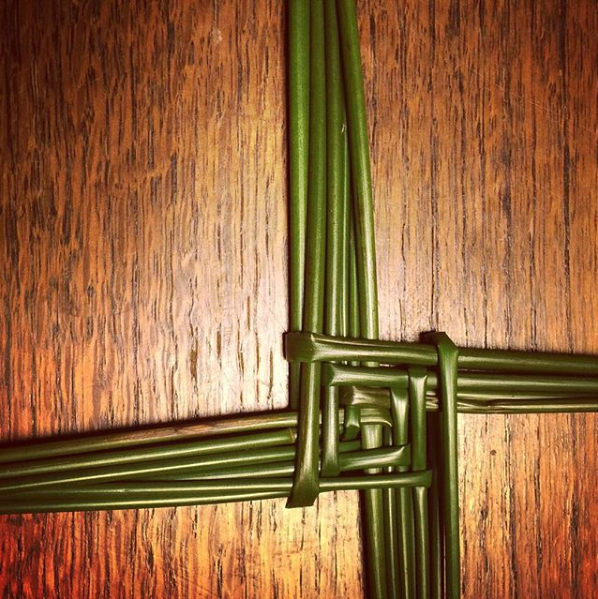
Flushed with the excitement of imbolc, I walked out into the rain and cut a handful of green rushes on the hill. Following direction from an out-dated website, I plaited the strips into the small, simple cross of St Brigid. Symbols like these have all but vanished from Galloway over the past Century, but this sign would have been well known as a symbol of good luck to my ancient relatives.
I don’t know Brigid’s story, but the symbolism has me spellbound – a woven fragment conveyed out of a dark, half-forgotten past. I’m not sure what ancient festivals will mean to me, but the first signs of spring are truly worth celebrating. Perhaps there is still room for old gods.

 Bog Myrtle & Peat
Leave a comment