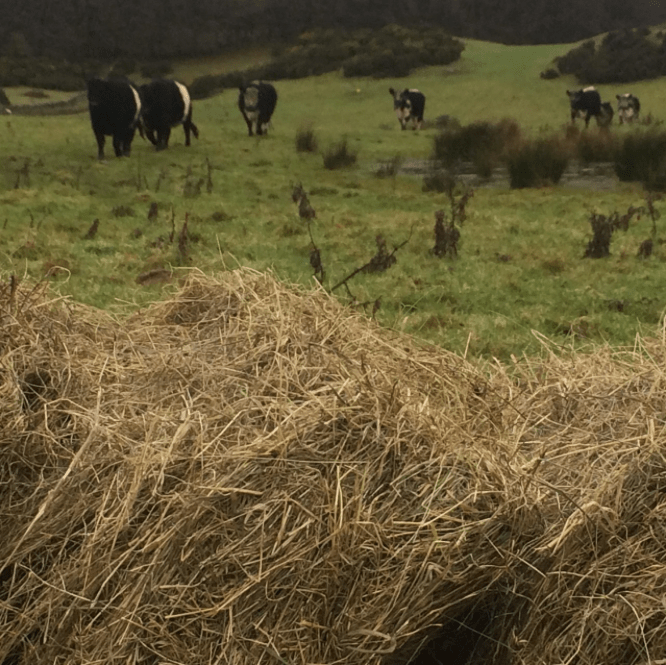
Our summer’s hay has received mixed reviews from the galloways. Some bales are beautiful and flossy, but others burst apart in clouds of mould like talcum powder. This mould is horrible stuff, and the heifers combine the powder with their frosty breath until they almost vanish behind a smoke screen. I’m assured that it will do them no harm, but this kind of feed is far from ideal.
We knew that some of the bales were damp even as we made them. There was an astonishing variety of moisture even in a small field, and good bales were made within a few feet of poor ones. There seemed to be little rhyme or reason to this, but the problems have not been helped by storage. The bad bales have not got better, and several of the good ones have grown mouldy. Some have had to be thrown away altogether, while others have gone for pig bedding. I still maintain that we were right to make hay, but we were very close to the dividing line where the cut grass should have been wrapped and made into silage.
The cattle are fed on a different spot every morning, and it is interesting to inspect the remains of the previous day’s bale when I go out. A sweet bale has often vanished without a trace, but poorer stuff is often visible in tufts and crusts of leftovers. This year’s haymaking has been hugely instructive, and I continue to learn about winter forage with every passing day – hay is not a definite article, it is a sliding scale running from sweet and pure to lank and lumpen. Galloways are a forgiving audience since they will eat almost anything, but lessons learnt this winter will be hugely useful when the summer comes again.

 Bog Myrtle & Peat
Leave a comment