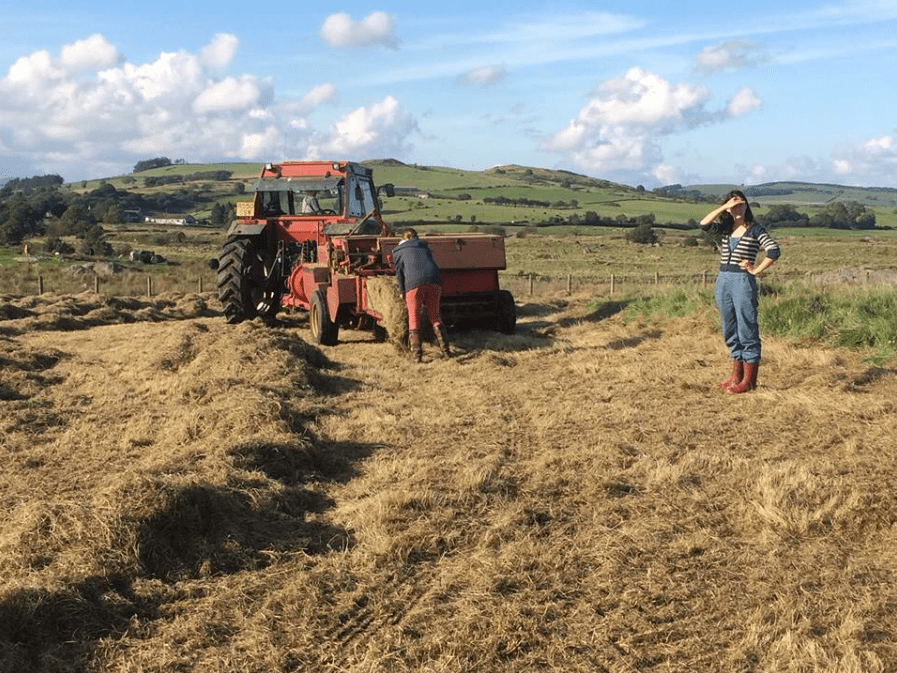
Having allowed a few days to let the dust settle, I can hardly resist a gloating post to record the fact that we made hay on Saturday with just moments to spare before the rain came. In the final few hours before the baler arrived, I kicked out the rows of hay one more time and found them flossy and light, tumbling in gales across the field to snag on the fence and build drifts against the dykes.
The moment of truth had arrived, and I was tantalised by the fleeting nature of it all – that morning, the dead grass had lain red and limp beneath a thick dew and veils of clammy autumn mist. Curlews flew invisibly overhead, calling in the cloud as I walked between the rows and prodded them gloomily with my boot. But during the course of seven hours, the sun and the breeze had stirred this aspiring compost into soft, downy billows of crackling hay. If we had missed this window, the dew would have started to fall again and the moment would have been lost.
I had no idea how much this science would blur into art, and I loved every second of the process, fatalistically obsessed by the certain knowledge that black clouds were lumbering off the Atlantic towards us with every passing minute. The baler was half an hour late, and I lay in a fever of anxiety as the minutes ticked past – the time was ripe, but it was slipping away.
And then the cavalry arrived – a wonderful old baler which scraped over our bridge and into the yard like a grand piano with just inches to spare between the gateposts. Soon we were churning out bales with machinery that came alive to a joyous clicking pulse of cogs. Bales were deposited onto the yellow ground as the sun began to set and lit up the entire landscape for miles in every direction. The dearly beloved hills of home were piled up in stacks of deep blue beneath the gathering clouds, and I was simultaneously filled with excitement and a pride which came close to tearful ecstasy. Those old hills have seen a thousand crops of hay from a thousand of my distant ancestors, and I was just taking my place in that queue. I had underestimated the heritage value of working on the land – the literal timelessness of soil and my own point of origin.
Friends and family turned up to help, and we laboured well on into the darkness building the bales into a dyke to help them dry still further. Tons of grass were hauled as the evening came on and the first stars began to emerge. At last we threw tarpaulins over the massive rampart, and then cracked open bottles of cold cider to drink as mallard flew beneath the rising moon and the first beads of dew began to form on the hawthorn berries. After two years of abstinence, I even smoked a cigarette and enjoyed the heady buzz of nicotine and alcohol which blended perfectly into the scent of hay and grease from the tractor. The field had been conjured into one hundred and eighty small bales of hay, and the process felt more meaningful and satisfying than anything I have achieved in almost ten years of work.
Perhaps the novelty would be less compelling if I was dealing with one thousand eight hundred bales of hay every year, but as a taste of what is possible, I was absolutely hooked. Another vein of life pumped fresh life into this farming project, and I was asleep before my head hit the pillow.


 Bog Myrtle & Peat
Leave a comment