Long-term readers will remember my attempts at growing game crops in previous years to boost partridge and blackgame habitats. These didn’t produce exactly the results I was hoping for, but the crops provided plenty of food for thought.
Lots of local people remember shooting black grouse and grey partridges from turnip fields on hill farms across Galloway into the 1970s and 80s, and one farmer friend vows that drilled turnips are the most game-friendly crop it is possible to grow. I hoped to resurrect some aspects of this process by sowing crops in 2012 and 2013, but the birds turned their noses up at me and totally ignored my hard work and investment. The same process has happened elsewhere when farmers have sown sacrificial cereal crops to conserve black grouse – the results have usually been disappointing, and I don’t know anyone who has persevered with the idea beyond a season or two.
The reality is that we’re asking a great deal of birds when we expect them to return to their old habits. There is nothing inherently hard-wired in a blackcock’s head which makes him seek out oat stooks or turnip fields – these are very human habitats, and historical records of blackgame as an arable raider are more a reflection of opportunism than innate behaviour. Behaviours passed down through generations of birds were lost when the big declines bit, and we can hardly expect the birds to rush back to upland arable when they simply have no idea what it is.
Perhaps a sustained and large scale resurrection of fodder crops would kickstart some old behaviours, but we have no idea how long it took the birds to colonise these crops in the first place. Perhaps we were growing oats for decades before blackgame learned that harvest time represented a feeding bonanza. We regard Thorburn’s Edwardian paintings of blackgame on the stooks as an archetypal symbol of man in harmony with nature, but it is really no different from a fox in a wheelie bin.
It’s no wonder that I was slightly disappointed by my first forays into arable agriculture, but the silver lining was a window into a mysterious world of soils, nutrients and plant life. I adamantly believe that stasis is bad for conservation, and that farming is bound together with wildlife in a system of flux and dynamism. Unmanaged land soon becomes less productive, and agricultural improvement can be a powerhouse for wildlife (provided that it is part of a balance).
My first crops made no difference to the black grouse, but they provided a leg-up for dozens of insect and plant species. I was thrilled to find that even when my crops were dead, gone and returned to grass, the field was still a magnet for curlews and lapwings. A human being would be hard pressed to tell the field apart from its neighbours, but my work had initiated some profound changes at a molecular level. Perhaps the crops had encouraged more worms or leatherjackets in the soil, or perhaps these invertebrates were more nutritious. The same processes are borne out by studies elsewhere, particularly in the forestry world where ploughing and fertilising new plantations in the 60s and 70s created an explosion of wildlife.
I don’t need to understand the science to feel a buzz of excitement at the possibilities this presents to my farming venture. It is so hard to quantify how this nutrient dynamic works, but I can’t help wondering how a general lack of investment in agricultural improvement in the uplands over the past forty years has contributed to declines of birds and wildlife of all kinds.
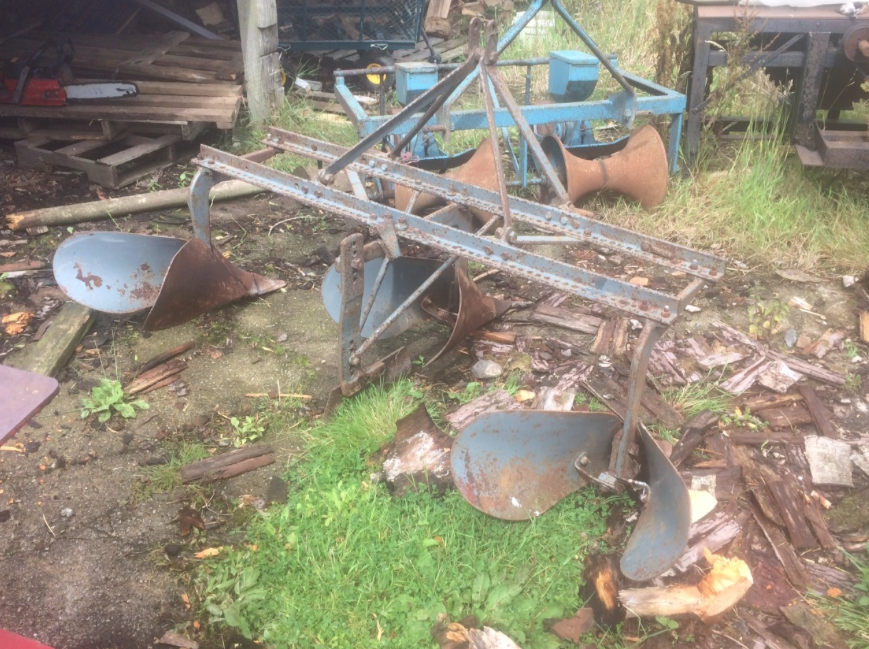
I was lucky enough to get hold of an old turnip seed drill and a drill plough (pictured above) at a farm sale on Saturday. They might look a little rusty, but both implements will run nicely behind our David Brown 996. The link between farming and conservation grows ever more fascinating, and I hope that 2018 will allow me to get further into the crux of the matter. If I can grow a few acres of turnips for my cattle, I can really get my teeth into the kind of mixed, traditional farming which has become a dying art form.
During my brief stint as an agriculture student last winter, I was scoffed at for aspiring to grow turnips. I was directed instead to feeds like palm kernel and soya meal. Modern agriculture often leaves me scratching my head, but if nothing else, I want my project to contribute towards a healthy, sustainable and diverse countryside. I chose to keep traditional cattle in a traditional landscape – perhaps it’s no surprise that I should now choose traditional methods of feeding them.

 Bog Myrtle & Peat
Leave a comment