I made an extremely heartening discovery this afternoon while moving crow traps around on the in-bye fields. I noticed a pair of crows building a nest in an ash tree in the middle of April, and I marked them down for a trap when time allowed. These trees command a fine viewpoint over the hayfields where curlews often nest, and when I first started to catch crows on the Chayne, I used to find the “sucked” eggshells of pheasants and waders littered across the green beneath the trees. The birds which use this site are often easy to catch over the course of 24 hours, but I occasionally have to sit out and shoot them if they prove to be shy of the traps.
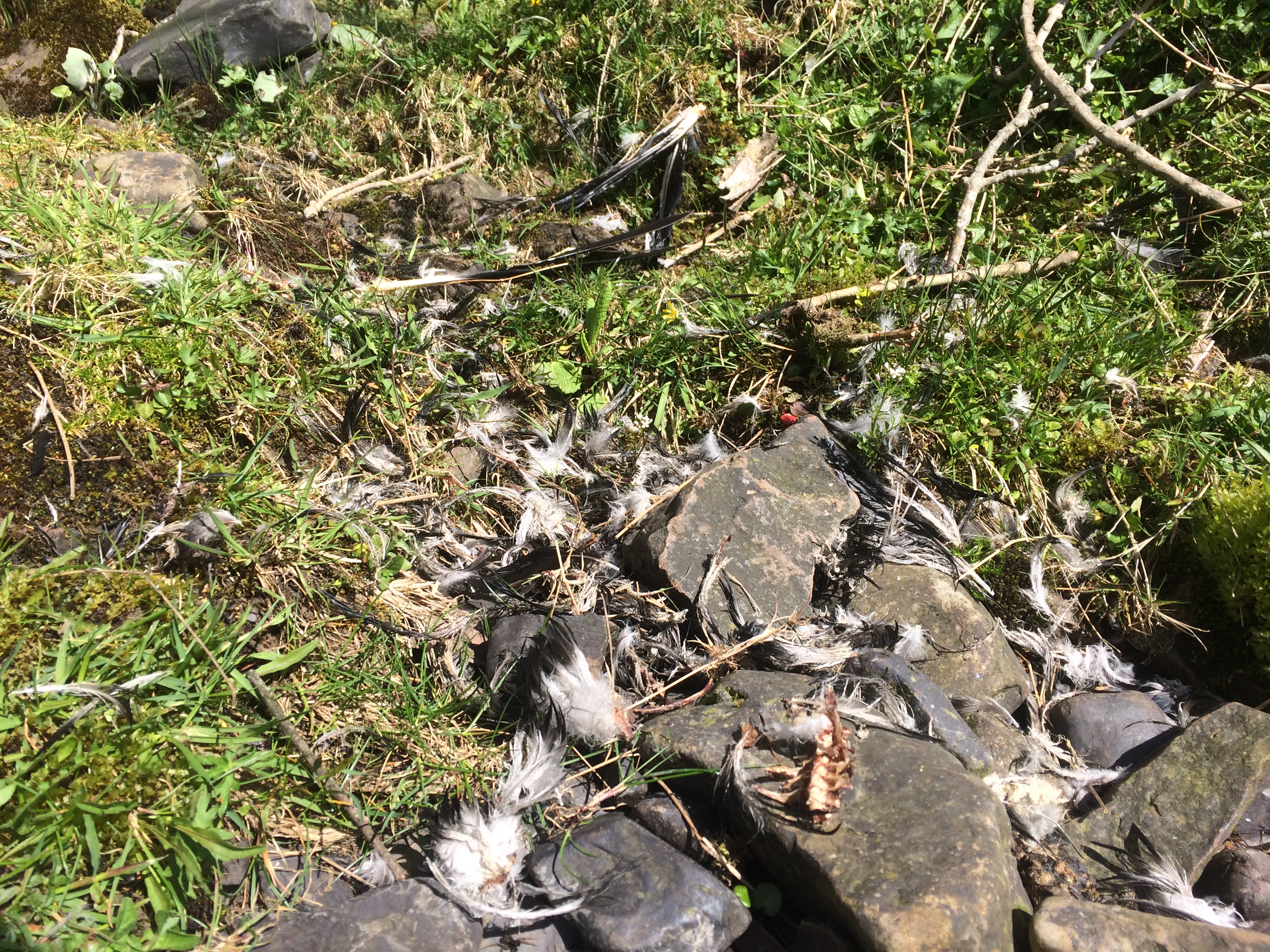
But I arrived with a trap this afternoon to find a mess of black feathers strewn around the cleugh where the tree stands. Conducting a full forensic investigation, I soon found parts of a spine and a long shard of leg bone. Something had beaten me to this pair of crows, and I felt almost certain that this was the work of a goshawk. I wondered if the hawk had killed the hen on the nest, since the greatest concentration of feathers was vertically beneath the twiggy platform, which was already beginning to look unkempt and abandoned.
A single goshawk has been surprisingly conspicuous on the lower part of the farm this year, and I have seen it hunting several times over the rushy ground. Goshawks are renowned for their habit of killing crows, and some people argue that in a “rewilded” world, these mighty raptors would do away with the need for larsen traps. I like this idea, but I can’t quite make my peace with the impact they have on other species like black grouse. This discovery comes just a few days after I received this photograph (below) from a gamekeeper friend in Aberdeenshire who found the shattered remains of a blackcock which may well have been hit by a gos.
There are several studies into how goshawks impact on blackgame and capercaillie in Sweden, and the results are surprisingly positive – the theory is that goshawks dispel egg thieves and form part of a more balanced environment to the grouse’s favour. But at the same time, there are all kinds of complex mechanisms in the deep Scandinavian forest which mean that it’s impossible to pick these results up and apply them directly to Britain.


 Bog Myrtle & Peat
Leave a comment