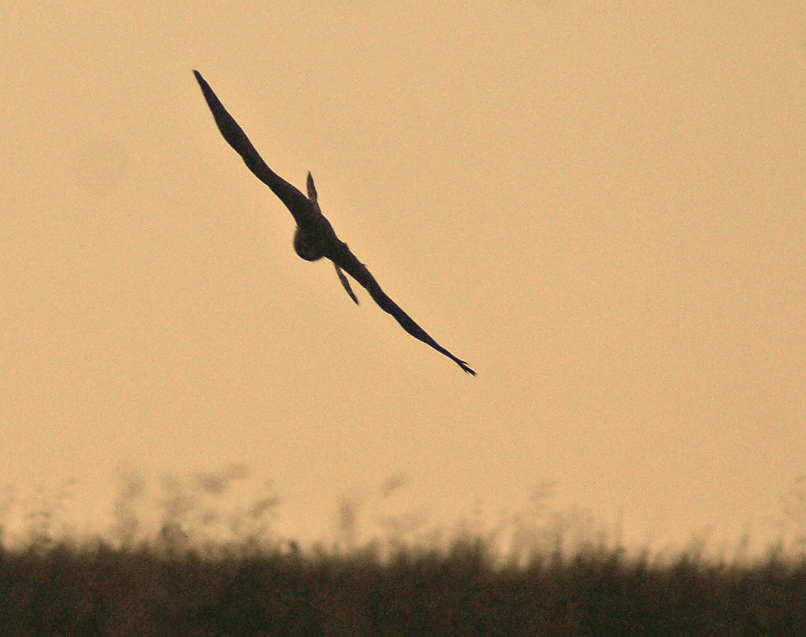
Watching a blue hen harrier cock hunting over the grass last night, I had a fresh opportunity to see how these birds interact with grouse. I had spotted a grouse cock quietly picking through the moss at a distance of perhaps five hundred yards, and the harrier’s arrival drew my eye away as the sun began to set. Harriers hunt on a knife-edge, and this bird was poised to grab anything it came across with the supreme acuity of a mouse-trap. Here and there, a pipit flared up and away but always too far out for the jaws of the trap to close. A harrier can pivot almost 180 degrees on a single wrist joint, and those yellow legs are as reactive as wire springs. If you’re small and fleshy you don’t stand a chance.
Over the course of ten minutes, the hunter meandered slowly over towards the grouse. I was mildly interested by the possibility of a collision between the two, since the tiny male harrier would never stand a chance at tackling a wily, full-grown grouse cock. In the event, the encounter came as a horrible shock to both parties. The harrier flared away like a scalded cat and rushed off into the wind as the grouse burst up almost directly beneath him. The two birds dashed in opposite directions, and I caught snatches of the grouse’s distant expletives on the breeze seconds later.
Of all the reading and asking around I’ve done on harriers over the past few years, I can find few records of these raptors killing healthy adult grouse. The huge majority of their upland diet at this time of year must be made up of finches and pipits, particularly after a poor year for voles, and while unwary late young grouse might still present a possibility, a well-grown adult has more serious problems to worry about.
There is an old 19th Century record of a harrier killing an adult blackcock, but I think that this is so wholly improbable that it must be a mistake – one of the two birds must have been misidentified. There is a stuffed male hen harrier in the museum at Carlisle, and it is a useful reference when you are only used to seeing them over vast areas of open ground. The bird is tiny – far too small to pose any real threat to an adult grouse. In reality, the huge majority of grouse eaten by harriers every year are tiny chicks – fuzzy little scraps of blood and bone with no survival strategy beyond “sit still”. Harriers were designed for this kind of quick-snap ambush hunting.


 Bog Myrtle & Peat
Leave a comment