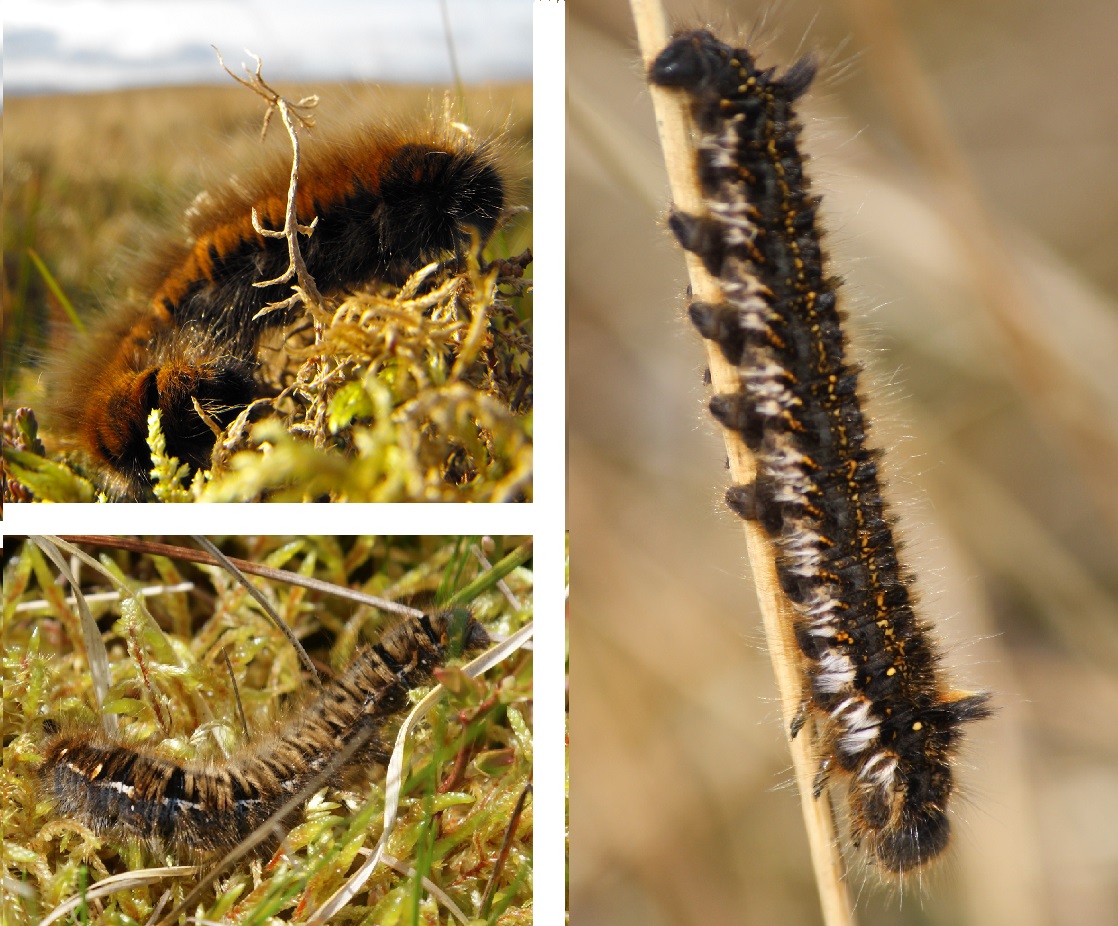
The recent flood of hairy caterpillars on the Chayne has coincided beautifully with the arrival of the cuckoos, and I had a great opportunity to watch a cock cuckoo wiping the bristles off a drinker moth caterpillar at close hand on Friday. As a finale, the cuckoo pinched one end of the caterpillar in its beak so that a drop of something fell out of it, then it swung the whole thing up into its beak and swallowed it in one gulp.
There are huge numbers of drinker caterpillars across the whole farm, but I am surprised by how few fox moth caterpillars there are this year. I don’t think I’ve seen a single one yet, when usually they are the most common species I find. I have a theory that perhaps the late snow of 2013 killed a huge number of fox moth caterpillars, because they are often the first out in the spring and they are vulnerable to low temperatures. We’re now dealing with the aftermath of this cold weather, and it will be interesting to see how and when the fox moths recover.
I have also spotted (for the first time) a number of northern eggar moth caterpillars, although these are restricted entirely to the more heathery areas. Drinkers and fox moths can usually be found anywhere on the bog, but the eggars are restricted entirely to the heather which was so badly damaged by beetle in 2013. They were formally identified as “oak eggars” on the ever trusty ispotnature.org (where you can post pictures of things that you would like to have identified), but given that they seem to be eating heather and not oak, birch, larch or rose, I can only assume that I am dealing with the northern race of this species.
For all their complexity, I find moths and caterpillars pretty interesting. Added to their appeal is their huge value as cuckoo food, so while these gargantuan fuzzy caterpillars are doomed to be disappointingly dull brown moths, perhaps the best they can hope for is to be eaten by one of the most fascinating birds on the hill.

 Bog Myrtle & Peat
Leave a comment