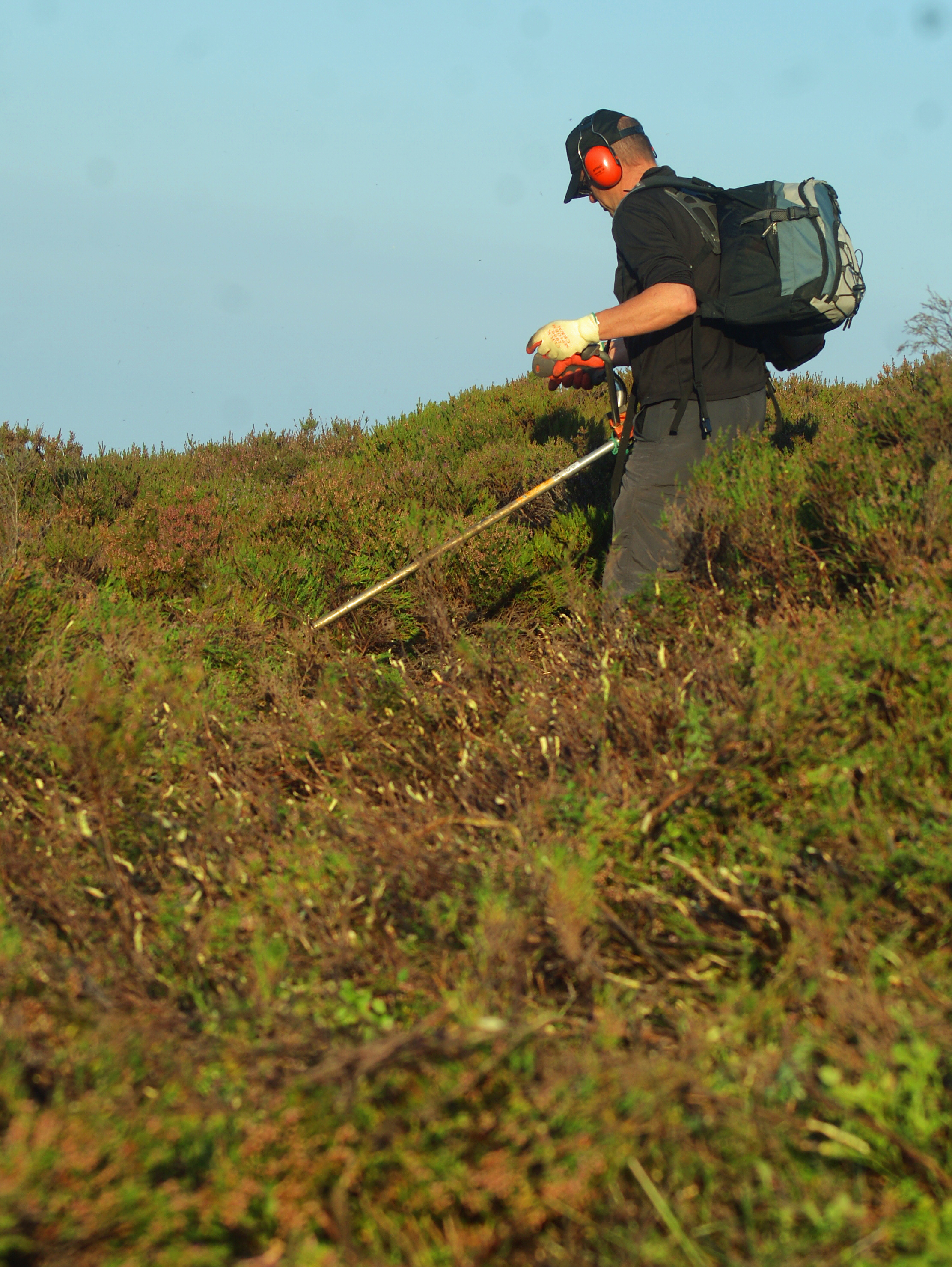
Perhaps the greatest challenge facing our small grouse syndicate down on the Solway coast is the huge extent of old, mature heather and the fact that it lies on extremely steep hill faces. It is tricky to burn, since the hill is surrounded on almost every side by forestry plantations, and a lack of management over the past ten years has meant that there are no firebreaks or even much in the way of paths or tracks. With the exception of a small fraction of land which can be reached by quad bike, the huge majority of the hill is a definite “no-go area” for machinery of any sort.
Extensive uniform spreads of heather make controlled burning tricky at the best of times, and we have until recently been stuck in a awkward position which essentially boils down to being unable to manage heather because it has not been managed. One third of the heather was burnt off two years ago during a wildfire, but that still leaves hundreds of acres which have not been touched in any way for a considerable length of time. Interestingly, part of the solution seems to be cutting by hand.
Using standard strimmers fitted with specialised cutting discs, it is possible to mow long, wavy lines through the taller vegetation. It is a slow process, but very satisfying to see heather plants blown away like threads of grass before the mosquito whine of the strimmer. Around 300 metres of 2.5 metre wide track can be cut every hour, which sounds slow compared to a tractor or argocat but when it is your only management option, it is hard to quibble over distances and times. It’s either a slow job or no job.
The quality of the cutting varies hugely. On rough, broken ground it is difficult to get the strimmer head down into the stick properly for fear of touching granite boulders lurking beneath the moss, but where the ground is soft, some really excellent cuts become possible. In some spots, it is possible to trim down the stick to three or four inches, skimming harmlessly over the sphagnum and nipping off the blaeberry shoots with all the neatness of a pair of nail scissors. Because the heather is so old, it shouldn’t respond very well to being cut, but actually the results are not at all bad. We have found that sprigs of fresh growth appear within a few months of cutting, and the fact that this nutritious foliage is within reach of passing grouse can only be a good thing, particularly since elsewhere on the hill they are expected to stand on tip-toes to reach anything halfway decent in terms of forage.
The cuts are almost too narrow to function as firebreaks. In some places they do work, but we have had some hairy moments with others and I would rather not trust them again. Aside from anything else, narrow cuts do allow you to cautiously burn a more substantial firebreak made up of little “mouthfuls” taken from backburning gently into them. On the right day, you can work along narrow cuts, lighting tiny fires that are just five or six feet into the windward side of the cut and letting them burn back and fizzle out. With patience, the cuts can be widened into fantastic firebreaks, and it is difficult to imagine how this could be done without them on such a huge area of unmanaged moorland.
It is easy to feel overwhelmed when tackling a huge area of moorland, and while people may laugh to see heather being cut using little two-stroke engines, it is a surprisingly useful (and cheap) way of getting started. Interestingly, within hours of the first cuts being put onto the hill three years ago, grouse dropped into them with that entertaining curiosity they display to anything new on the hill. Even months later, the cuts were being regularly topped up with piles of fresh shit, showing less about the food value of fine lines in the heather and more about the importance of breaking up habitats to introduce diversity. At a rate of 300 metres per hour, it’s going to be a long winter. But knowing that we will be able to start a proper burning programme in the spring makes it all worthwhile.


 Bog Myrtle & Peat
Leave a comment