Having started to develop an interest in hill walking a few years ago, I find that one of the most interesting elements of the pastime is watching other people do it. In my limited experience, human beings have a range of reasons for wanting to ascend steep, challenging mountains, but in Scotland there is a unique school of hill walkers who climb the hills as part of a nationalist self-discovery. In the pub afterwards, they noisily list names of beinns, toms and bealachs as if they were old friends, pretending that their tongues glide easily over the obscure gaelic syllables. These few are motivated by a drive that is as keen as any cairn-slapping munro bagger, and it is surprising how often they are encountered on the high ground.
Usually, hill walkers are dressed up like nylon dragonflies, and it is entertaining to watch the thin procession of humanity as it grinds along the wavy, zig-zag footpaths up to the summit and home again. Unfortunately, the very height which designates a munro is slightly over the invisible line of altitude at which the terrain and vegetation really get interesting. An interest in “Scots alpine” habitats requires a certain resignation to the company of others, even several miles from the nearest town or village. The great consolation is that the vast majority of walkers stick religiously to the trampled trench that was once a footpath. From this soggy gutter, they certainly do take pleasure from their surroundings and audibly remark upon the flora and fauna around them, but few realise that even venturing a few feet away from the path reveals a majestic world of true solitude.
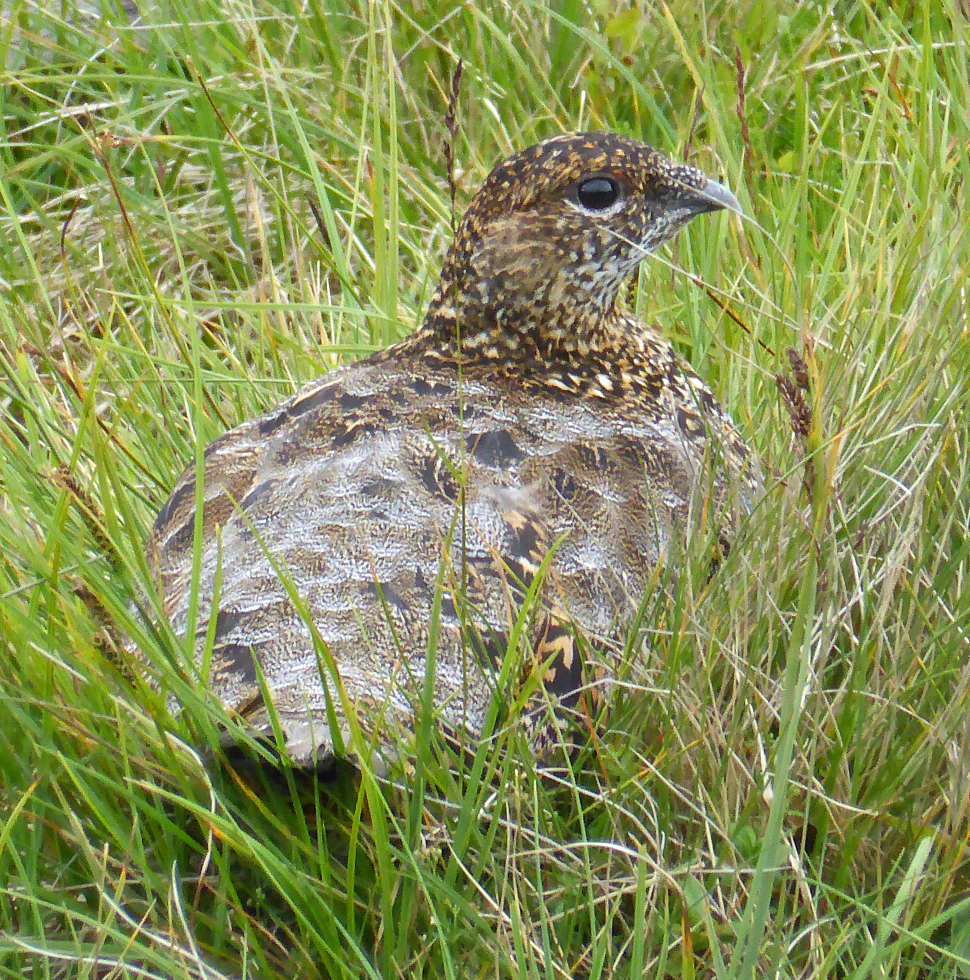
When the major ski centres of Scotland were being built, conservationists fretted that the clanking pulleys and shrieking holidaymakers would disturb the wildlife and threaten its viability. Within a few seasons, it became apparent that ptarmigan in particular are strangely accepting of human intrusion. These gentle little beings allow humans to approach far closer than red grouse ever would, and so took man’s arrival on the high ground with a pinch of salt. That said, they are not stupid. They are surprisingly forgiving of bobble hats, but in a toss-up between sharing the hill with sweating humans and crouching in the timeless windswept wilderness a few feet over the nearest rise, they frequently opt for the latter. While walkers in Angus, Aberdeenshire and the Cairngorms will often encounter ptarmigan on their travels, this small number of visible birds is just the tip of the iceberg. Venture away from the well trodden paths and an entire world of wildlife just waits to be uncovered.
Walking in Aberdeenshire at the beginning of August, I found dozens of ptarmigan just a few yards over the leeward side of a great shattered corrie. I spent three hours watching coveys of young birds as they ticked their tails and jerkily worked through a mattress of crowberry, sometimes almost within hand’s reach. Descending to the path for a speedy return to the car, I mentioned to a passing walker that I had been amazed by the quantity of ptarmigan I had seen. I spoke before I had thought, remembering how indifferent most people are to birds and wildlife. I expected him to say “what’s a ptarmigan?” or, more directly, “why are you talking to me?” but instead was surprised to hear that he hadn’t seen one all day, despite having been on a great circuit of munros which lie together in a semi-circular chain.
Later that day and a few miles further south at the huge ski emporium at Glenshee, I came across ptarmigan in surprising quantity during a tangential wander between the Cairnwell and Carn Aosda. Most people sigh and roll their eyes when Glenshee is mentioned, but although the traffic is an irritant and the ski slopes do look ugly in the summer, the sheer teeming quantity of wildlife is a sight to behold. Blue hares seem to lurk behind every stone, and the ranges of red grouse and ptarmigan overlap to such an extent that for a wide band across the contours, it can be quite different to tell the difference between the two during high summer when the only thing you can see is an arrogant, stately head above the crowberry.
In amongst the springing mat of vegetation, I found determined sprigs of cloudberry thrusting through, with wrinkled, papery leaves holding their own above the low canopy. I am always inclined to treat cloudberry as something of a novelty, but since I first identified it, I have found it quite widely distributed across Britain, from Caithness to Derbyshire. With its geranium leaves, cloudberry certainly looks unusual in the humble carpet of wind-nipped ling, crowberry and cowberry, but it is hardly what might be described as rare.
Particularly eye-catching are the monstrous red berries, which to my childish eye resemble haemorroids. Undeterred by proctological comparisons, I have eaten a few cloudberries, but find them extremely watery and tasteless. There is a twinkle of sweetness in there, but there is no comparison with an August blaeberry. In areas where there is even a faint grazing pressure, cloudberry is one of the first to lose its berry, making the angry, swollen fruit quite rare to see in many places. Although it is not restricted to extremely high ground, perhaps it is more often noticed there, where sheep and deer are less likely to nip off the stiff, woody stalk which acts as an inviting tee for passing browsers. Comparing it with Mull, where I had been walking on the previous day, the landscape was unrecognisably different. Where the west coast had rustled to the sound of a million grassheads, the summer months on these east coast hills bring flowers, fat berries and an irrepressible swell of prosperity.
In terms of blue hares, there is a real pleasure to be taken in watching these odd beasts as they trundle silently over the moss. It often seems a shame that they are shot as a control measure for ticks as part of grouse moor management, but I realise that I view them as a rare novelty and feel protective of them as a result. Walking down from the Cairnwell with hares flickering around my feet like midges, I had the opportunity to think about these beasts in objective terms. More on this to come.


 Bog Myrtle & Peat
Leave a comment