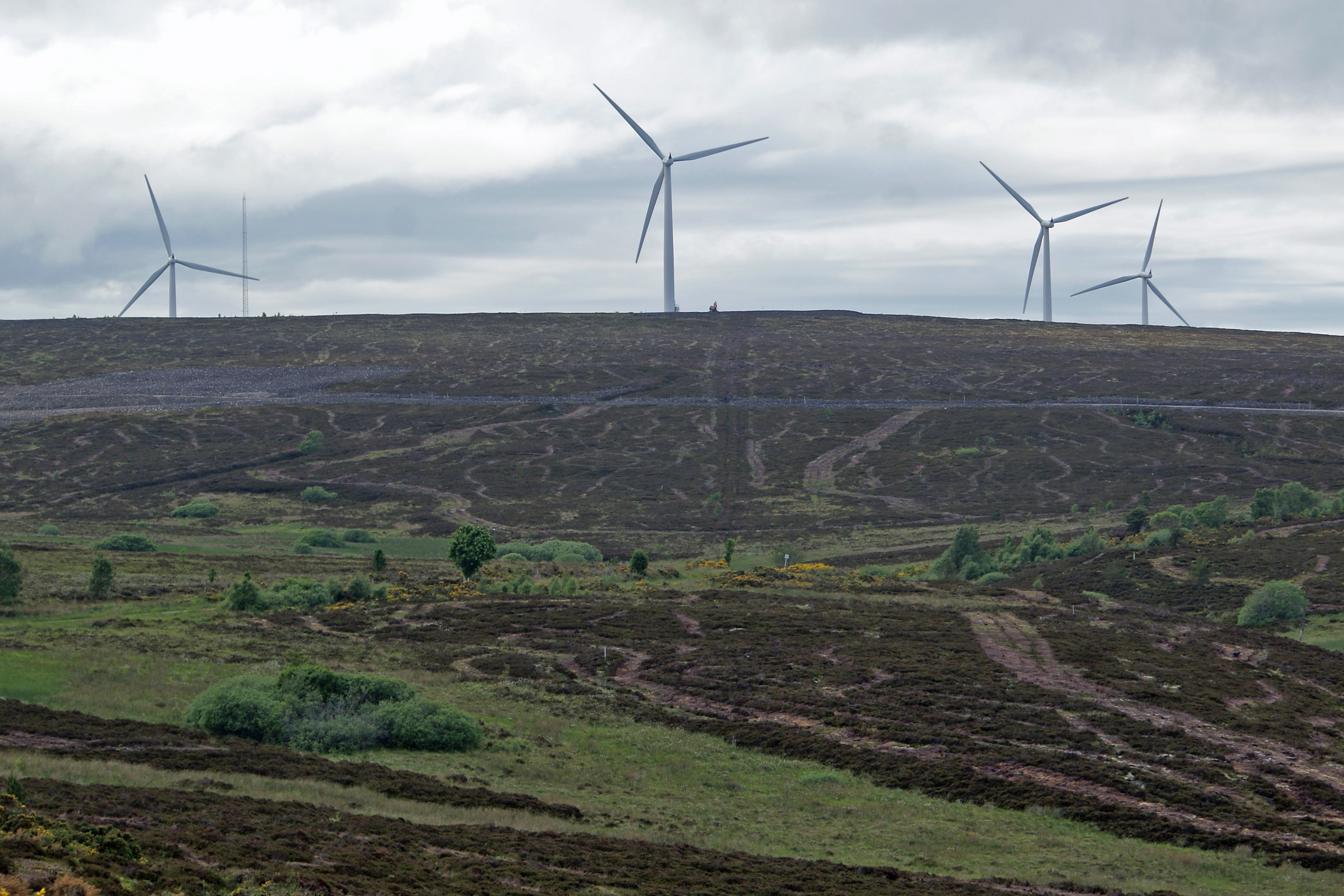
Heading to the North East of Scotland last week, I had the opportunity to spend a few hours in the magnificent hills of Strathdon (where there are so many black grouse that the Pennines would blush to see them), before heading over the heights of Lecht and down onto Speyside to visit Dick Bartlett, who is representing a new school of thought when it comes to heather management. Having posted before about innovative heather cutting which I saw in the Peak District, it was interesting to compare the small, tidily designed cuts on Peak Naze near Glossop with a prime example of so-called “Narrow Strip Matrix” cutting on a hill in Morayshire.
Dick Bartlett has masterminded the NSM technique, running wavy parallel lines across the heather with a horizontal disk flail, then crossing them with a system of perpendicular wavy lines to create an irregular grid with fine tracks lying like a net across the area. Not only are a huge number of potential burns created by this technique (each one bounded by a neat little firebreak in any weather or wind direction), but the gridwork itself functions as mile after mile of “edge” habitat, suitable for grouse. Along with larger cuts lying periodically across the hill to function as failsafe firebreaks, the network of 5’6″ wide passages creates a maze of habitat which is fantastic for grouse. With some patches of heather burnt and others left on a long (this area of Scotland has a surprisingly long) rotation, the wobbly-looking gridwork provides a number of functions for which burning alone has no real equivalent.
This is where cutting really ensures its long-term future as a management tool – in specialising in things that burning cannot do. If you guage the efficiency of a moor’s management by the presence of tennis-court sized burns across a huge expanse, then cutting is never going to be of serious value to you other than putting in the odd firebreak here and there. When tractors and flails try to replicate the effects of fire, they very seldom manage to pull it off. But all too often, tractors and flails are written off altogether because they don’t do what fire does, even though they have the potential to do different but equally valuable things.
There is no burning equivalent of the NSM, yet here is a management technique which supplies adults and chicks with the same access to plant (and insect food) as burns do without ever forcing them to leave the security of taller heather more than two or three feet away. Close cut areas let chicks dry out and keep warm in the wet weather, while passageways of short heather allow hens to lead broods safely from burn to burn without traipsing them through rank and hazardous tick-filled heather. Despite the relative slowness of heather regeneration from the cuts on Speyside, some great blaeberry recovery provides good feeding within just a few months and the heather is not all that far behind it (provided it is young enough to come back from the stick). Breaks in the long, continuous cuts foil low-level hawk attacks by making raptors jump a hurdle of mature heather every twenty five or thirty metres, and while it’s easy for a fox to ambush a sitting hen just outside the short boundary of a burn, I pity the charlie who has to search along mile after mile of cutting for his chance at a clocker.
In terms of aesthetics, the narrow cuts really don’t look all that bad. On areas of formerly drained moorland, the heather coverage breaks away where the ditches have collapsed, leaving parallel streaks of mossy green across otherwise uniform undergrowth. Similarly, the NSM system leaves an impression more reminsicent of a curious and antiquated attempt to drain than evidence of a deliberate management technique. Twisting, bendy cuts make the heather look strangely fractured, but your eye quickly adjusts to it and assumes that it is in some way normal. Some of the larger firebreaks do look quite obvious and ugly, but if you were to be pedantic and safety conscious, you could argue that every significant area of heather in the country should have a dull, ugly firebreak around it in one form or another.
There are those (mainly those who are determined to find anything to pick holes in grouse shooting) who would say that, no matter what form they take, both cuts and burns are unacceptably ugly. Looking at extensive cuts (above) and burns (below), I personally don’t have a problem with either, particularly if the alternative is no management at all. As I’ve written before on this blog, the best management technique is not cutting or burning but a combination of the two. The NSM system exemplifies this – the best of both cutting and burning becomes available.
Dick’s website British Moorlands has a huge amount of information relating to everything from cutting and burning to a system of remote sensors so that gamekeepers can keep a closer eye on their traps and snares. It makes for interesting reading, and while there’s no doubt that the NSM system is not applicable everywhere, it’s heartening to know that there are always new ways of dealing with old problems, and that the search for heather management techniques is never over. I gathered a huge amount of good material during a single day with Dick, and more posts on this blog will appear in due course to cover my trip to Speyside.

 Bog Myrtle & Peat
Leave a comment