Having visited the Langholm Moor Demonstration Project a few times over the past eighteen months, it’s been interesting to see the various techniques used to restore the horrendous damage caused by heather beetle which took place largely during 2010. More than a thousand acres of heather were wiped out altogether during these outbreaks, and without any intervention they would quickly have reverted to a grass-dominant mixture – indeed, some small patches which haven’t been treated since the outbreak serve as a stark warning against failing to manage beetle damage. These little corners are now home to some well established clumps of molinia grass, which in due course will form self-perpetuating tussocks through which it is impossible for anything productive to grow. Silver, woody stems stick out of these emerging banks of molinia as if to remind the observer that heather “was ‘ere”.
After a serious beetle outbreak, the heather plants are dead and cannot regenerate. Grass obviously grows much faster than heather, so when dead plants are left untreated, grass quickly invades the area and stifles the life from any young heather plants which are trying to grow up and replace the previous generation. To combat this, areas of dead heather are sprayed with glyphosate (round-up), which kills the grass so that everything is dead. This puts all plant life on a level playing field by ensuring that all subsequent regrowth will then come from seed.
Once the area is sprayed, it is then cut with a flail, which mashes up the stalky remains of the heather and dry moss into a wet, absorbant seed bed which looks rather like the damp cotton wool used to germinate watercress in classrooms. There is usually enough heather seed in the moss to allow for a surprisingly impressive amount of natural regeneration – after all, heather seed can survive and remain viable for almost a century. Where the heather seedbank is thin or failing, seed which has been harvested and treated can be spread over the area to bulk up the concentration of young heather plants, but this is not normally necessary after a beetle outbreak on well established moorland.
Through this flailed mash of seed and moss come heather plants and grass seedlings together. It’s only after a two or more years that grass dominance will begin to smother and suppress the heather plants, and during this time, regenerating heather stands can look very grassy. Many of these emerging grasses are quite useful to birds, particularly when they are young plants with accessible seeds.
As and when the invasive grasses begin to pose a problem for the heather, they can be sprayed off with a selective graminicide which will not harm the heather, leaving a heather dominant mixture. There will always be some grass in this mixture, but heather will be able to predominate. The theory behind this heather beetle treatment is relatively straightforward, but it is not wholly popular for some conservationists, who view the pro-active management of moorland as being in conflict with the perceived “natural ways” of the hills. Four wheel drive tractors spraying weedkillers do not make a very environmentally sensitive impression, but Langholm is a fantastic example of how apparently “interventionist” treatments provide resoundingly successful outcomes.
Areas at Langholm have been sprayed and flailed in the past eighteen months. Already, the growth of heather is astonishingly rapid and some plants are almost seven or eight inches high. But this is not an exercise in heather farming. Langholm traditionally has far larger grouse clutch and brood sizes than the national average, and this is often attributed to the amount of cotton grass flowers which the hens have access to in March and April. Last week, the moor was bobbing with white cotton grass fruits – a long way from the cynical “monoculture” of heather which many detractors of grouse moor management are keen to tut and shake their heads at.
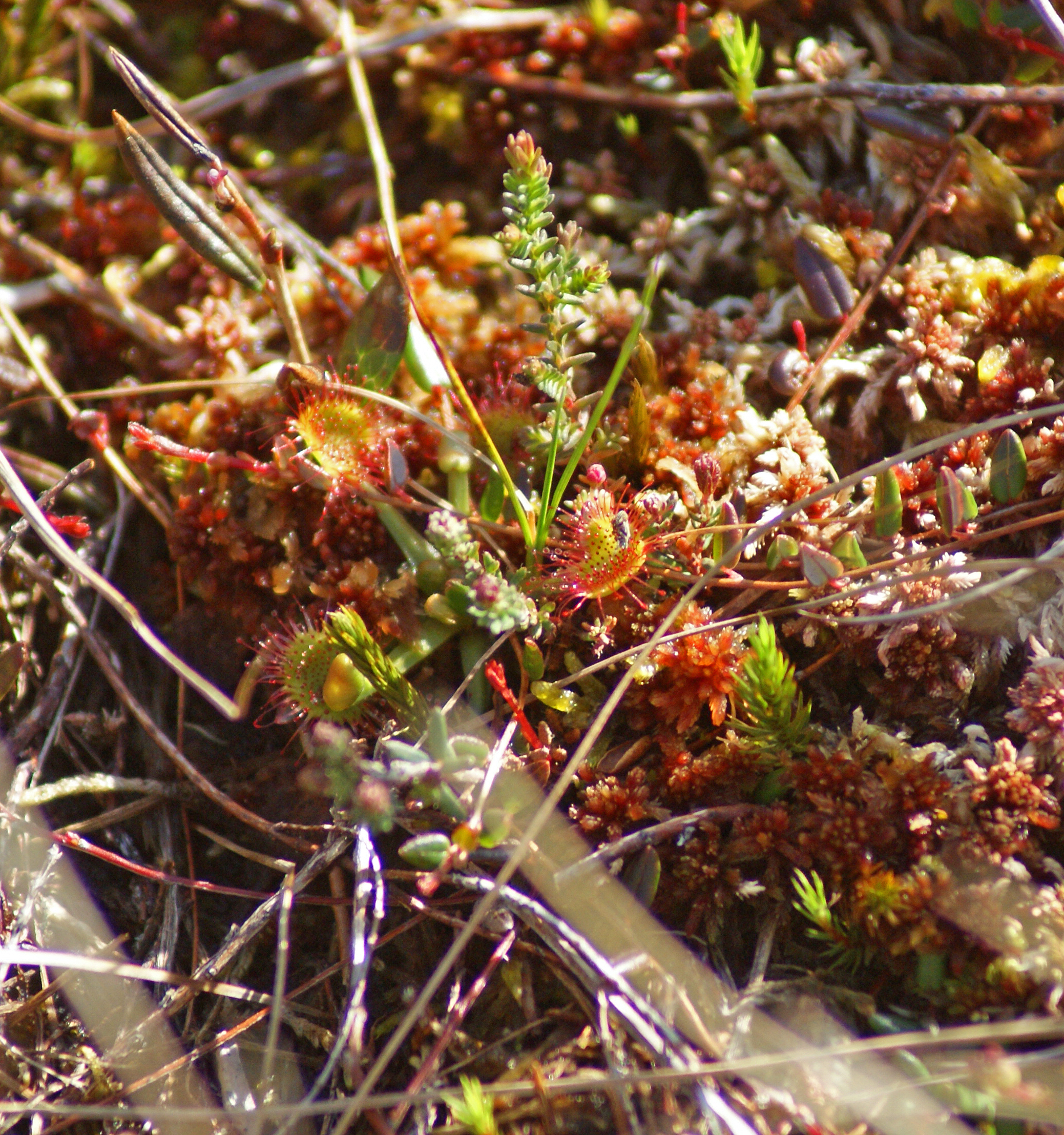
But bog cotton is just the thin end of the wedge. I took a photograph of a young sundew plant growing on an area of recently sprayed and mowed heather at Langholm (above), and it was only when I got home and examined the image on the computer that I also spotted bog rosemary, blaeberry and cranberry, as well as heather and sphagnum plants which both look to be “in the pink” after the treatment. The seeds of these plants clearly respond well to management, and indeed it’s hard to imagine such a great diversity either on grass dominated moorland or in unmanaged rank heather. There’s no question that this form of management produces results which go far beyond the stereotypical “more heather, more grouse” attitude which is popularly associated with shooting in the uplands, and it seems decidedly at odds with the idea of “barren” and “bare” moorlands which seems to be receiving attention just now in the media.
It’s impossible to use Langholm as a case to absolve the negative aspects of moorland management wherever it occurs, but in terms of the moor’s status as a “demonstration project”, it is showing us very clearly that active upland management sustains and preserves biodiversity, even in the face of challenges like heather beetle. This mix of species at Langholm is responsible for making the moor one of the most nutritionally productive moors for grouse in the country, and it flies in the face of the “old school” of moorland managers who saw value in nothing but heather. Langholm’s response to heather beetle over the past three years has presented a fantastic, progressive victory for conservation, and it’s time that the shooting community started to spread the word.


 Bog Myrtle & Peat
Leave a comment