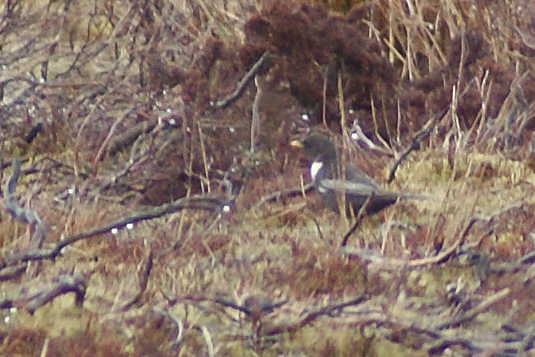
Getting to know the Peak District is proving to be a very worthwhile exercise. A day spent walking in the hills above the Upper Derwent Valley yesterday with the National Trust tenant produced a jaw-dropping array of wild birds, and it was extremely exciting to get my first proper look at a ring ouzel. Having only ever seen a ring ouzel from a great distance in Caithness a few years ago, I was thrilled to see a second bird at a distance of around fifty yards, hopping keenly through an area of recently burnt heather. Just a few paces further on, I disturbed another two ouzels which flew weirdly away over the wet heather. The marbled black shapes looked for a second like merlins as they flew, but when they landed and bobbed their white bibs cheerfully in the rain, there was no mistaking them. Ouzels used to be extremely common in Galloway, but from what I can gather they are now extinct as a breeding bird. As I watched the incongruous yellow beaks ducking up and down, I made a mental note to build suitable habitat for them back into the Chayne over the next few years.
There were plenty of red grouse, with cocks standing proudly out in the burns and hens lurking secretly just inside the longer heather. Judging by previous years, they should just be starting to lay, but there were no nests or eggs to be found as I walked. Swarms of golden plover came writhing through the sweating clouds of water vapour, turning over the moss to land abruptly in groups of fifty and sixty, where their heads broke the horizon like a rack of skittles. Lapwings jerked and twisted in the wind, sweeping down on exaggerated paddle wings to mob some unseen foe. Although I am used to seeing curlews in abundance, the high-arching display flights brought a homely air of familiarity to an area of moorland which was visibly buzzing with life. As if to add to the variety, faded white hares rose spookily out of the longer heather, seizing the moss with their long front legs and flinging it jerkily out behind them as they cantered off in a series of zig-zags.
I’m sure he won’t mind my mentioning it, but the last time I posted about the Peak District, a reader of this blog commented that he had visited the same area and had been appalled by the lack of visible raptors. He equated this absence with the suggestion of unseen persecution being dealt out to the birds of prey which ought to frequent the area. Purely as an exercise, I kept a note of the predators I saw during those few hours above Ladybower Reservoir. In total, I saw twenty five ravens, two buzzards and two short eared owls. I also saw the remains of two grouse which had been killed by peregrines during the last week. I have an inherent distrust of any human estimation of “potential habitats” (which usually leads to impossible guesstimates of how many individuals there should be in a particular area, as seen with hen harriers), but it was clear to me that while there is an obvious shooting interest in the area, there is also a range of conspicuous predators.
The Peak District is relatively new to me, and it’s not for me to comment on raptor persecution in the area – I simply don’t know enough about it. But I would say that it is a crying shame that while so many endangered species are thriving in these hills under the management of private tenants who (along with government funding) invest thousands of pounds of their own money into the land, the entire exercise is being deliberately soured by the single spectral issue of persecution and the fact that some people have an issue with grouse shooting. While there is no doubt that raptor persecution is a serious issue which needs to be dealt with, moorland management for red grouse is about so much more. As I watched the ouzels flickering through the freshly burnt ground, the thought occured to me that if half the press attention was given to the abundance of these critically endangered birds on the hills above Ladybower Reservoir as is given to the sustained campaign to villify grouse shooters, the nation would be able to have a much more constructive discussion about moorland management.
One of the reasons why I don’t write about raptor persecution on this blog very often is because the issue is so stale and the arguments so entrenched that discussion serves little purpose. I also write around the issue because dwelling on the activities of the few does such a tremendous disservice to all that sensible grouse moor management can deliver.


 Bog Myrtle & Peat
Leave a comment