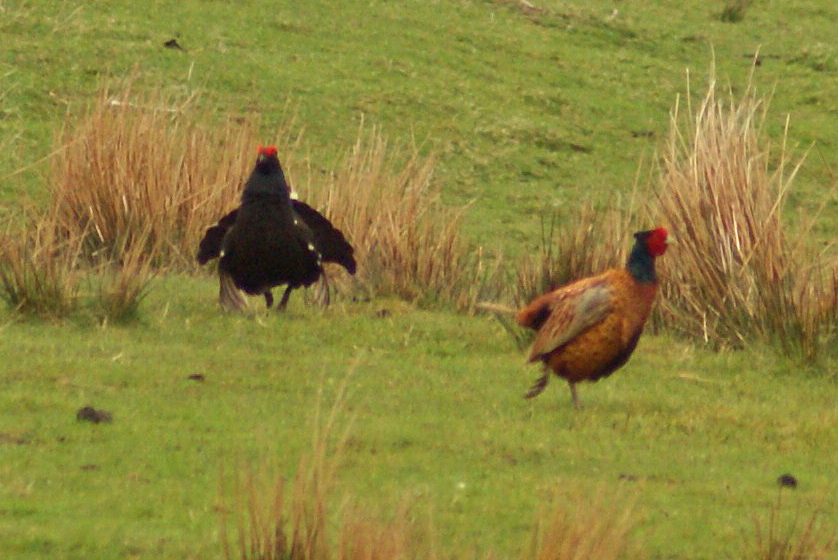
I was just going through some photographs on my computer and found this one; for some reason the only surviving photograph of a series I took of my favourite blackcock doing what he did best – kicking hell out of a pheasant. He liked nothing more than a good scrap, and given that he spent his life amongst vagrant pheasants, they bore the brunt of his cheerful fury.
When I showed him a stuffed blackcock, he wasn’t all that bothered by it. It’s only when I waved it around that I managed to get any reaction out of him at all. My blackcock’s life in isolation made him miss a number of important developmental stages which ultimately led to him being an odd loner. In fact, my bird may never have seen another adult blackcock in his life, and even the bird that fathered him could have been miles away by the time his egg even hatched. Perhaps if I was talking about human beings, my bird could have been described as having “abandonment issues”.
I expected my blackcock to want to lek with the stuffed bird, but if he had never even seen another blackcock, let alone lekked with one, it’s not surprising that he didn’t really know what to make of it. When you show a stuffed blackcock to a lone bird that is used to seeing other males, he will burst with fury and delight and almost rip the decoy to pieces in his enthusiasm. From what I have seen, blackcock learn everything they need to know in their first year, and if it’s not in their head by the time their first moult comes along, it never will be. This is a broad generalisation, obviously, but it seems to ring true in a number of ways. If I was to have caught my blackcock and taken him to a place where there were others, I’m sure he would have been totally horrified. Rather than run into the arms (or wings) of his fellows as you might expect, he would have headed off in the opposite direction.
This is odd for a bird that is so gregarious and sociable when it is present in sufficient numbers, and it rather hints at a final nose-dive into dysfunctional, destructive behaviour amongst cock birds in scattered or isolated populations. It also suggests an explanation for why you sometimes find two or three blackcock lekking alone in an area where you might expect them to want to meet up and lek together. I have known three lone blackcock who showed no visible response to the appearance of a stuffed bird in their midst during lekking displays, and the answer can only be that the ritualised lekking behaviour we see when a number of birds gather together is not hardwired into their brains but is learnt or acquired at some point. If you miss “lekking lessons”, you never get a second chance. All very well, you can bubble and strut, but unless you are shown what to do, the whole job is meaningless. Perhaps this is an explanation for the surge of lekking behaviour which takes place in the autumn when young blackcock are accepted into packs – maybe the young birds are being shown what is expected of them in April and May. Interestingly, despite a life amongst pheasants, my bird knew precisely what a greyhen was when he first saw one during his first breeding season, and this may have something to do with the fact that poults are reared entirely by their mothers.
I’m looking at this side of things at the moment and will post again when I have worked out what to think on the subject. If blackcock brains need to “acquire” lots of knowledge in order to survive and spread their genes, then this could be another stumbling block to explain why artificially reared birds tend to struggle in the wild. Perhaps we assume that just because they know how to look part, they inherently know what they are doing when the spring arrives. When the time comes for me to produce and breed black grouse for the Chayne, I will have to consider the possibility that, in the absence of wild birds, physically teaching the poults how to behave might have to be an option. It opens a whole new world of fascinating new complexities, and I can’t wait…

 Bog Myrtle & Peat
Leave a comment