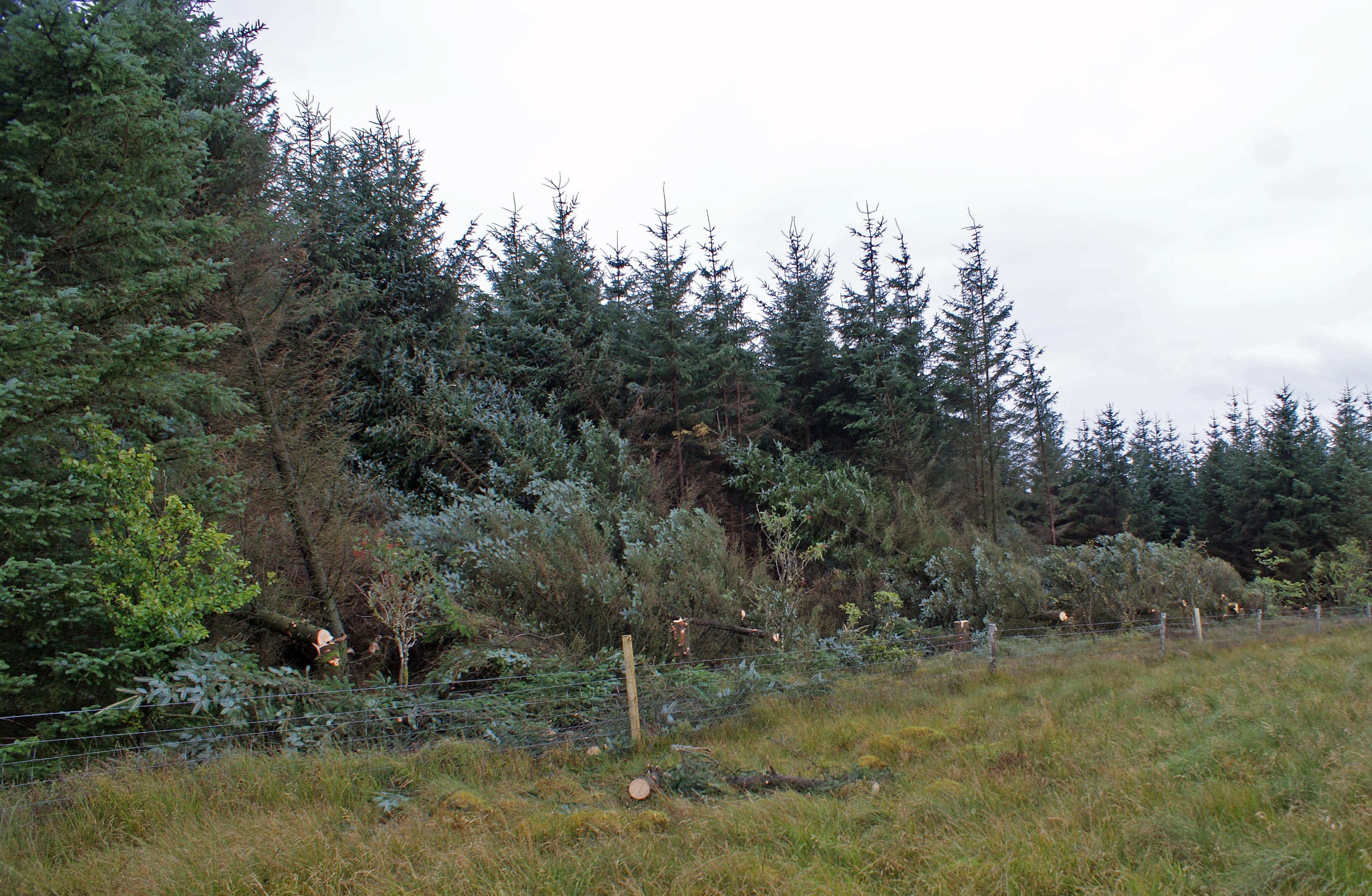
I lost my temper on Saturday, and I took it out on some sitka spruces. For three years, I’ve been experimenting with ways of making mature sitkas a little more amenable to black grouse. My experiments have been based in a five hundred yard long windbreak which, at its widest, is just over thirty yards. I’ve hollowed out rides, thinned, brashed and bothered the trees until they have finally started to take on a different appearance, but there is nothing quite so satisfying as going for the total “destruction” option. My new technique is to fell trees onto one another, until there are just one or two bearing the weight of a dozen leaning trees. I can then let gravity and a brisk southwesterly wind do the rest.
There was a trend in black grouse conservation a few years ago which encouraged the formation of a “scalloped” woodland edge, in order to break up the hard lines between trees and open moorland. In retrospect, I see that what I’ve done is something similar to “scalloping”, but this is a happy accident. The felled area is that shape because I got tired and could hardly swing the chainsaw into another trunk, leaving a neat but wholly coincidental seventy yard long bay of fallen trees in the side of the strip.
With the possible exception of automatic air fresheners, I hate sitka spruce trees more than anything else in the world. It would be impossible to find a single thing that has caused more damage to the Southern Uplands than sitka spruce trees over the past century, and nothing makes my blood boil like the appearance of self sown sitka saplings on open moorland. Surrounded on three sides by commercial forestry, I have tried to work with the small sliver of sitkas on the Chayne, but I am rapidly losing patience with them. They offer nothing in the way of comfort, shelter or food for anything worth talking about, and the little benefit they do bring could be amply contributed by any number of native tree species. They are ugly, vulgar and irritatingly prickly, and I wouldn’t shed a tear if I never saw one again.
These trees will lie where they fell. It’s incredibly awkward to remove timber from this stretch of the wood, so as they rot down in the next few years, I’ll cover over their ugly remains with some birches and rowans. A few rowans were surviving on the fringe of the wood which has been cleared, and I hope that they now get some much deserved breathing space. A few more stress busting sitka destruction sessions and the wood will be all the better for it. Gradually exchanging spruces with native trees is proving to be extremely satisfying…


 Bog Myrtle & Peat
Leave a comment