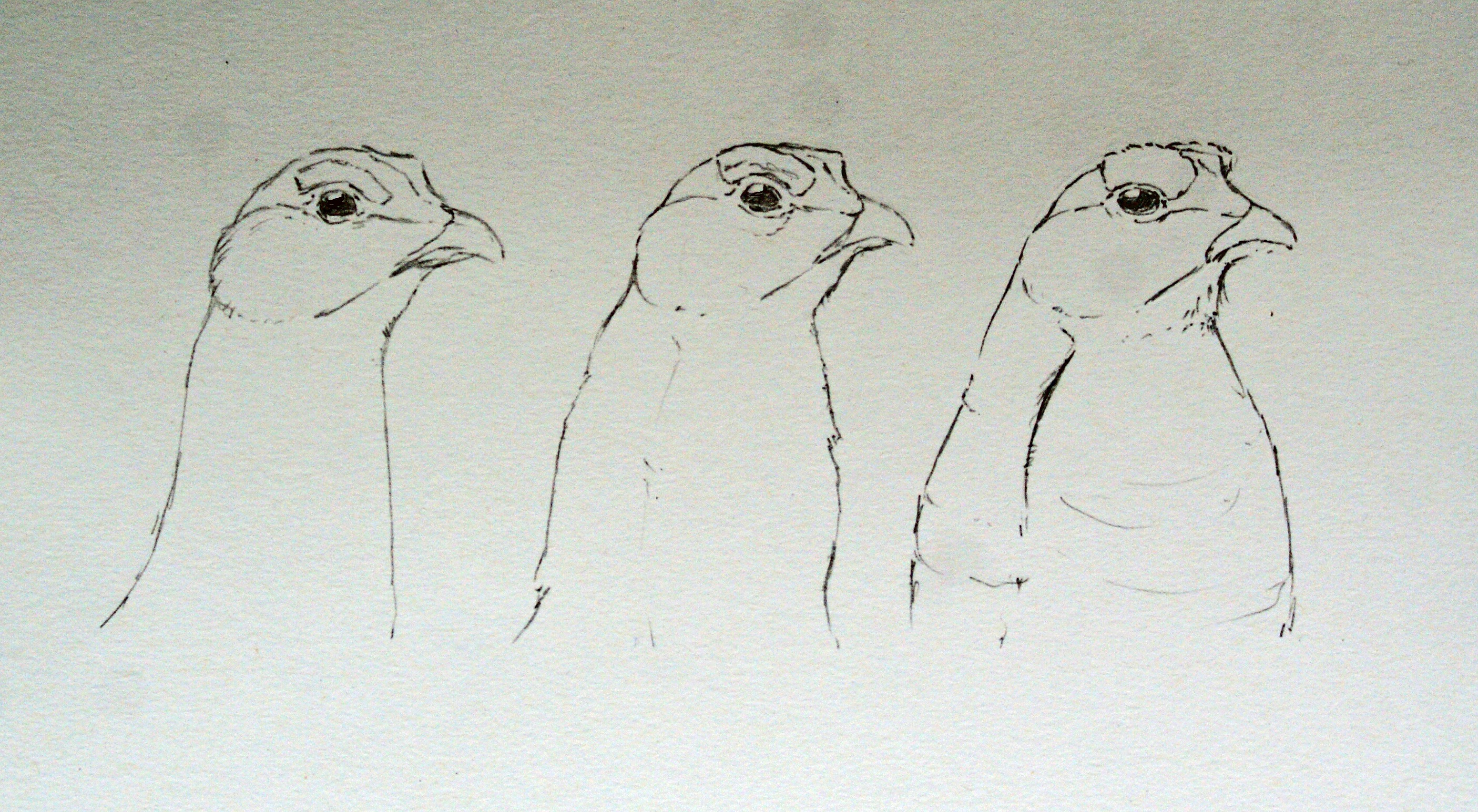
Ever since getting hold of a domesticated blackcock, I’ve been on an extremely steep learning curve. I’ve had an amazing opportunity to get to know him at close range, and I’ve picked up things that I might never have learned in a lifetime spent working with wild birds.
On his first night, I tried to scoop him out of his crate and settle him into his new pen. Rather than meekly submit like any other gamebird would, he produced a loud and extremely threatening hissing sound. He swelled up his breast, lay part over on his side and prepared to give me a damn good kicking. I hadn’t expected black grouse to have any sort of threat posture, and I must say that as he inhaled and began to hiss, he made such a dangerous spectacle that I genuinely did think twice about touching him.
There is alot of interesting body language going on, and although my guy is perhaps less active than most owing to his blindness, his gestures and movements are fascinating. He has an odd habit of wagging his tail snappily from side to side when he is excited. The movement is so subtle and takes place in such short bursts that it’s not surprising that I’ve never seen a wild bird do it.
But most interesting of all is the lekking behaviour. He is moulting quite heavily at the moment, and his head and chin are speckled all over with white and brown feathers. The moult is associated with a drop in testosterone, so it’s not surprising that he’s not feeling as manly as he might, but when I played him a recording of black grouse lekking from a distance, a transformation came over him. He was immediately animated, and stretched his neck up to find out where the sound was coming from. His washed out wattles instantly unfolded, and although they were nothing like the wobbling sponges of an April blackcock, they were substantially larger than they had been.
If you’ve heard black grouse at lek before, you’ll know that there are (basically) three different sounds being used. The first is the classic, resonant bubble, the second is the harsh, rasping sneeze and the third is a shrill, feminine giggle. You can hear all three on This Fantastic Recording of two lekking blackcock from the British Library – the giggle is the first thing you hear on the recording, and also the last – If you haven’t heard a black grouse at lek before, please listen to the recording anyway – there’s no finer sound in the world.
Now, I thought that the giggle and the bubble were two different calls, but after studying my bird at close quarters, it appears that they are the same. The difference is that the giggle becomes the bubble when the air sacks in the throat are filled up. When he wants to bubble, my bird does a few short giggles, then begins to suck in air in a series of almost inaudible little gasps. His neck swells from the top down, and as soon as his sacks are full enough, he makes a sound that is somewhere between a giggle and a bubble. Something about the effort of making this intermediate sound wobbles his head and makes everything north of his shoulders vibrate. Taking more and more sips of air, faster and faster, the bubble comes in little bursts until it is a constant stream of sound. As the air sacks deflate again, the bubble reverts back into the giggle.
All this talk of bubbling and giggling seems ridiculous, but if you imagine the difference between playing the chanter and playing the bagpipes, you see that it’s just the same instrument making a different sound. It makes sense now to remember that the giggle is most frequently heard before and after periods of bubbling, and it is a common feature of periods of actual combat between two males, when the swollen throats are empty of air and the neck becomes a long, snakelike cylinder. Away from the lekking ground, blackcock will sometimes quietly giggle to themselves, and I wonder if this is a way of communicating an interest in bubbling without actually having to go the whole hog.
For now, I have to provoke my blackcock to lek using artificial records, but as the autumn comes in and the testosterone starts to flow back through his veins, I hope that I’ll be hearing alot more from him.

 Bog Myrtle & Peat
Leave a comment