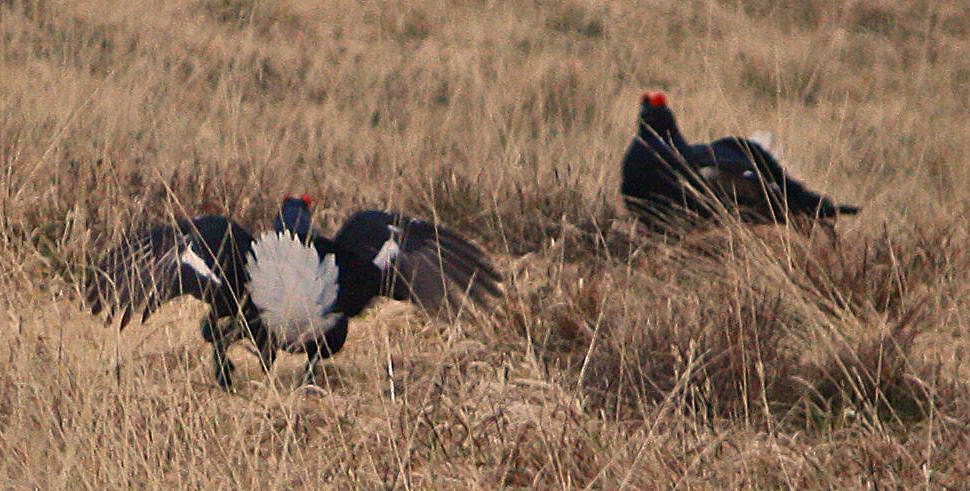
It was an early start this morning and up onto the hill to try and get this year’s black grouse census underway. It’s still a little early for blackcock to be displaying at full bore, but after a cold, frosty night and a decent mist up on the high ground, it seemed too good an opportunity to miss. I always like looking for blackcock in a thick mist. Not only does the sound travel further and clearer, but it also means that if you stumble on an unexpected lek, you have a good opportunity to duck out again before you disturb anything.
I was reminded of lessons learned last year about just how surprisingly difficult it is sometimes to tell the difference between a lekking blackcock and the gurgle of a stream. A few times I stopped dead, certain that I was hearing a displaying blackcock, only to be embarrassed by the realisation that it was just the same old burn I’d been following for hundreds of yards. I walked right over the back of the hill; an hour’s trek through rough grass and patchy heather. Here and there, sheep looked up at me through the mist, and a crow followed overhead for a while, screaming insults. I was heading for a stand of larches at the farm’s extreme north eastern point, and as I drew closer, I started to get excited. I know that there are blackcock back there, but I’ve never seen them.
Two hundred yards up from the larches, I stopped and sat with my back against the march dyke. Woodpigeons swelled in the invisible trees, and my heart leapt. It’s surprising how you can confuse the swell of a woodpigeon with the bubble of a blackcock, but it’s a mistake I often make when I’m straining my ears. A woodpigeon’s call has none of the wobbling, insolent musicality of a blackcock, and is really nothing more than a lovely but monotonous chant. Maybe there’s something about the pitch, but I sat in the soaking grass and caught my breath with premature excitement everytime a woodpigeon started to swell.
After half an hour, it was almost full daylight. I stood up and slung my rifle over my shoulder just as a very distinctive and familiar bubble came through the larches from the neighbour’s hill behind. It was so far away that it was almost non-existent, but my ear caught the rhythm if not the actual note of the call. He was a long way away, but that bird certainly warrants a second visit later on in the month. There are more black grouse in those hills than anyone knows, and the only way to get a definitive number is to do the leg work. There will be plenty more early starts before the middle of May…


 Bog Myrtle & Peat
Leave a comment