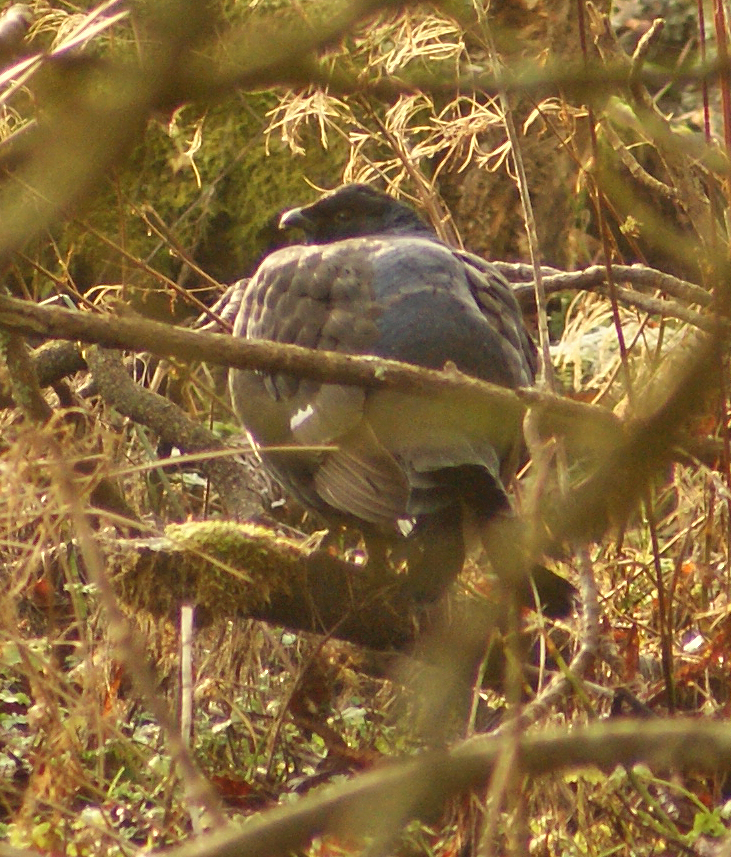
Having finally got my camera up and running again after almost a month, it’s been good fun picking up where I left off in my attempts to document the Chayne in photographs. One of the first things I managed to swing the lens onto today was this blackcock, lurking in the debris of zome old horsechestnut trees. Despite their loud electric blue colouring, blackcock are sometimes pretty well camouflaged, particularly at a distance amongst peat haggs and thick cover, (as above).
The thinking behind the blackcock’s garish colour scheme is presumably the same as that of the cock pheasant – Once you reach a certain size, being strong and fast enough to evade most predators is as effective a safety mechanism as camouflage. It’s almost as if a refusal to blend into the surroundings is a metaphorical middle finger to predators, sending out a signal to say “don’t bother messing with me – I’m fast, strong and I back myself to such an extent that I don’t even need to hide from you”.
That’s not to say that blackcock are immune to predation. Many are killed every year by a variety of predators, but since blackcock don’t have to sit on eggs like greyhens, they can afford to be black in an environment where almost every other bird is speckled, brown and almost totally invisible.

 Bog Myrtle & Peat
Leave a comment